

Reviews
AFF Review: Hellaware
 Written and directed by University of Texas graduate Michael Bilandic (who we interviewed before Austin Film Festival began), Hellaware is a playful modern morality tale that explores the ups and downs a young photographer experiences while trying to make himself a part of the New York art scene.
Hellaware stars Keith Poulson (Somebody Up There Likes Me) as Nate, a slacker with abstract dreams of fame and just a few vague ideas about how to actually achieve it. After his girlfriend (Kate Lyn Sheil) dumps him to be with the pigtail-wearing Brooklyn artist of the moment, he descends into a downward spiral of self-pity and complaints. One night while attempting to mute his sorrows with booze, drugs and the internet, Nate and his friends (played by Sophia Takal and Duane C. Wallace) stumble across something on YouTube that is mesmerizing in its repulsiveness.
An absurd rap/rock video made by an Insane Clown Posse-type group (they're called the Young Torture Killers) captures Nate's attention, and before he knows it he's setting off to Delaware to track down a bunch of violence-obsessed teenagers with a taste for purple drank. Nate looks down on the group (he thinks they are backwards and terrible musicians), but is also intrigued by their authenticity. These audacious kids are different from the pretentious wannabe-artists he's surrounded by, and ultimately he hopes to capitalize on their rawness to his own advantage -- ideally in the form of a photography show that will jumpstart his career.
What follows is an arrangement where Nate takes what he wants from his subjects (exploitative photos they haven't given permission to use), and then a sleazy art gallery owner in turn takes advantage of Nate. Talk of truth and beauty goes out the window when money and notoriety beckon, and soon enough everyone starts to show their ugly sides as tempers flare, friendships tangle, and egos get really, really big.
Review: Thor: The Dark World
 Bigger, better and more full of thunder, Thor: The Dark World smashes onto screens this weekend. The sequel to 2011's Thor -- part of the Marvel Avengers movie continuity -- catches up with characters Thor (Chris Hemsworth), Jane Foster (Natalie Portman) and Loki (Tom Hiddleston) several years after the first installment.
The story by writers Christopher Yost, Christopher Markus, Stephen McFeely, Don Payne and Robert Rodat was directed by Alan Taylor, who has a few feature credits but has directed episodes of numerous TV favorites including among his credits Six Feet Under, Sex and the City, The West Wing, The Sopranos and most recently, Game of Thrones.
Taylor's experience directing Game of Thrones is immediately on display as the film opens with a battle scene in which Asgardians and Dark Elves do battle using a combination of medieval weaponry and laser fire. In a greatly expanded role, Anthony Hopkins' Odin narrates the battle fought by his father (Tony Curran in an uncredited role) against Dark Elves who seek to kill all other life and return the universe to darkness. Now, the nine worlds are coming into a once-every-five-thousand-years alignment, and the time is ripe for the Dark Elves led by Malekith (Christopher Eccleston) to try again.
Comic book fans may be displeased by changes to established details and storylines, but Thor: The Dark World is a crowd-pleaser. More of the action takes place on Asgard where in addition to Hopkins, Rene Russo enjoys a much more involved role as Frigga, Thor's mother. The rest of the gang is back including Jaimie Alexander as Sif, Zachary Levi as Fandral, Ray Stevenson as Volstagg, Tadanobu Asano as Hogun and Idris Elba as Heimdall, all of whom serve more important roles than the set dressing they provided in the previous film. A newcomer to the Marvel universe, Chris O'Dowd appears as a matter-of-fact blind date for Portman's Foster, and Alice Krige makes a brief surprising appearance.
Review: All Is Lost
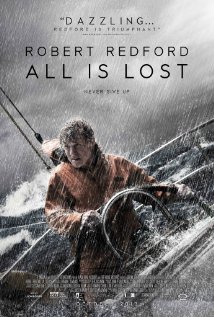 The first time I saw a trailer for All Is Lost, I wondered why Robert Redford had gotten involved in a too-soon remake of Life Of Pi. Of course, once you see the film you'll understand that it's the kind of story best reserved for an audience knowing as little as possible about it going in, and that a marketing trailer has to do its best to entice you without giving too much away. There's no question that this is a challenging film to promote, but it's truly a remarkable work of art that should really be seen on the big screen.
Director J.C. Chandor (Margin Call) doesn't waste any time establishing the story. Redford's character is never named (his official credit is "Our Man") and we don't get any identifying details about his life. He's asleep on his yacht in the middle of the Indian Ocean when he awakens to a crash. His vessel has collided with a shipping container full of shoes and it's taken quite a toll on the stability of his boat. We see him leap into survival mode, and while we don't know anything about his background, it becomes clear that he's a hell of a sailor. He takes command of the yacht and seemingly knows every possible solution to each problem that pops up.
Even though his navigation and communication systems are down, he's able to use nautical maps and tools to chart his approximate location and a course of action. If he can just direct the boat back towards a major shipping route, he'll be able to get help. That is, unless a series of intense storms would happen to rage over the water and further damage the viability of his ship on his cursed voyage.
Redford commands the screen in All Is Lost with a ruggedly weathered face that, even under duress, hides the fact that he's 77 years old. Single-handedly, the actor holds our rapt attention through almost two hours of unforgettable trauma without almost any dialogue. It's a feat that very few actors could pull off, but here it's done beautifully.
AFF Review: Finding Neighbors
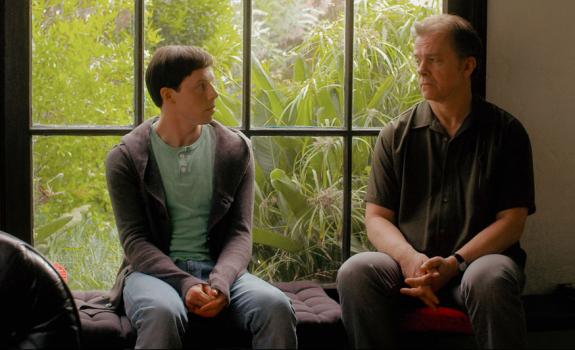
When was the last time you talked to your next door neighbor? With all of the crazy reports out there in the news today, it seems that we as human beings have become more closed off to the world. I recall having a realization that, after almost one-and-a-half years of living in my apartment, I had never introduced myself to (or even seen) the person next door. I'm sure I looked rather foolish making an introduction after so long, but it seemed so unusual to live right next door to someone and not know anything about them -- even their name. Writer/director Ron Judkins explores this exact topic in his latest film, Finding Neighbors.
Sam (Michael O'Keefe) is a graphic novel artist, famous for works he did many years ago. It appears that he's hit a lull in his career and is struggling to create anything for his latest book (we gather this through the many voicemails from his publisher). Although he is happily married to his wife Mary (Catherine Dent), he still seems to be missing some sort of outside connection. Working from home doesn't help this problem, either. Sam feels as if things won't ever change -- until he meets his sassy gay next-door neighbor, Jeff (Blake Bashoff). Jeff knows about Sam and his work, but Sam knows nothing about Jeff. In learning about Jeff's life and struggles, Sam begins to put the pieces of his life back together.
AFF Review: All Of Me

Director Alexandra Lescaze came to Austin and spent several years following a group of local women, most of whom met via a Yahoo message board for BBWs (or "big beautiful women"), for her second feature-length documentary film, All of Me. They started out as a tight-knit support group not just because they were all overweight, but because they were proud and happy about it.
As members of the National Association to Advance Fat Acceptance, the majority of these ladies came together to celebrate and have social outings where they wouldn't be judged by the outside world. While the group initially seems to have a strong resistance to losing weight, the film focuses on the successes and struggles of a few of them to undergo weight-loss surgery and how it affects everybody around them.
AFF Review: Sombras de Azul

A long-form poem set to film and interspersed with dialogue, Sombras de Azul from Kelly Daniela Norris takes the viewer on a scenic trip to Cuba. Maribel, played by the director's cousin Seedne Bujaidar, arrives in the country after the sudden death of her older brother Carlos. In the touristy areas, silent museums and colorful back streets of Havana, she looks for hints of her brother at the same time she pays a sort of tribute to him.
During her short time in the country, Maribel meets friendly cafe owners, a Swedish tourist (Charlotta Mohlin, True Blood), and carpenter/failed thief Eusebio (Cuban actor Yasmani Guerrero). Each in their different way aid in her healing process.
Sombras de Azul moves in quiet meditation, with Maribel's reflections about her brother spoken over scenes of landscape, cityscape or beach. People in white congregate on the streets for an unnamed sacred event. Maribel sits silently in a graveyard under a tree, the audio of her narration softly spooling out a tall tale Carlos once told her about a snake.
AFF Review: Nebraska
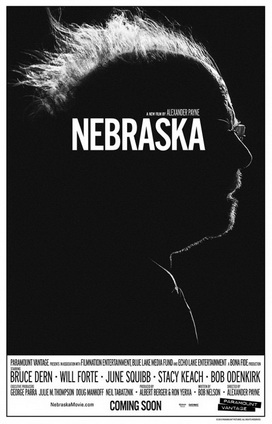 The territory Alexander Payne explores in his films, that place where melancholy and outlandish human behavior collide, is once again accessed in his latest movie, Nebraska. Starring Bruce Dern as an aging alcoholic and Will Forte as his well-meaning son, the film meanders across the plains and valleys of family relationships, nostalgia and regret to reveal moments of sad beauty and awkward humor.
Falling for a magazine marketing ploy, old Woody Grant (Dern) believes he's won a million-dollar sweepstakes prize. Though his son David (Forte) knows it's simply junk mail, he has nothing better to do -- so he agrees to drive from Montana to Nebraska with his father to collect the money and let him find out the truth for himself. Along the mishap-laden journey, the two men visit Woody's hometown and encounter a cast of family and old friends.
Filmed in black and white in a landscape defined by sparseness and open space, Nebraska is filled with striking moments of stark desolation and piercing loneliness. Woody embodies these traits himself; he is a man who often tried his best over the years, but never shared himself with his wife and sons and mostly devoted himself to drinking instead. As David travels with his estranged father and finds out more about him, he is greeted with surprise after surprise and realizes he never knew much about Woody at all. The more he learns the more confused he becomes about his own life, which he seems to be passively enduring.
Payne explores similar themes to the ones found in About Schmidt, but in that film he cleverly used an epistolary device to dive into the depths of his main character's head and heart. Unfortunately he has less success with revelation here; Woody remains largely inscrutable and distant, and David functions as a question-asker and chauffeur but doesn't get to do much else. Overshadowed by imagery (lovely as it is), the two main characters never feel fully formed in the ways that many of Payne's previous creations have been.
Review: About Time
From Aristotle to Einstein to Hawking, much debate has occurred over the structure of time and the possibility of time travel. If time travel were possible, where would you go? More importantly, how do you prevent the paradox of destroying your own identities -- or the worse fate of your own existence and others -- in the process?
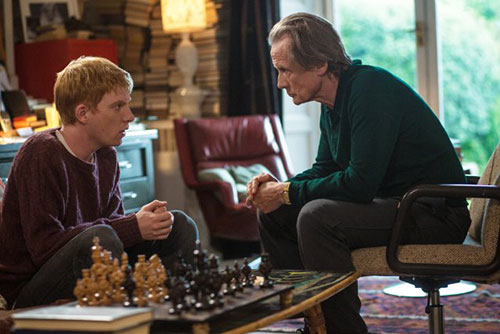
The most widely talked-about moments in time to change often leads to an assassination of Hitler or saving of the Titanic. But a more personal use drives the time-travel paradigm in the romantic comedy About Time by writer/director Richard Curtis (Love Actually, Notting Hill). On his twenty-first birthday, lovelorn Tim (Domhnall Gleeson) receives extraordinary news of a special gift shared by his father (Bill Nighy). The men in their family have the ability to travel through time within their own lives -- "You can't kill Hitler or shag Helen of Troy" -- Tim decides what he wants most is a girlfriend, so he sets forth to secure the love of his life as he begins his professional career as a lawyer in London.
One fateful night, he meets and becomes enamored with the beautiful yet insecure American girl Mary (Rachel McAdams), but his use of time travel to resolve a failed performance for his landlord and playwright Harry (Tom Hollander) results in unintended consequences. It is as if he and Mary have never met, and he must find a way to place himself in the right moment to win her heart. However, his efforts impact the lives of his loved ones, including his sister Kit Kat (Lydia Wilson), and he is faced with the critical decision of letting those he cares about most learn life's lessons on their own.
Review: Ender's Game

Opening this weekend, Ender's Game represents something of a puzzle. The movie is based on a novel considered by many to be the greatest work of science fiction ever written, but authored by Orson Scott Card, controversial as a homophobic contributor to the anti-gay marriage movement. Many people have vowed to boycott the film because of Card's views, but Ender's Game is a story that deserves to be told.
It was a bold move to put such a sizable production for such an important story into the hands of Gavin Hood, director of the much maligned X-Men Origins: Wolverine. The resulting film, however, does manage to hit the important points of an extensive story while failing to completely do it justice.
The premise is a future Earth that has survived an alien invasion through the heroics of one exceptional leader. Seventy years later, the government is seeking a new leader for an attack force who has the ability to understand the enemy and the genius to defeat them.
Children are considered the only viable candidates, and Andrew "Ender" Wiggin (Asa Butterfield) represents the greatest hope for success. Leading his training is Colonel Graff (Harrison Ford), who has some unconventional ideas about instruction. Vilified for being smarter and more successful than his peers, Ender is manipulated by Graff into being emotionally detached from his classmates in order to make him a better leader.
Watching the movie Ender's Game, I had a feeling that never occurred as I read the book -- that it vaguely resembles the Harry Potter books. Ender is no orphan, but is separated from his family. He's everyone's hope for victory, and he's the star player of zero-gravity quidditch. This is likely the result of adapting an involved novel into only 114 minutes. A story that takes place over four years is compressed into little more than a few months. Sweeping plotlines from the source are abandoned, and what remains must be calculated to sell (and therefore pleasantly omits the anti-gay slurs found in Card's book).
Review: Blue Is the Warmest Color
 Every so often, a film comes along that gains a reputation. Maybe it's because it has graphic sex scenes or intense violence. Maybe the subject matter is something most audiences consider taboo. The stories often get swept under the rug, sadly -- or the movies are just watched to see what all of the hype is about instead of paying attention to the story. But these are the films that usually have the most substance, as they tell a story that truly captures us as humans. Blue Is the Warmest Color is one of these films.
I can't recall the last time a romance on film captivated me as much as this one. So many movies have been made about relationships of every kind, but rarely do you find one that contains all of the microscopic moments that make up a romance. It can be a glance, or the way a person holds someone's hand, or even just the way they reference the person they love. Director Abdellatif Kechiche has done that so beautifully in this film that it's making me scratch my head and thumb through my "Directing Actors 101" books.
The story follows Adèle (Adèle Exarchopoulos), a junior in high school struggling through the pressures of dating and sexuality. Realizing she is not attracted to boys like the rest of her friends, she finally accepts this fact after she meets Emma (Léa Seaydoux). Emma is unlike anyone Adèle has met before; she is a painter, a philosopher, a mentor and ultimately a lover. The bond these two women share is unlike any other, reminiscent of those tumultuous relationships many of us have been through at some point in our lives.
One of the complaints I have heard about Blue Is the Warmest Color is that its running time is too long (179 minutes). Sure, three hours is a stretch for a film; I couldn't get through Django Unchained without a bathroom break. But this movie hooked me, leaving me wanting to know what was going to happen next with these two. A film about a relationship sounds uneventful to most people, but Kechiche perfectly captures both the joyous new elements of budding love all the way down to the gritty, exposed parts. Three hours actually didn't seem like enough time.
