

Reviews
Review: The Invisible Woman

I've always felt that there's something quite beautiful and haunting about British cinema. Actor/director Ralph Fiennes, in his second time working behind the camera, shows us just how true that can be with The Invisible Woman.
The film's trailer would lead one to believe that this is a story about a hidden romance that eventually blossoms and embraces our main characters. It is hard to believe that the great author Charles Dickens had a secret life, hiding one woman away for so long. Research proves, however, that this is actually fact... for the most part. (The story itself is based on the book The Invisible Woman: The Story of Nelly Ternan and Charles Dickens by Claire Tomalin.)
Fiennes is at his acting best, although one wouldn't expect anything less from him. His portrayal of Dickens causes one to raise eyebrows as he ping-pongs back and forth between being a jovial, brilliant artist to being a man torn between his desires and husbandly duties. This struggle is made clear when he meets Nelly (Felicity Jones), a beautiful 18-year-old actress who is enamored with Dickens' work. One might question whether his attraction to her is based on love or of flattery; perhaps it is a bit of both.
Sundance Review: Kumiko, The Treasure Hunter
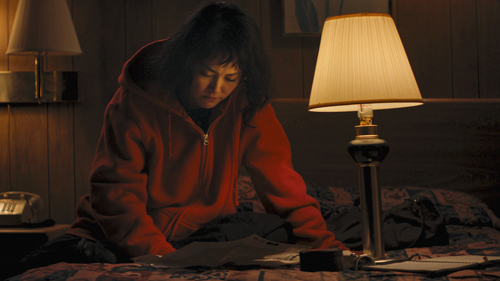 After seeing the premiere of Kumiko, The Treasure Hunter at Sundance this week, it is easy to understand why Alexander Payne (Nebraska) and Jim Taylor (Sideways) signed on as executive producers for the latest feature from Austin filmmakers David and Nathan Zellner (Kid Thing). This film is a superlative visualization of a lonely woman's quest to escape her reality in Japan for the mythical destination of Minnesota in the "New World" of the Americas.
Kumiko (Rinko Kikuchi) deviates from the traditional Japanese society, as she isolates herself from her coworkers and silently rebels against her conservative boss. Her mother's disembodied voice on the phone reminds Kumiko incessantly that if she remains unmarried, she should return home to live. Not that Kumiko's current lifestyle is the most appealing, as she lives in a cramped apartment with her pet rabbit Bunzo as her only true companion.
Review: Jack Ryan: Shadow Recruit
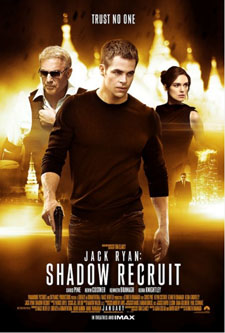 It's been 12 years since the character of Jack Ryan has graced the silver screen, and following in the footsteps of Sean Connery, Harrison Ford, and Ben Affleck is Chris Pine, known as the star of the revamped Star Trek franchise. The Jack Ryan films have all seen great box office success no matter the critical reception (don't worry about The Sum of All Fears, Ben, you moved on to bigger and better things) so now seems like the perfect time to venture back into the world made popular by author Tom Clancy. Jack Ryan: Shadow Recruit was directed by Kenneth Branagh, who is taking on a film with a bit of a larger scale than what he's used to working with.
Young Jack Ryan is a masters student in London in 2001. One fateful day in September turned out to be one of the worst days in United States history (try and guess which one) After the New York attacks, Jack enlists in the Marines. Too smart for his own good, he's often questioned why he joined such a dangerous branch given his immense intelligence and on another fateful day, he never gets to answer that question. A helicopter crash nearly paralyzes him and forces him into retirement from the military. One day though, a stranger (Kevin Costner) comes calling with an opportunity for Jack to continue to serve his country, as a financial analyst for companies on Wall Street that are suspected of funding terrorist groups. Naturally, Jack discovers a plot with the potential to send the United States into an economic meltdown we would likely never recover from.
Jack Ryan: Shadow Recruit borrows from plenty of other action/spy films. There are elements of Jason Bourne, James Bond, Mission Impossible, and many other film franchises throughout this movie. Oddly enough, since this is a reboot of sorts of the Jack Ryan character, it doesn't appear to borrow from previous Jack Ryan movies.
Branagh has proven to be a great director, fully capable of a movie like this, and he does well with what he's given. The problems lie in the inept writing, especially of the many side plots that are ever-present. Jack's girlfriend, played by Keira Knightley, crashes a mission in Moscow because she suspects Jack is having an affair, and then after being forced to come clean to her that he is a spy, puts her in a position where she must play a vital role in a covert op distracting the dangerous Bond villain played by Branagh himself.
Lone Star Cinema: D.O.A.
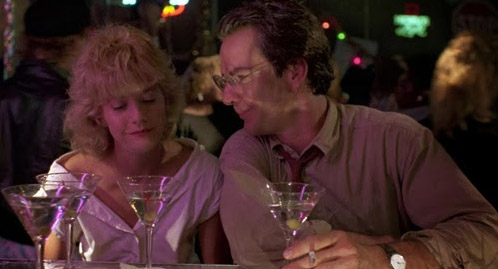
Had the stylish thriller D.O.A. been more plausible, it might be more than a footnote in the history of Austin film.
Released in 1988, the murder mystery had much promise. After all, it was a loose remake of an iconic Fifties whodunit of the same title. Its leads were Dennis Quaid and Meg Ryan, two sexy Hollywood darlings on the verge of megastardom. At the helm were Annabel Jankel and Rocky Morton, co-directors of the innovative, critically acclaimed and quintessentially Eighties TV series The Max Headroom Show.
But for all its potential, the movie D.O.A. is mostly forgettable mix of crime thriller clichés and farfetched plotting. It's a watchable bit of neo-noir, but nothing more.
Review: Her
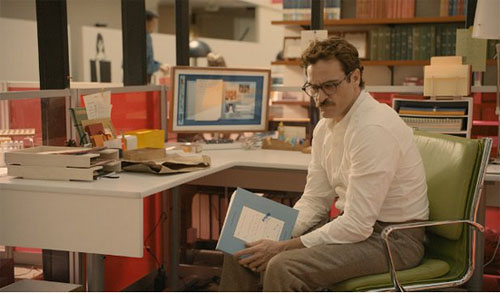
Filmmaker Spike Jonze doesn't make it easy in his latest film Her. He takes a fairly simple story, dresses it up in a realistically futuristic setting, and with the help of superb casting, creates a movie with such emotional impact that it feels like a kick in the head. More than once.
The film opens on an extreme close-up of Theo (Joaquin Phoenix), speaking directly into the camera, reading a love letter that sounds poignant and sweet. We come to realize that he's writing the letter on behalf of someone else -- he's a kind of professional Cyrano -- and that we've been watching him from the POV of a computer monitor, as though it were another person.
And that factors in heavily later, as lonesome Theo buys an operating system advertised as having artificial intelligence and the ability to learn. The OS assumes a female voice (Scarlett Johansson), and names herself Samantha. At first she is simply an efficient helper, but as she learns more about Theo and the world around him, she develops a personality as complex and emotionally rich as any human being. It follows naturally that Theo and Samantha build a strong attachment to one another.
Review: The Legend of Hercules
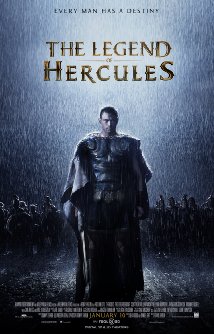
The first thing one might expect in a film called The Legend of Hercules would be that it actually recounts some or all of the story of Hercules. Instead, Renny Harlin presents a derivative hodgepodge of several sword-and-sandals film mashed up with select Biblical imagery in a tale bearing little to no resemblance to the Hercules of mythology.
Scott Adkins appears as power-hungry King Amphitryon, who, after conquering his latest kingdom in single combat against its ruler, returns to his bedchamber where he finds his wife Alcmene (Roxanne McKee) bemoaning his cruelty. Alcmene flees his unrepentant presence to the temple of Hera and prays to the goddess for a child that will put an end to Amphitryon's cruelty.
Twenty years later, Kellan Lutz is cliff diving into the arms of Hebe (Gaia Weiss) who has already been unknowingly betrothed to his older brother Iphicles (Liam Garrigan), who spends his time stalking the two lovers and taking credit for his brother's great deeds.
Except for the brief interaction with Hera and an impressive bit of special f/x with a lightning bolt later in the film, The Legend of Hercules dispenses entirely with the "myth" portion of the Herculean mythos. The man with the strength of a god is powerless until he opens himself to his feelings, and this so-called legend features only one feat of strength.
The predictably boring events of the ensuing story share equal blame, however, with astoundingly bad camera work. Poorly-lit scenes fail in their masquerade as the result of a stylistic choice when they cut to other scenes that are perfectly bright. It's as if not just the story but also the visuals were cut and edited from more than one film. The presentation in 3D was equally bad, or perhaps even worse, as the action shots in every fight scene looked like they were ripped from a video game.
All this is compounded by nausea-inducing technical glitches that frequently cloud the vision in one eye or cross both. Perhaps the worst-looking movie ever shot on Red Epic cameras, that company should consider a demand to have its name removed from the credits.
Review: August: Osage County
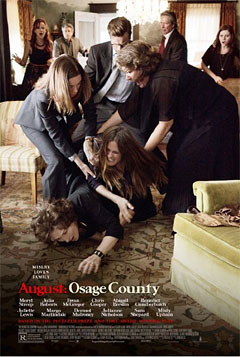 Of all the things to pop into my head while watching August: Osage County, quotes from a Noel Streatfeild "Shoes" novel would seem to be the very least likely.
But there it was -- I kept recalling quotes from Theatre Shoes, related to a family of actors in the book. (Bear with me a minute as we digress into young-adult lit.) Sorrel is a 12-year-old girl who is learning to be an actress, and her Uncle Francis is a very grand and haughty actor-manager who "very consciously acted when he was acting and ... thought there must be something wrong with a performance which came naturally and easily."
In another series of quotes, Sorrel and her teacher discuss Uncle Francis's ambitious daughter Miranda taking a turn as Ariel in The Tempest, a role Sorrel also plays:
"Miranda's brilliant -- and yet, as Ariel you give the better performance, and that you'll find all the way through your stage career. It's getting inside the part that matters, and I think you've got inside the part as your uncle wanted it, and Miranda hasn't."
"But he said he would bet Miranda would be a great actress."
"So she will. Great like Edith Evans, perhaps ..."
Enough with the quoting, you say -- what does this have to do with an all-star adaptation of a Tracy Letts play (scripted by the playwright) led by Meryl Streep and Julia Roberts?
In August: Osage County, we watch Streep and Roberts give performances "with a pronounced personality and bursting with talent." (Sorry, these Streatfeild quotes are just too apt.) Streep in particular isn't acting; she's Acting. And while that can be impressive in its way, I found it tiresome, especially since few of the characters in this play are sympathetic or frankly, very interesting.
Streep plays Violet Weston, a rural Oklahoma woman fighting cancer who is short on tact and long on drug addiction. When her husband Beverly (Sam Shepard) disappears, she gathers her family around at the old family home for some extended tirades of verbal abuse and self-pity. The family includes her three daughters, portrayed by Roberts, Juliette Lewis and Julianne Nicholson.
Review: Lone Survivor
 In 2005, four members of a Navy SEAL team were assigned to a reconnaissance mission in the Hindu Kush mountain region of Afghanistan as part of Operation Red Wings. Their goal was to gather intelligence about Taliban movements in the area, but unfortunately the mission was compromised when the team was discovered and then outnumbered by over 200 Taliban fighters. In the subsequent rescue mission to extract the team, 16 Special Forces personnel, including eight SEALs, were killed when their helicopter was shot down by the Taliban fighters. It was the largest single-day loss of life in SEAL history.
Native Texan and Petty Officer Marcus Luttrell was the only team member to survive enemy contact that day, and his book documenting the event is the basis of the action drama Lone Survivor. Director Peter Berg has painstakingly captured an ultra-realistic vision of what that day must have been like for the brave men who endured the brutal elements of a mountainous region while wounded by enemy bullets. Most importantly, he has captured the brotherhood between the men who push their bodies to almost superhuman strength and endurance to succeed and survive at all costs while adhering to the rules of engagement.
Lone Star Cinema: All She Can

Benavides, a small town in south Texas, is the setting for the 2011 slice-of-life drama All She Can. Immigrants attempt passage over from Mexico, drug searches occur regularly at the high school, and senior Luz (Corina Calderon, End of Watch) worries she may be stuck. She hopes her weightlifting prowess can net her a scholarship to The University of Texas at Austin ... but this film doesn't follow the formula of your typical sports movie. Heck, All She Can doesn't really follow any typical formula at all.
The plot of this narrative feature seems anything but far-fetched. For instance, since her family has no internet access, Luz has to use a computer at the town library to Skype with her older brother JM (Jesse Medeles), who is stationed in Afghanistan. The military seems the only career path open to many of her peers. She's accepted into UT Austin, but her mom can't afford to co-sign any school loans. Her family is barely getting by, and Luz feels utterly limited by her lack of options.
Many other factors give All She Can a realistic feel, from the wardrobe to the low-key acting by the cast. Even the lighting adds a natural touch, with nighttime scenes washed in a soft yellow as if from a sodium light. The predominantly Latino cast delivers a compelling story with familiar elements for most Americans.
Review: Mandela: Long Walk to Freedom
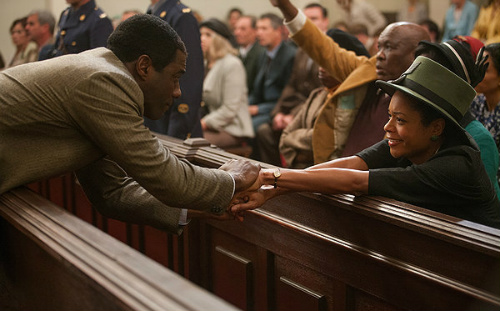
"There is no time, only now." -- Winnie Mandela, Mandela: Long Walk to Freedom
Mandela: Long Walk to Freedom is an imperfect biopic about an imperfect hero. Idris Elba (Pacific Rim, HBO's The Wire) plays South African activist and revolutionary Nelson Mandela. The movie is based on Mandela's autobiography of the same title, published in 1995, so it only covers his life to that point -- which is still quite a fantastic spread.
The story starts with montages (this movie is quite heavy on the use of montages) of the statesman's rural childhood, then kicks into gear in 1942 Johannesburg where Mandela, as a young lawyer, becomes involved in the newly-formed African National Congress. He marries, separates after infidelities and a harsh altercation with his wife, then meets and falls for Winnie (Naomie Harris, Skyfall). After some years of work with the ANC and leading the group in a more aggressive direction against the apartheid authority of his country, Mandela is imprisoned for 28 years. The film tries to stress Mandela's humanity, frailties and all, over the almost mythical figure celebrated in his later years.
