

New Releases
Review: Wrong
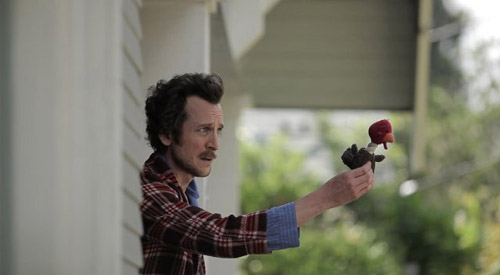
As a fan of Quentin Dupieux's delightfully Dadaistic 2010 feature Rubber, I had high hopes for his new film, Wrong. I envisioned a movie just as quirky as Rubber, but with a more mainstream plot about a man searching for his lost dog.
I was, well, wrong. (Sorry -- I couldn't resist.) Wrong certainly is quirky and absurd, but it lacks the endearingly odd humor, cool factor and narrative originality of Rubber. It's weird, but not engaging.
Wrong is the story of Dolph Springer (Jack Plotnick), who awakens one morning to find that his dog, Paul, has gone missing. What happens next probably will make no more sense in written form than it does on screen, so I'll just say that while looking for his beloved pet, Dolph embarks on journeys both physical and mental.
Along the way, Dolph encounters a host of strange situations and oddball characters, among them a flaky pizza restaurant employee, Emma (Alexis Dziena); his Hispanic gardener with a French accent, Victor (Eric Judor); a hot-tempered pet detective, Ronnie (Steve Little); and the mysteriously metaphysical pet-care book author, Master Chang (William Fichtner). All of them interact with Dolph in off-kilter ways, some of which make more sense than others in the context of the story.
Review: NO

Although set in 1980s Chile, the historical drama NO is eerily relevant to contemporary America, where politicians and political agendas are marketed like any other product.
A fictional story, NO is based on actual events during the campaign to oust Chilean dictator Augusto Pinochet in 1988. Under international political and economic pressure to bring democracy to his country, Pinochet is forced to call an election; the nation will vote yes or no on extending Pinochet's rule for another eight years.
Pinochet's opposition, commonly known as The NO, has 27 days to convince the voters to oust their leader, and is granted 15 minutes of TV airtime every evening to make their case. Pinochet also gives himself a nightly 15 minutes.
Opposition leaders hire René Saavedra (Gael García Bernal), a brazen but successful young advertising executive, to create their TV broadcasts. Not surprisingly, Saavedra envisions a brash and unorthodox campaign: Rather than pandering to voters' fears of Pinochet's violent regime, the ads will present a sunny and optimistic picture of the country's democratic future. The voters don't want to be reminded of murder and repression, Saavedra argues -- they want to be happy, and the campaign theme should be "Happiness is coming if you vote NO!"
Review: Stoker

Chan-wook Park might not be a familiar name to you, but one of his greatest films is one you've more than likely at least heard of -- Oldboy, the Korean drama that is heavy on violence and style. His American debut feature film, Stoker, has a lot of the familiar tones that are right in Park's wheelhouse. Mia Wasikowska, Nicole Kidman, Dermot Mulroney and Matthew Goode all bring some great performances to an otherwise textbook drama about a family that is shrouded in secrecy among themselves.
India Stoker's (Wasikowska) world turns upside down when her best friend in the world, her father (Mulroney), suddenly dies in a car accident on her 18th birthday. To help the family settle in during these rough times, an uncle India never knew about, Charles (Goode) emerges and unsettlingly has charm and wit that is evident to everyone except India.
Review: Admission

Marathon-length viewing of 30 Rock episodes laid the groundwork for my fandom of Second City and Saturday Night Live alum Tina Fey, but it was her witty insightful book Bossypants that set my admiration of her in stone. I was a bit conflicted about reviewing the dramedy Admission both due to my bias as well as being skeptical about an onscreen romance between Fey and co-star Paul Rudd. Although Rudd is no stranger to being a romantic lead, the combination of these actors who often portray rather quirky characters left me wondering how well they would mesh. The result is a light-hearted vehicle to explore chemistry between Fey and Rudd, with veteran comedic actress Lily Tomlin stealing scenes with her portrayal of a strong feminist.
Based on a novel by Jean Hanff Korelitz and directed by Paul Weitz (About A Boy), Admission focuses on Princeton University admissions officer Portia Nathan (Fey). Portia seems to be content with her prestigious and challenging job and stable live-in relationship with English department chair Mark (Michael Sheen). However, she finds that her life is not as perfect as she has thought, having to compete with colleague Corinne (Gloria Reuben) for the coveted position of head of admissions ... and her boyfriend leaving her for his pregnant mistress.
Review: West of Memphis

The history of American criminal justice abounds with cases of justice denied, delayed and miscarried, but there are few cases more egregious than that of the West Memphis Three.
The three men were convicted as teenagers in 1994 of murdering three eight-year-old boys in West Memphis, Arkansas in 1993. Damien Echols was sentenced to death, Jessie Misskelley, Jr. to life imprisonment plus two 20-year sentences and Jason Baldwin to life imprisonment. Amid the hysteria over Satanism in the 1980s and early 1990s, the prosecution easily convinced jurors that the three rebellious teens killed the boys as part of a satanic ritual.
After the sentences were handed down, questions about the case arose almost immediately. Criminologists and forensic experts criticized how the police handled the crime scene and the evidence, and charged that the prosecution based its case on unfounded accusations rather than any evidence linking Echols, Misskelley and Baldwin to the crime. But despite widespread suspicion that the three were innocent, their convictions were upheld on appeal.
The horrendous crime and the three men's seemingly futile 18-year struggle to prove their innocence are the subjects of West of Memphis, a gory and chilling documentary about an unbelievable failure of justice. The film isn't for the squeamish, but it's an eye-opener for anyone not familiar with the famous case and a stark refresher course for viewers who are.
Movies This Week: March 8-14, 2013

While the SXSW Film Festival isn't the only thing happening in town this week, it's almost the only thing happening.
Heading to the festival? You know the drill: Avoid driving and parking downtown if you can (MetroRail has become a popular alternative), get in line much earlier than you think you need to, and consult Slackerwood's über-handy SXSW Film Fest Omnibus Survival Guide for everything you need to know about navigating the madness of Austin's largest film festival. Godspeed, indie film fans -- and I hope you catch a glimpse of Matthew McConaughey or your favorite film celebrity or at least one of Austin's bicycle thong guys.
The SXSW Community Screenings offer free films that anyone can see, first-come, first-served, at the Boyd Vance theater in the Carver Museum. The AFS Shortcase, which our contributor Debbie Cerda helps program, is one of the highlights. The Carver Museum is not quite downtown, and thus has plenty of parking.
Also, UT's Women in Cinema will host an unofficial SXSW panel, "SXSW Women in Cinema," on Wednesday at 7:30 pm at the University of Texas: Communications Building B (CMB), Studio 4D. The panel is free and open to the public. The filmmaker panelists are Jillian Schlesinger (Maidentrip), Lauren Wolkstein (Social Butterfly), Julia Pott (The Event), Lola Bessis (Swim Little Fish Swim), Frances Bodomo (Boneshaker) and Celia Rowlson-Hall (The Audition, Si Nos Dejan).
Review: 21 and Over

It probably shouldn't come as a surprise that the team that delivered the ultra sophomoric Project X would create another stinker in the new movie 21 and Over. It isn't quite the mess that Project X was, and not being a found-footage film, it's more structured and therefore at least slightly better than the mangled mishmash released last year. 21 and Over already had a lot going against it, and to see it cleverly deliver a few laughs was a pleasant surprise, but it still has the same level of immaturity and homophobia as its predecessor, plus an out-of-nowhere romantic ending it doesn't deserve.
This time around, instead of three high-school losers desperate for popularity, the three leads are in college. The character of Miller (Miles Teller, also in Project X) is a mashup of the three Project X losers mixed with a crappy impression of young Vince Vaughn. His friend Casey (Skylar Astin) is a level-headed senior who's got his eye on his future. Surely there's no way he can be lead astray, right? And finally, Jeff Chang (Justin Chon) is the birthday boy who's more concerned about a med-school interview set up by his oppressive and intimidating father. Jeff doesn't want to go out, but of course he gives in to peer pressure, and then -- as so often happens -- wackiness ensues.
Review: Jack the Giant Slayer

Nicholas Hoult, still on screens with the lukewarm Warm Bodies, returns in this week's slightly warmer Jack the Giant Slayer, directed by Bryan Singer. Written by Darren Lemke (Shrek Forever After), Christopher McQuarrie (The Usual Suspects, which Singer also directed) and Dan Studney, the movie is an enjoyable but largely forgettable reimagining of "Jack and the Beanstalk."
I don't want to appear too negative, as I did enjoy most of the film's 114-minute run time, but nothing here was as impressive as what ABC has already given us in the TV series Once Upon a Time. Hoult does justice to a role that is perhaps not worthy of his talents, joined by Ewan McGregor, Stanley Tucci and Ian McShane all playing to their individual strengths. (I confess it was difficult not to imagine McShane loosing a storm of profanity once or twice, but this is a family film.) The effects are well executed though again unmemorable, and Singer is no slouch at directing, so my problem lies squarely with the story.
In a time when, with few exceptions, strong female characters are disappearing from Hollywood, this reimagining strikes a particularly anti-feminist tone. Jack the Giant Slayer features a princess, Isabelle (Eleanor Tomlinson) who craves adventure, bored as she is with her palace surroundings. Normally escorted by guards wherever she goes, Isabelle sneaks away during the night and immediately finds her way into danger, requiring the help of her father's best men and one farm boy to rescue her. At no point during the subsequent "adventure" does she do any adventuring or even attempt to effect her escape.
There's also the matter of an evil advisor to the king (Stanley Tucci), whom Isabell will be forced to marry against her wishes. The writers go full-Disney, making sure the princess' mother is dead and even rewriting the tale so Jack's mother is replaced by a grumpy uncle (who last appears as Jack and Company begin to climb the beanstalk, and never resurfaces).
Although Jack the Giant Slayer is presented in 3D, that's of little importance, as it isn't used to any great effect -- unfortunately for a film about giants, where it could have created an exagerrated perspective to highlight the difference in size. The best things about the film are Hoult and Ewan McGregor, though the vibe between them mimics the relationship between McGregor and Hayden Christensen's characters in Star Wars Episode II.
Review: A Place at the Table

According to the Capital Area Food Bank of Texas (CAFB), food insecurity is "the condition of not having regular access to enough nutritious food for a healthy life." CAFB serves 21 Central Texas counties, from cities like Austin, Round Rock and Waco with dense pockets of poverty to small, rural communities with limited access to services. Of the nearly 300,000 people CAFB serves each year, 41 percent are children, and more than a third of the agency's older clients go for extended periods without food. CAFB reports "1 in 5 families served by CAFB experience the physical pain of hunger."
Across the U.S. the numbers become even more staggering, with 50 million people uncertain about where their next meal will come from. Directors Kristi Jacobson and Lori Silverbush bring this critical socioeconomic issue to audiences in their hard-hitting and engrossing documentary, A Place at the Table, focusing on three at-risk individuals from rural Mississippi to Philadelphia. Mississippi has the highest food insecurity rate in the U.S., but also the highest obesity rate from the empty calories consumed.
The main subjects featured in the film A Place at the Table include Barbie, a single mother in Philadelphia trying to get an education to provide a better life for her kids than she had growing up; Tremonica, a Mississippi eight-year-old who suffers from asthma, compounded by her weight issues brought on by the empty but cheap calories her mom can afford; and Rosie, a fifth grader who can't focus and is failing in school due to hunger and the resulting fatigue, and whose dream is to be an honor roll student.
Review: Snitch
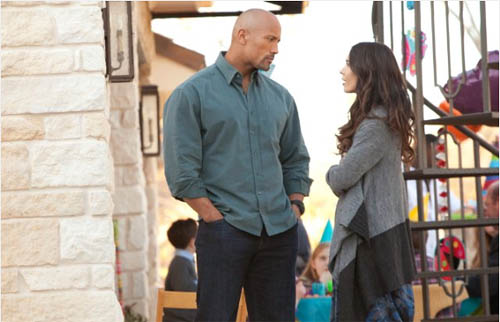
2013 will be The Year of The Rock. With G.I. Joe: Retaliation, Fast Six, Pain and Gain and this week's new release Snitch, four movies this year will star the most charismatic and talented professional wrestler to make the jump from wrestling superstar to action movie superstar. It's a move that guys like Hulk Hogan, Rowdy Roddy Piper and others have tried, but haven't been nearly as successful.
Dwayne "The Rock" Johnson brings something different to the table. He's been a relentless bounty hunter, an ultraviolent assassin and even a family-friendly tooth fairy. He's played nearly every type of action movie archetype except an everyman who's in the wrong place at the wrong time. While his role in Snitch isn't a true wrong-place/wrong-time character, it might be the closest we ever get because he is, after all, an intimidatingly huge man.
Jason Collins (Rafi Gavron) is a normal everyday kid who makes a really dumb mistake when he lets his drug-dealing best friend mail him a package of Ecstasy. When he's caught, he learns the hard way about the minimum sentencing laws for nonviolent drug offenders. He's offered a deal to reduce his sentence if he can provide information that leads to more drug arrests, but he won't send anyone up the river, even though that's exactly what happened to him.
