

Reviews
AFF 2010 Review: Under the Boardwalk: The Monopoly Story
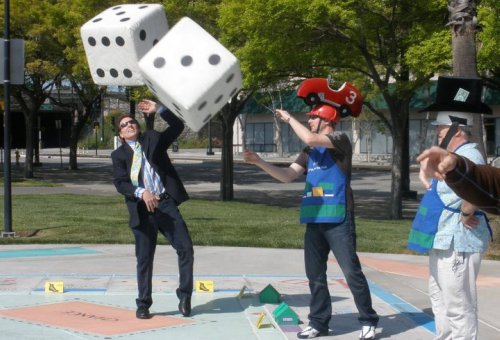
After feeling extremely disappointed in a documentary that I highly anticipated due to its subject, I was hesitant to see another documentary on a topic I thought I had less interest in -- the game of Monopoly. Sure, I played the game as a kid, but I'd expect a feature-length film about a board game would be dry and boring. I'm not too proud to admit that the filmmakers behind Under the Boardwalk: The Monopoly Story proved me wrong. Kevin Tostado directed and co-wrote along with Craig Bentley a delightfully engaging piece on a classic game that is firmly rooted in households across the world. The game is now sold in over 110 countries around the world in 40 languages, although as stated in the film, Monopoly "doesn't get translated, it gets located."
Narrated by Chuck star Zachary Levi, Under the Boardwalk: The Monopoly Story presents a cohesive story with several storylines, one of which is the history of the game and other notable facts. Most notably, I was surprised to learn that although Charles Darrow has historically been known as the founder of Monopoly, it was actually Elizabeth Magie who'd originated the concept in 1903 as an anti-capitalist game known as "The Landlord's Game." Thirty years later the game had evolved and Darrow was the final developer who was successful at selling the game to Parker Brothers. The game's initial success is credited with the same reason that Darrow created the game-- he needed a way to earn money during the Depression. Monopoly was well-received as unemployed and poor folks could play a game that allowed them to buy property and houses.
AFF 2010 Review: Waste Land
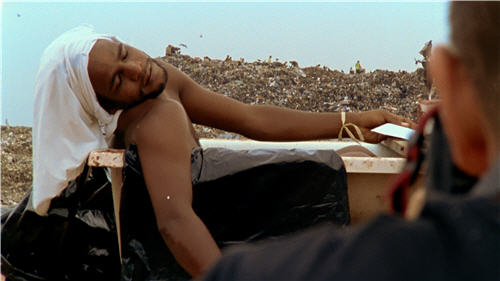
Filmmaker Lucy Walker's documentary Waste Land is lovely to behold ... yes, a lovely film about creating art from trash. A few years ago, artist/photographer (and native Brazilian) Vik Muniz made a decision to use his art to create social change, and the film documents his plan and how it was carried out.
"What I really want to do is to be able to change the lives of a group of people with the same material that they deal with every day," Muniz tells the camera at the start of the film. He travels from his home in the U.S. to Jardim Gramacho in Brazil, the largest landfill in Latin America. Here he comes to know some catadores, people who pick out recyclable items from the garbage in the landfill.
Muniz involves the catadores in his art project, constructing portraits of them out of items found in the landfill. As he learns more about them, we do as well. Zumbi started working the landfill at a young age, was almost killed when the back door of a truck fell down on him, and is upset when people throw away books. Tião, the young president and co-founder of Associação dos Catadores do Aterro Metropolitano de Jardim Gramacho (something like a union for catadores), reads Machiavelli and dreams of a better life for the workers. Irma, an elderly woman, cooks for the workers. Suelem, a teenager, is separated from her two children during the week as she works in the landfill. Magna, a wife and mother, comes to realize her worth during this artistic process.
AFF 2010 Review: Dog Sweat
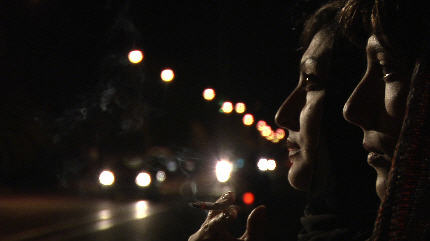
Iranian cinema is not known for taking on complex social issues, particularly those that challenge the current regime's restrictive expectations. Somehow, Dog Sweat was filmed and has reached international audiences. Maryam Azadi's debut script features six young Iranians with intertwined lives struggling to reconcile their not-so-conservative longings with contemporary Tehran realities just prior to the 2009 elections.
Shot clandestinely throughout Tehran, Dog Sweat opens with Homan, Massoud, and Hooshang getting drunk while arguing the value of Johnnie Walker whiskey and contemplating some unusual tactics they'd employ if America invades, unequivocally establishing Dog Sweat as a very different film than the usual Iranian fare that makes it to American shores. Each character is at a crossroads, following one's heart's desires or cowing to societal pressures. The consequences aren't minor; these are criminal acts in Iran, and as each character makes their choice, there is no turning back.
Massoud is more concerned about where to get liquor, be it Johnny Walker Blue or home brewed "dog sweat." Hooshang enjoys spending all his free time with Homan, but considers the trappings of marriage as a means to finding freedom. Counterpoints to these young men are Katie, Katherine and Mahsa -- a self-proclaimed feminist hiding her affair, a shy girl who just wants to "have fun" with Kate's brother, and an aspiring singer who could be arrested for even attempting to fulfill her dream.
AFF 2010 Review: New Low
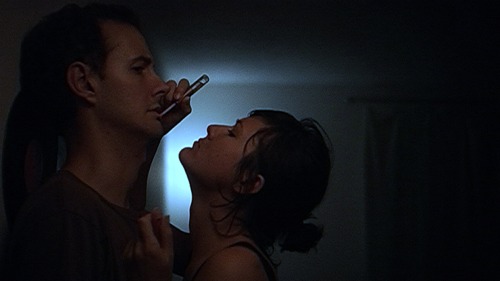
Does hanging out with "good" people make you a good person? New Low attempts to address this question. Twenty-something Wendell (played by writer/director/editor Adam Bowers) is a slacker video-store employee living in Gainesville. In his free time, he helps write stand-up material for his pal Dave (Toby Turner). He has no desire to venture into the world of stand-up himself, though. This says a lot about his character: he's lackadaisical with no forward momentum.
He meets dumpster-diving bartender Vicky (Jayme Ratzer), who on their first date points out three of Wendell's physical faults (and sleeps with him anyway). Vicky is happy to troll dumpsters for food or mooch off of free food offered at gallery openings. She appears to be stuck in a rut, but at least (we discover as the movie progresses) she does have goals as far as her art is concerned.
Joanna (Valerie Jones) -- the other woman -- is an activist/feminist who happens to be an artist as well. While Vicky is the type of gal who tosses her empty cigarette packets on the ground, Joanna is the type who picks up other people's litter, telling Wendell, "I don't understand why people insist on living in such a shitty world." She drags Wendell along to parties where he never really fits in and gifts him with a book on environmental/social action.
Review: Paranormal Activity 2
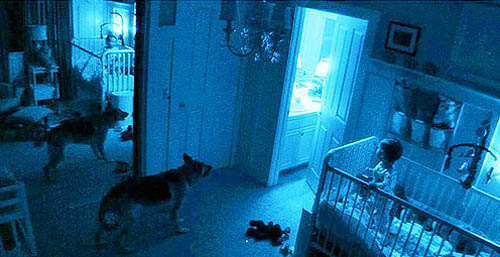
Last year, the audience at Fantastic Fest was among many around the country to enjoy a midnight screening of one of the most deeply unsettling and truly frightening films since a man tore off his own face in 1982's Poltergeist. With a shoestring $10,000 budget, handheld cams, and unknown actors, Paranormal Activity rode a wave of good word-of-mouth to exceed a $100 million gross. Writer/director Oren Peli scripted believable, sympathetic characters and created unbelievable effects, weaving them masterfully into a terrifying experience. With a $2.5 million budget, Paranormal Activity 2 puts shiny bookends around the first story, but doesn't quite live up to the hype.
An audience shouldn't have to do homework to watch a movie, but I highly recommend you brush up on Paranormal Activity before hitting the theater for #2. Set two months before its predecessor, Paranormal Activity 2 retcons the story to include the family of Katie's sister, Kristi, including her newborn son Hunter, husband Dan, stepdaughter Ali and faithful German shepherd. Again presented as found footage, the film begins with some establishing scenes shot on a home camcorder as the family returns home with the new baby. These shots introduce the characters and provide a tour of the house ... then the film cuts to perhaps a year or two later, when the same tape is used to record the aftermath of what looks like a home invasion. Every room of the house is trashed, except the nursery. Nothing is missing, except a necklace that was originally a gift from Katie. After this, security cameras are installed in every corner of the house, allowing for a much improved picture quality and multi-angle scenes.
AFF 2010 Review: Adios Mundo Cruel
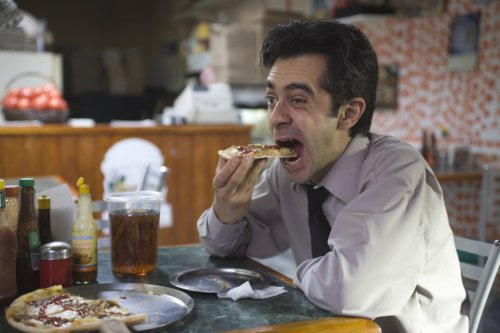
University of Texas alum and writer/director Jack Zagha Kababie makes his feature film debut at the Austin Film Festival this year with Adios Mundo Cruel (Goodbye Cruel World), a delightfully understated dark comedy from Mexico. Reminiscent of Jean Pierre-Jeunet's film Micmacs, the story focuses on an individual who through an unfortunate turn of events is pulled into a ragtag group of thieves and their world of crime. However, Adios Mundo Cruel is much more subtle and accessible to audiences who are able to identify to the main character's job situation and marriage woes.
Angel (Carlos Alberto Orozco) is a hard-working, mild-mannered accountant who wants nothing more than to provide for his family. His wife Claudia (Adriana Louvier) is content to stay home and watch soap operas all day -- so much so that any news of the day is about her favorite soap's character Luis Armando (Rafael Amaya). Unfortunately Angel is laid off from his job, and is greeted at home by the news that his wife has just bought a new car that they won't be able to afford. After an unsuccessful attempt to tell her that he's lost his job, Angel endures a series of job interviews so far from his experience, including in a pet shop and as a door-to-door cosmetics salesman.
Review: Hereafter
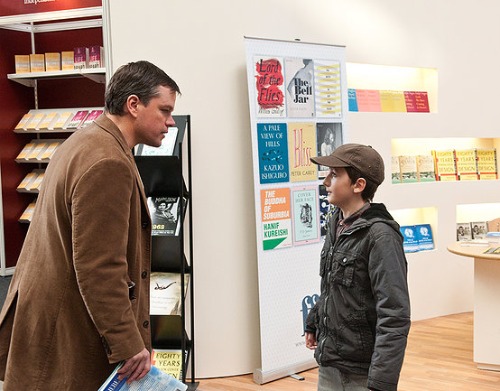
There are three storylines in Hereafter, Clint Eastwood's latest flick. These focus on three characters who all have some connection to death and/or the afterlife: Matt Damon's George in San Francisco, Frankie McLaren's young Marcus in London, and Cécile De France's Marie in Paris. The film jumps around between them until their stories slightly converge.
George is a humble psychic who doesn't like to give readings and tells his brother (Jay Mohr), "A life that's all about death is no life at all." He blames his "gift" for his lack of a social life. Marie is a French journalist who barely survives the Asia tsunami and becomes obsessed with the "hereafter" after that experience. Marcus is dealing with the death of a very close relative (and his story is made to coincide with the 2005 London bombings).
Covering such a heavy topic as death and what comes next, it's disappointing how emotionally detached Hereafter leaves the viewer. As Marcus says good night to the container holding his relative's ashes, I felt slightly connected to his plight. However, this is primarily due to the performance by McLaren, and is only one of a few such moments.
AFF Review: Paradise Recovered
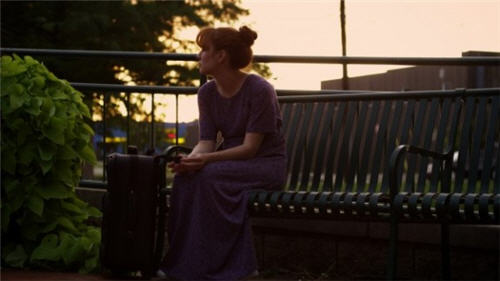
Storme Wood's debut feature film Paradise Recovered tackles secular freedom and spiritual fulfillment in the story of a young woman forced into finding herself.
Esther (Heather del Rio) is a young woman in service to the local pastor of a fringe Christian group. She's obedient and accepting of the life her church has planned for her until an unexpected encounter leaves her cast out into the world without a home, spiritual or otherwise. When Gabriel (Dane Seth Hurlburt) and his roommate take her in, they take it upon themselves to help Esther adjust to her newfound and unwanted freedom.
Andie Redwine's script could easily have been cliché-ridden, and while there are stereotypical characters, the focus is on Esther, and her self-doubts and much as her self-discovery and she tries to find balance between the world she used to know and her predetermined path and the greater world where she must forge her own future. The initial crisis of conscience that delivers Esther from her dreary life is just the beginning; Esther is more homeless than she initially appears. verything she valued and relied upon becomes suspect, but she's not able to completely abandon all of her beliefs.
DVD Review: October Country
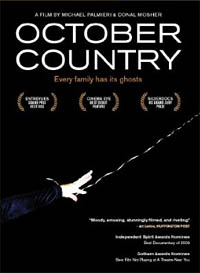 The documentary October Country, which played the Dallas International Film Festival this spring, is now available on DVD
Filmed over the course of a year from one Halloween to the next, we see an American family that seems normal at first. It is through the camera lens that we are allowed a more intimate view of the issues that his family struggle with in their daily lives. Patriarch Don Mosher is a veteran of the Vietnam War, Desert Shield and Desert Storm. He suffers from post-war trauma, never speaking with his wife or family about his experiences. What they do know is that he can't be around fireworks as they remind him too much of the bombs of war. Don's relationship with his sister Denise is nearly non-existent as he does not approve of her lifestyle. She is a self-proclaimed witch, which doesn't bother Don -- he'd be happy if she could make a living at it. Instead Denise is unemployed and living off disability payments because of her rheumatoid arthritis, and so Don considers his sister to be of no use or value in society.
Don's wife Dottie Mosher is the most frequent narrator in this documentary. Dottie appears to be the family member who tries the hardest to keep the family together. Her efforts include providing a home for their son, Chris, who has been in and out of foster homes since the age of 5 until he finally comes to live with the Moshers. Unfortunately, Chris's involvement with drugs and petty theft prove to be too much when he's finally caught with stolen goods that were taken from the Mosher household. Dottie is also trying to ensure that her granddaughter Daneal doesn't repeat the mistakes of her daughter Donna, to no avail. Daneal has continued the cycle of getting pregnant at a young age and then being in physically abusive relationships. The only Mosher female that has much of a chance of breaking the cycle is Donna's youngest daughter, Desiree -- but will she be scarred from the loss of her own father, jailed after molesting his eldest daughter Danael?
Review: Jackass 3D
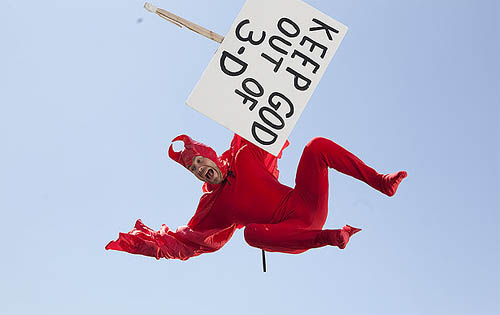
Please welcome our newest contributor, Mike Saulters, to Slackerwood. Mike was braver than the rest of us when it came to seeing and reviewing Jackass 3D, which opens in theaters today.
To call me a fan of the Jackass franchise would be an overstatement. I have seen the first two films on DVD as well as a smattering of the MTV episodes. Jackass, however, was never something that generated much excitement for me. Some of the stunts could occasionally make me laugh, or cringe, but I found at times that things felt formulaic as the same stunt was repeated ad nauseam. I can admit without shame that when first exposed to the series, I got my snob on and pooh-poohed the poo-poo humor of the show.
In case you have somehow been living under a rock or spent ten years studying silverback apes, I should explain the Jackass concept. Jackass began as a series on MTV in 2000 and made the necessary jump to movies in 2002. I say "necessary" because too much of the source material could never make it past network censors. Jackass has no plot, no story, no normal redeeming values you would expect to find in a film. It is a series of vignettes in which the performers subject themselves or other people to asinine, stupid and generally dangerous stunts such as application of a taser to the testacles or lighting one's hair on fire. Often, stunts will have a name attached such as "Poo Cocktail" but others are simply presented with no name or introduction.
