

Reviews
Review: Catfish
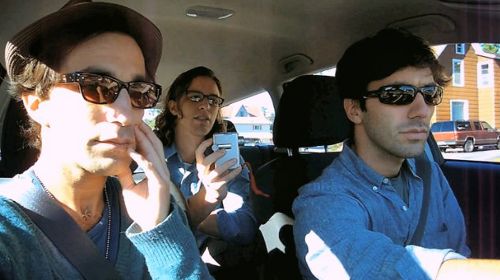
The marketing campaign for the movie Catfish centers around "secrets" that are meant to intrigue you enough to see what's going on. It is suggested that people who have seen the film not spoil it by mentioning anything at all, not even the premise. If you like this way of seeing a movie, stop reading this review, and come back again after you've seen the film. I don't think that Catfish is the kind of movie that deserves a "the less you know, the better it is" review style. On the other hand, the more I think about it, the less I like it, so there may be some basis for that line of thought.
Nearly everyone is willing to share the film's setup: Filmmakers Henry Joost and Ariel Schulman share an office with photographer Nev Schulman, Ariel's brother. In 2008, Nev starts getting artwork in the mail -- paintings of his photos, and notes from an 8-year-old girl, Abby, who says she loves his photos and loves making art from them. Nev is interested, and starts a correspondence with Abby via the internet -- she sends him pictures and videos of her painting, he friends her entire family on Facebook. He also starts talking to some of Abby's family members on the phone. And then ... that's where I'm supposed to stop telling you about the storyline, lest I spoil anything.
That doesn't work for me. If you say "And then ..." and get all ominous, I am going to watch this film waiting for someone to leap out from the bushes with an axe. Or perhaps a chainsaw. I love going into movies knowing practically nothing (this is why you rarely see me writing about trailers; I like to avoid them), but somehow the lack of understanding what this movie was, and where it might go, was more annoying than thrilling. I truly was waiting for something brutal and fatal.
Review: The Town
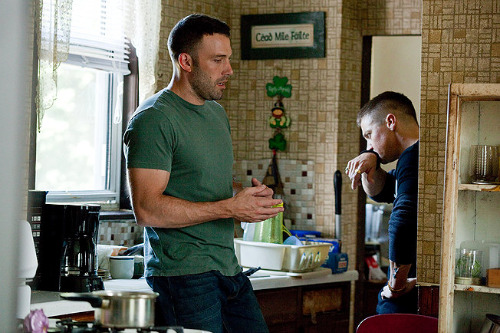
As The Town opens, a black screen with white quotes regarding the Boston neighborhood of Charlestown appears. This is "the town": the neighborhood of Charlestown in which, we are told, an extremely large percentage of armored truck/bank robbers reside.
Director/actor Ben Affleck's crime-romance movie follows two main storylines: bank robber Doug MacRay (Affleck) falling for bank manager Claire Keesey (Rebecca Hall) as he tries to keep her from discovering too much, and Jon Hamm's FBI Agent Frawley as he endeavors to capture Doug's gang. Oscar nominee Jeremy Renner plays Doug's hot-tempered pal and crime partner James "Jem" Coughlin, and Gossip Girl's Blake Lively plays Coughlin's drugged-up kid sister Krista. Throw in Chris Cooper as Doug's jailed father, Irish indie favorite Pete Postlethwaite as a sadistic florist/drug dealer, and Titus Welliver (The Good Wife) as Frawley's FBI partner and you have a pretty stellar cast.
The stellar cast and their performances draw the viewer into the story. The Town isn't a dismal film, though it deals with dark issues (drugs, murder, and more). Affleck's smooth direction and the screenplay (by Affleck, Peter Craig, and Aaron Stockard, based on a book by Chuck Hogan) have a lot to do with this. At the point in the movie when Claire says to Doug, "On sunny days, I always think of someone dying," the line seems portentious, yet Hall's delivery is far from maudlin. Claire and Doug's connection is almost palpable, and Affleck is able to pull off a true anti-hero with this role. Doug has done some bad things, but Affleck keeps the character likable and the audience pulling for him.
Review: Easy A
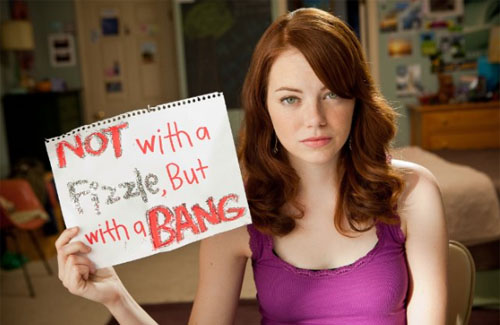
Easy A (directed by Will Gluck, written by Bert V. Royal, starring Emma Stone, with Malcolm McDowell as the principal) is a surprisingly well-written and intelligent teen comedy with oh-so-many inside jokes and film references.
A high-school girl decides to pretend she and a gay male friend had sex at a party so her friend will stop being beaten up at school. However, her plan backfires when her reputation as a "loose lady" spreads all over. Soon, she is making money off her bad reputation by letting loser high school boys spread rumors of her various sexual exploits with them for varying retail gift card amounts -- $50 at Home Depot for saying there was a grope session behind the athletic field, $250 at Office Max for saying the deed was done in the back of Mom's car, etc.
Coincidentally, the protagonist Olive (Emma Stone) has a slight crush on her English teacher Mr. Griffith (Thomas Haden Church), who is teaching The Scarlet Letter in her class. He is rather paternalistically enamored of her as well, believing she is the one person in her class who has actually read The Scarlet Letter, although we see in various montages of clips from the silent movie version of The Scarlet Letter that Olive has only watched the oldest movie version of the book she could find.
Review: Sweethearts of the Prison Rodeo
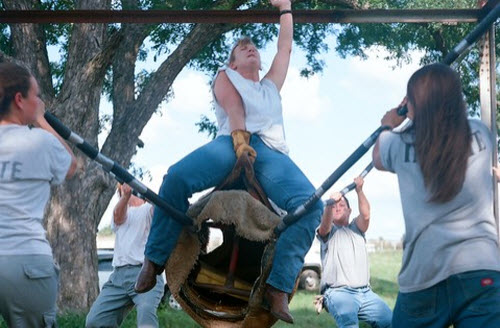
The Great State of Oklahoma's female incarceration rate is the highest in the nation, and is more than twice the rate of any other state. This statistic says a lot about the state's conservative, law-and-order political climate. As Oklahoma State Senator Cal Hobson said, "Oklahoma leads America, and America leads the free world in incarceration."
This lock-'em-up mentality is the backdrop for Sweethearts of the Prison Rodeo, a powerful and bittersweet documentary about female inmates who compete in the 2007 Oklahoma State Penitentiary Rodeo. The film, opening today at Alamo Drafthouse on South Lamar, is at once an intimate portrait of prison life, a thrilling rodeo action film, and an astute sociological study of criminal justice in America.
From its stark opening shots of prison walls and handcuffed inmates dressed in rodeo cowboy garb, Sweethearts of the Prison Rodeo is a familiar look at life behind bars and yet a thoroughly original story about inmates who, to experience an unlikely sort of freedom, risk serious injury and even death. We've all seen prison documentaries with the standard mix of dreary cellblock cinematography and drearier inmate interviews, and there is some of this familiar territory in Sweethearts of the Prison Rodeo. Although the interviewees' life stories are very interesting, they're not new or surprising. What sets the film apart from other prison docs, however, is its sports drama-like, root-for-the-underdog storyline.
Review: Machete
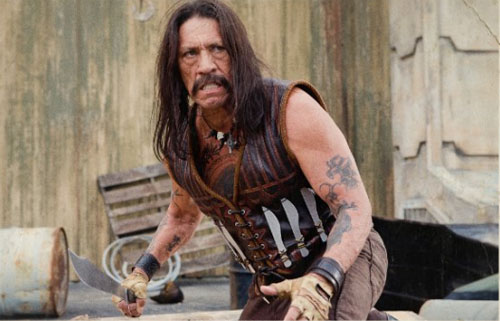
"Finally, the movie that Eat Pray Love should have been."
-- Slackerwood contributor Don Clinchy, immediately after watching Machete
I feel I can't really do Machete justice without channeling Joe Bob Briggs, the drive-in movie of Grapevine, Texas, and giving you a count on decapitations, bare breasts, nine kinds of fu, and other grisly types of fighting, wounding, and death. And tattoos. But Joe Bob, I am not.
I also wish I'd seen Machete in a drive-in theater, but we don’t really have those in Texas anymore -- not the old-fashioned kind, anyway, with the crappy speakers that hook onto your cars and the scary faraway bathrooms and all that. Since drive-ins are nearly extinct, Robert Rodriguez's latest flick will flourish with a big, receptive, rowdy audience for full enjoyment. Don’t wait for DVD. You want the kind of crowd you get at an Alamo Weird Wednesday, who can respect the movie while at the same time cheering and applauding for the best lines and the most creative kills.
However, while Machete was born to be a midnight movie, the movie is happily free of too much self-awareness of this fact, and avoids an excess of camp, apart from the occasional knowing wink to the 1970s exploitation films that inspired it.
Review: Going the Distance
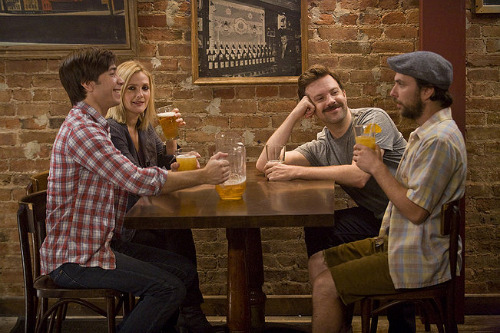
There have been worries in recent years that the romantic comedy genre is dead or dying. Going the Distance could prove that theory wrong; the amusing romantic comedy tends to stay outside the confines of the typical rom-com formula.
For starters, Drew Barrymore's Erin is a potty-mouthed broad who holds the high score on the neighborhood bar's Centipede game. She's also focused on her career track, and the film (thankfully) doesn't treat this as a negative quality.
Thirty-one and currently in grad school at Stanford, Erin is finishing up her summer internship at a fictional New York City paper when she meets affable twentysomething Garrett (Justin Long), who works for a record label. They agree after their first night together that neither of them is looking for anything serious, but they meet up often during the six weeks before Erin heads back to California. They decide to attempt a long-distance relationship.
We see the fondness between the two characters growing, while their friends and family give them unsolicited advice on how to deal with a long-distance relationship. As the professions Erin and Garrett have chosen -- working for the print media and the music industry -- are hard hit by the economy, the recession plays a role in their story. Will they ever be able to live in the same time zone when jobs are so hard to find? Should either of them give up their career to stay in the relationship?
Review: Mao's Last Dancer
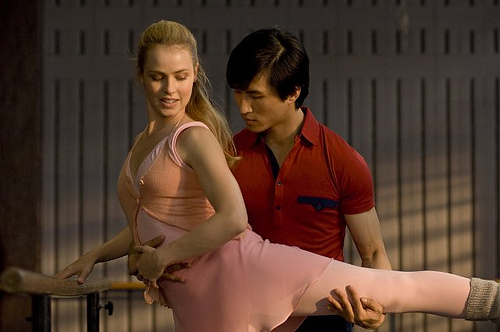
While living in Houston over 20 years ago, I became acquainted with some of the principal and soloist male dancers from the Houston Ballet Dance Company. To me their lives were glamorous and dramatic. Their passion on stage with their pas de deux partners often extended beyond the stage to fiery romances. I also remember one young Chinese dancer who was friendly enough but more restrained than his boisterous British and American counterparts. I had no idea at the time what led to his employment with the Houston Ballet, but the less-than-glamorous circumstances were captured in Li Cunxin's 2003 autobiography adapted by Jan Sardi (Shine, The Notebook) for the screen in the biopic Mao's Last Dancer. Directed by Academy Award nominee Bruce Beresford (Driving Miss Daisy, Tender Mercies), this film captures the politics and drama involved in Cunxin's remarkable journey from rags to international stardom.
Mao's Last Dancer spans several decades through a series of flashbacks. At the height of China's Cultural Revolution in 1972, Jiang Qing -- also known as "Madame Mao" -- revived the Beijing Dance Academy. Mao's cultural advisors traveled through the country to select those children who not only had the physical attributes of a dancer but also devotion to serving in Chairman Mao's revolution. Li Cunxin was the sixth of seven sons born to peasants in the poverty-stricken Qingdao province, and his family welcomed the opportunity for Li to pursue a better life. At the age of 11, he left home to begin seven years of harsh training regimen at the Academy.
Review: The American

Opening with a silent panoramic shot of winter twilight in remote Sweden, The American quickly separates itself from typical international thrillers. Unfortunately, it also means that it won't find the audience normally drawn to such films.
Based on the Martin Booth novel A Very Private Gentleman and adapted by Rowan Joffe (28 Weeks Later), The American is the tale of Jack, an assassin (George Clooney) at the end of his career, paranoid and tense, and reluctant to take one last assignment. After Jack is targeted by a hit squad, he runs to Italy only to have his handler set up a place to lay low in a remote town.
Director Anton Corbijn leans heavily on moody imagery and panoramic shots to set the mood. Corbijn, whose background is in music videos and documentaries, relies more on imagery than dialogue to drive the story. The frequent wide shots set a tone of increasing isolation and sense of entanglement in Jack/Edward's life, whether he's talking to his handler, a client, or the people who insist on getting involved with him.
Review: The Last Exorcism

When it comes to contemporary scary tales, most films resort to fantastic gorefests and extremism to provoke reactions from the audience. Thankfully, The Last Exorcism rarely resorts to such cliched convention.
Shot in documentary style, the subject is Cotton Marcus (Patrick Fabian), a reforming evangelist who's out to prove how believers can be convinced that demonic possessions and exorcisms are faked to exploit them. Cotton is arrogantly charming, fully aware of his power to persuade, and how that factors into his ability to hoodwink the faithful. When he randomly selects a request to perform an exorcism to expose the trickery behind them, he and the documentary crew are off to rural Louisiana to answer a desperate farmer's pleas. Unfortunately for Cotton, he is asked by a desperate father to perform an exorcism he never wants to do; one on a child.
The acting in The Last Exorcism is outstanding, starting with Fabian (Big Love) as Cotton, whose glee at revealing his tricks could have been annoying, if it wasn't clear his goal is to help people. Ashley Bell, Caleb Landry Jones and Louis Herthum as the Sweetzers all seem straight off the farm, with homespun earnestness and love for their family that expresses itself in different ways for each character.
Review: Winnebago Man

Who is Jack Rebney?
After seeing Winnebago Man, I'm still not entirely sure. But in a way, not knowing Rebney may be a point of this documentary, which sheds barely a flicker of light on one of the Internet's most famous cult figures.
Rebney is better known as The World's Angriest Man, whose famously foul-mouthed rants during a 1989 taping of a Winnebago sales video have made him an Internet legend. In a collection of outtakes (compiled by the video crew without Rebney's knowledge), he leaves no F-bomb undropped and no Judeo-Christian deity unblasphemed, as he angrily curses at the heat, the flies, the crew and himself. Rebney's creative use of vulgar epithets borders on an art form, and his screw-this-job tirades have made him a hero to frustrated workers everywhere.
The outtakes began circulating via crudely copied VHS tapes in the early 1990s. When the Internet matured enough to allow trading videos and posting them on websites, Rebney's rantings quickly became a cyberspace sensation. And then came YouTube -- and the rest, as they say, is viral video history. But although Rebney had an Internet connection, apparently he had no clue about his unlikely fame.
