

Reviews
Review: Rare Exports: A Christmas Tale
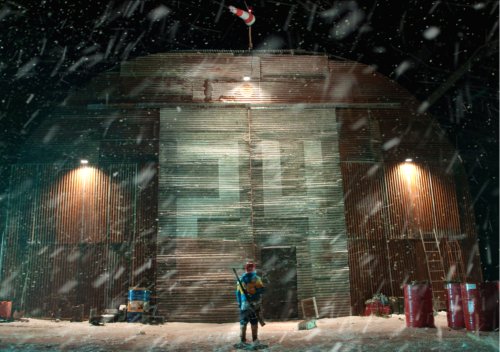
Earlier this week I had a flashback to my childhood Christmases -- the sound of springs creaking on an unseen attic door as it opened evoked a sense of excitement and anxiety. As a child, I imagined it was Santa Claus coming down from the attic because we did not have a real fireplace. As I grew older I realized that my parents hid our presents up there. It was a bit unnerving and overwhelming to think that Santa knew if whether I was bad or good, and could enter our house at will.
In the movie Rare Exports: A Christmas Tale, opening at Alamo Drafthouse on South Lamar tomorrow just in time for the holidays, Finnish writer and director Jalmari Helander reminds us of the not-so-jovial myths behind the mystic icon of Father Christmas. Helander first introduced his take on the origin and life history of Santa Claus in the short darkly humorous films Rare Exports Inc. (2003) and The Official Rare Exports Inc. Safety Instructions 2005 (2005), which went viral on the internet. Find out where to watch these award-winning short films after the jump.
Rare Exports: A Christmas Tale begins a couple of weeks before Christmas with a secretive dig in the depths of the Korvantunturi Mountains, located on the border between Russia and Finland. An American businessman with a multinational corporation delivers specific safety instructions to the site supervisor, as it is revealed that the "mountain" in which they are digging is actually the ancient tomb of Santa Claus. Two young boys, Juuso (Ilmari Järvenpää) and Pietari (Onni Tommila), misbehave by sneaking in through the border fence to investigate the dig. Pietari researches the story of Father Christmas, and is disturbed by what he finds.
DVD Review: Restrepo
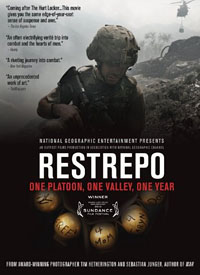

Fortunately, there are outstanding documentaries like Restrepo to remind us all that while U.S. combat operations in Iraq may have officially ended, the war in Afghanistan drags on. And like all wars, it's a brutal and bloody hell.
Now available on DVD

The platoon's mission is hazily defined at best: Take control of the valley (what "control" means isn't quite clear) by exchanging fire with a Taliban outpost on a nearby hill and patrolling the area to root out Taliban supporters. The patrols are often nail-biting, frustrating affairs; the Taliban wear no uniforms, so it's almost impossible to tell who the enemy is.
When 2nd Platoon isn't exchanging fire or on patrol, the soldiers' world is surprisingly mundane. They spend much of their time dealing with the difficult logistics of their harshly rustic home, where they live in plywood shelters, have no running water, and must burn their waste. The order of the day usually combines backbreaking labor with endless boredom. When not hauling supplies or maintaining their crudely built outpost, the soldiers entertain themselves with the most juvenile of horseplay and antics, wrestling each other and engaging in amusingly profane, boys-will-be-boys trash talk.
DVD Review: The Sicilian Girl
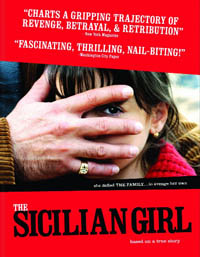

The Sicilian Girl (now available on DVD
Atria (called Rita Mancuso in the film, and played by Veronica D'Agostino) was born into a Mafia family in the Sicilian town of Partanna in 1974. As a young girl, she idolized her father, Vito (Michele in the film, played by Marcello Mazzarella), and was devastated at age 11 when a rival Mafia family murdered him. Six years later, her brother, Nicola (Carmelo in the film, played by Carmelo Galati), also was murdered, most likely because he knew the identity of his father's killer and had vowed to avenge his father's death.
Because her brother was a Mafioso also, Rita was privy to a lot of detailed information about the Mafia in her hometown. Distraught over his murder, she committed a stunning act of bravery, especially for a 17-year-old: She told all she knew to Paolo Borsellino, a magistrate with whom she bonded with as a father figure. She described the murderous Partanna Mafia wars and named her father and brother's killers, along with the heads of many powerful Mafia families.
Review: Tangled

Everyone should be familiar with the basic story of Rapunzel from Grimm's Fairy Tales. Variations of the tale have been told for a thousand years. Tangled's take is true to Disney form, with some of the darker elements glossed over or removed -- Rapunzel, for instance, isn't traded to the witch by her parents and doesn't get pregnant out of wedlock. In this version, Rapunzel (voiced by a very mature-sounding Mandy Moore) rather than the tragic waif depicted in fairy tales is a strong, adventurous free spirit who wants nothing more than to see the world.
Sheltered and trapped by the lying, over-protective Mother Gothel (Donna Murphy), she is doomed to live forever in her tower until the thief Flynn Ryder (Zachary Levi) stumbles into the grove where the tower is hidden. When she sees the chance to escape with a guide, and see the world, she jumps at the opportunity. As Disney villians go, Mother Gothel is intriguing as she pursues the pair. Described as a witch, she is never seen actually using any powers and is never herself threatening. She cleverly employs a pair of thugs to do her dirty work and proves to be the most powerfully manipulative Disney bad guy we've ever seen. In fact, given the situation in which she is introduced, Gothel could be a sympathetic character except that we quickly see how vain, self-absorbed and ultimately evil she is. Still, some in the audience may find it easy to identify with her as she's no Cruella de Ville.
Review: 127 Hours

In a very telling scene early in 127 Hours, Aron Ralston (James Franco) is biking at breakneck speed through the Utah desert when he takes a nasty tumble and slams into a spindly, scratchy bush. Unfazed and eternally cocky, he shakes off his pain and is back on his bike almost as quickly as he fell, as if to prove he's more than a match for any trouble that comes his way in the wilderness.
Of course, anyone familiar with the true story that inspired 127 Hours knows that this cockiness nearly led to Ralston's untimely demise. Another reckless, nasty fall left him stuck for five days in a deep crevasse with his arm pinned by a boulder. Unable to call for help, he had to rely on his wits and a handful of mountaineering equipment for survival. Because Ralston's story garnered so much publicity, it isn't really a spoiler to reveal that he ultimately freed himself. But the specifics of how he did so are central to 127 Hours, so I won't go into much further detail, except to warn the squeamish that some scenes are, well, not for the squeamish.
The narrowly focused 127 Hours is a definite departure for director Danny Boyle, who is known for revered ensemble pieces like Trainspotting and whose most recent success was the complex and sweeping Slumdog Millionaire. Early in 127 Hours, Ralston helps two lost hikers -- of course, they're conveniently attractive young women -- find their way, and they join him for a few hours of flirting and swimming in a hidden, crystal-clear pool. But the rest of the film is essentially a one-character story that, aside from flashbacks and dream sequences, takes place almost entirely in the claustrophobic crevasse where Ralston contemplates his fate.
Review: Harry Potter and the Deathly Hallows: Part 1
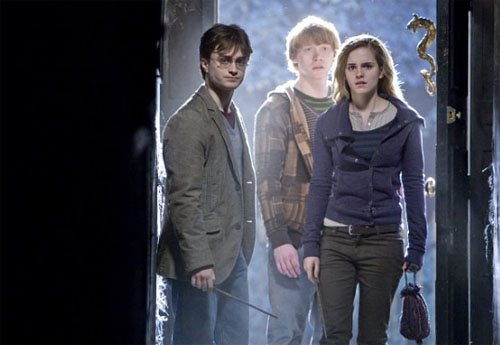
At this point, it seems almost silly to review Harry Potter and the Deathly Hallows: Part 1. For one thing, the seventh entry in the Harry Potter series cannot be considered a stand-alone movie. If you haven't seen any of the other movies or read the books, this is a terrible place to start. And if you loved the previous movies, you'll probably love anything that doesn't seriously screw up the universe of the film series. A few moments in Deathly Harrows: Part 1 show how egregious the film could be if it were badly made, reminding us that this is, in fact, a very good adaptation of the first half (almost two-thirds, really) of the last book in J.K. Rowling's popular series.
In the interest of time economy, the story leaps into gear immediately, even faster than the novel does, with few explanations. In fact, the explanations of who some people are at the beginning of the film are a little amusing -- some of these people were cut out of the previous films to the extent that the characters are just meeting each other for the first time, unlike in the books. "Wotcha, Harry, I'm Mundungus Fletcher, who was left out of the other film adaptations but unfortunately was impossible to cut this time."
Review: Cool It
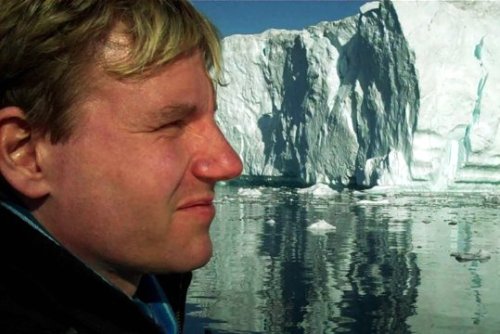
As a ecology and conservation biology student at UT, I had a rather idealistic view of environmentalism -- until I took a course that focused on conservation, economics and technology. Between those teachings and 10 years at an environmental regulatory agency, I've become aware of the need for a more balanced and feasible approach. And yet it wasn't until seeing the documentary Cool It this week that I've admitted my skepticism about the doomsayer films that serve to alarm through extreme viewpoints rather than address the important global environmental issues.
The 2006 film An Inconvenient Truth has been credited with revitalizing the environmental movement and creating a better awareness for the general public about global warming. However, An Inconvenient Truth has been criticized of being both an exaggeration and alarming in context. Cool It centers around controversial author and Danish economist Bjorn Lomborg, who asserts that the attention global warming receives is unwarranted -- that the problem is not as bad as it's portrayed, nor are the solutions that have been proposed going to have very much impact.
Director Ondi Timoner (Dig, We Live in Public) presents a more pragmatic view of the issues at hand in Cool It, through a positive profile of Lomborg, who is often referred to as a enviro-contrarian. Much of the controversy surrounds this former Greenpeace supporter due to his most famous book, The Skeptical Environmentalist. However, Lomborg's advocacy of alternative energy and discussions on what impact various technologies can have on our environment seem quite reasonable as they are presented by various researchers and engineers. Only one dissenting voice is heard firsthand within the movie, and yet the professor's solutions to issues aren't that far off from Lomborg's so that his criticism carries less weight.
Review: Skyline
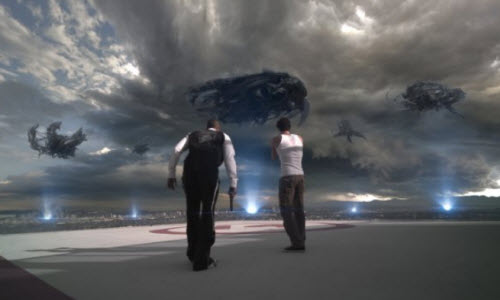
I fell asleep last night in front of the TV while it played Independence Day, The Matrix, Scanners, Invasion of the Body Snatchers and The Mist, and man I had the CRAZIEST dream. Oh wait, no I didn't. I just went to a midnight screening of Skyline. This is one strange, stupid, screwed-up mess of a movie. As much as I really want to hate this film, Skyline sets a new bar for shows-that-should-be-MST3K-fodder. Some movies are meant to be serious and some are meant to be comedies. Then there are the little nuggets that, while meant to be serious, are just more comical than they were ever supposed to be. Watching this at midnight with a bunch of friends will remain one of my more enjoyable memories.
Skyline isn't just bad. It tricks you into thinking it might actually be good. Opening credits, first shot, you have an eerie and unspeakably insidious alien attack. Reminiscent of Shyamalan's Signs, people are holed up at home and spooky lights appear through the windows. (Actually, everything in Skyline is unfortunately reminiscent of something else) Unlike Signs, though, these lights elicit some surprising physiological effects that culminate in making people disappear. This is one of the most attention-grabbing 3-minute openings to a sci-fi/horror film in recent memory.
Review: Welcome to the Rileys
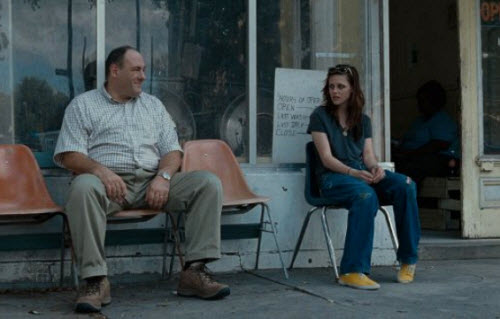
I have some friendly career advice for Kristen Stewart: Kristen, it's time to invest the fortune you made from the Twilight movies (for investment advice, consult a financial advisor -- not a film critic) and refuse all future roles in Hollywood schlockbusters, especially those marketed to tweenage girls. You're rich. You're famous. So, now you can prove your acting bona fides in grown-up films like Welcome to the Rileys.
Seriously, Kristen. I know Twilight's Edward Cullen is all sensitive and romantic and whatnot. But when you can so convincingly inhabit the role of a bitter teenage runaway turning tricks in a dank New Orleans strip club, you really don't need ol' Eddie Wussyfangs anymore. You have the acting chops to do much more, and it's time to move on.
Welcome to the Rileys is the leisurely, low-key story of the titular and terribly sad Riley family. Doug Riley (James Gandolfini) is an Indianapolis plumbing supply business owner who, along with his wife, Lois (Melissa Leo), lives a half-empty life since the couple's daughter was killed eight years earlier. The only spark in Doug's life is his ongoing affair with a waitress. When the affair ends tragically, Doug is left with little more than his crumbling marriage and soulless job. Lois has her own set of seemingly intractable problems; withdrawn and fearful since her daughter's death, she rarely ventures beyond her front door. Even walking to the mailbox is more than she can bear.
AFF 2010 Review: Veterans
 I've been planning on wrapping up my Austin Film Festival content with capsule reviews for some of the short films I saw at this year's festival. However, after reflecting on Veteran's Day I thought it only fitting to give special attention to one short film in particular that I'd not covered in the AFF 2010 Preview: Selected Shorts: Veterans, directed by Miguel Alvarez (Mnemosyne Rising) and funded by a 2006 Texas Filmmakers' Production Fund grant. With so many great short films at AFF this year, Veterans hadn't originally made it to the top of my list. However, after subsequent viewings I have to admit that this poignant and somber short film is a "must see." It's a touching story of sacrifices not just made for our country, but for loved ones.
Shot on Super 8 by cinematographer Bear Guerra, Veterans has a home movie film feel but with higher production value and striking visual imagery. The story is told through a series of images of family photos and movies along with mementos, and is narrated by Joe Alvarez, the director's father. The film opens with Joe Alvarez recounting his memories of dreams at 17 years of age, a premonition that he was hit by a bomb and sent flying through the air. He had the same nightmare every week -- until it actually happened while he was in Vietnam.
Joe Alvarez's father had also served in the military. During World War II, he was given an option to either join the army or go back to Mexico. Being patriotic, he decided to go to war despite family attempting to convince him that it wasn't his war with the response, "This country gave me everything I got, and now I'm giving my life for this country."He took part in the invasion of Normandy and the Battle of the Bulge, where he was hit with shrapnel in the back, knocked out and hospitalized. His experiences left him with a lot of anger and frustrations that he internalized. He kept secrets in his handmade souvenir box, including a collar from a German officer that he'd overtaken in a foxhole.
