

Reviews
Review: Red
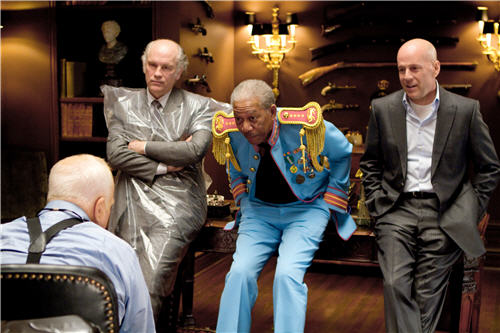
What could make audiences flock to a movie that rehashes plots from True Lies, The Whole Nine Yards, Mrs. and Mrs. Smith, and a dash of Space Cowboys just to name a few? In the cast of Red, an all-star cast clearly in it for the fun of it.
Frank Moses (Bruce Willis) is a retired CIA operative who's so incapable of adjusting to the quiet life. His only real relationship is with Sarah (Mary-Louise Parker), a pension-fund agent at a call center in another state, who talks romance books with him. When his past life catches up with him, Frank runs for the help of his old friends, including Joe (Morgan Freeman) and the less-than-stable Marvin (John Malkovich). Their search for the truth leads them halfway around the country, chasing a conspiracy and shooting up several cities east of the Mississippi.
Chasing them around the country is CIA operative William Cooper (Karl Urban), who does his job so well he can multitask a grocery list while carrying out an assignment. When Cooper eventually finds out his targets are designated RED -- Retired Extremely Dangerous -- it's clear that more is behind his assignment than a simple kill order. And the longer Frank is on the run, the more he gets reacquainted with people from his past, using all their unique skills to uncover the truth.
Review: You Will Meet a Tall Dark Stranger

Why do I let myself believe in Woody Allen anymore? I see a movie of his and am unimpressed, and then someone talks me into seeing another one, and I get my hopes up that this one will finally be up to the standard he maintained through, say, the early 1990s. And then my hopes are shattered and it takes another two or three Woody Allen films before I will try again and be disillusioned. The last film of his that I liked was Scoop, which my husband persuaded me to see (and it took some persuading).
Now we have You Will Meet a Tall Dark Stranger, which opens today at the Arbor, with a splendid cast and an intriguing title and other reviews (from cities where it opened earlier) proclaiming that although old-fashioned, it is one of the best Woody Allen movies in possibly a decade, and so my hopes were raised and one more time, they were dashed. You Will Meet a Tall Dark Stranger was tedious, tired, unbelievable and rarely amusing, with a rather unsatisfying ending. Woody, you tease.
The movie has an ensemble cast with several stories entwined, providing an excellent opportunity to sigh over the wide range of acting talent wasted in this film. Helena (Gemma Jones) is at the center of the London-based action, an older woman who has started visiting a "fortune teller" after psychiatry failed to help her deal practically with her husband Alfie (Anthony Hopkins) leaving her. Helena also enlists the fortune teller to attempt to see the future in regards to her daughter Sally (Naomi Watts), who is an assistant to art gallery owner Greg (Antonio Banderas), and Sally's husband Roy (Josh Brolin), who can't seem to sustain his career as a novelist.
Fantastic Fest Review: We Are What We Are

Family dramas usually don't involve ritual murder and the consuming of human flesh. But that's not the only thing that makes We Are What We Are (Somos lo que hay) stand out in writer-director Jorge Michel Grau's first feature, and not just because it won two awards at Fantastic Fest this year (Best Film and Best Screenplay-AMD Next Wave).
Grau's merciless, gritty thriller centers on a destitute family reeling from the sudden loss of their patriarch. But unlike most families, he's not the breadwinner so much as their only procurer of victims for their bloody rituals. They don't especially mourn for him but have to find his successor and keep to their rituals. Alfredo (Francisco Barreiro) assumes it's his responsibility to be the man of the house, but he's ill equipped, despite the urgings of his sister Sabina (Paulina Gaitan), who clearly favors Alfredo over her other, impetuous brother (Alan Chávez). All the while their mother Patricia (Carmen Beato) seems paralyzed with grief, as the clocks in the house seem to be counting down to some point of no return.
Fantastic Fest Review: Corridor
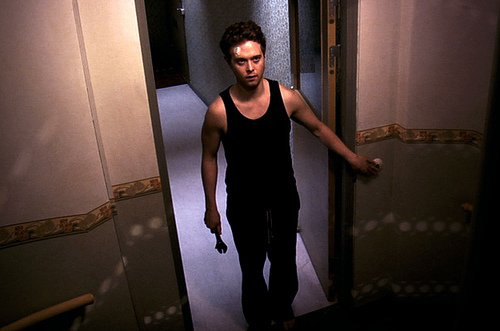
I strongly believe that anyone who proclaims themselves a horror fan should be required to read Danse Macabre, Stephen King's non-fiction commentary on horror fiction in print, radio and film. Although it was written almost 30 years ago, his often-academic examination into the influences on his writing is extremely insightful. One discussion that I think of time and time again is his classification of the horror genre into three levels: terror, horror and revulsion. King further states that terror is the "finest element," and one he strives for himself. He defines terror as the suspenseful moment before the actual monster is revealed -- horror is when we actually see the monster. Finally, King equates revulsion with the gag reflex, a bottom level which he considers a cheap gimmick.
One of the horror films that I saw at Fantastic Fest this year captured the finest element of terror, so much that I saw it in the theater twice -- the psychological thriller Corridor, written and directed by Johan Storm and Johan Lundborg. In an everyday setting of a Swedish flat, these emerging filmmakers created a terrifying experience for both their characters and the audience.
Corridor opens with an introduction to Frank (Emil Johnsen), an introverted medical student who has a small quiet flat where he can focus on his sutides. However, when new neighbor Lotte (Ylva Gallon) moves in upstairs, his quiet life is disrupted by her intrusive nature and late-night lovemaking with her abusive boyfriend Micke (Peter Stormare). Frank also resents his classmates, from the teacher's pet who gets a perfect score to the poor scoring student who wants to study with him.
Review: It's Kind of a Funny Story
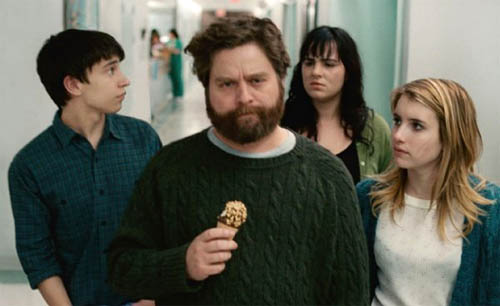
It's Kind of a Funny Story is not quite aptly titled, as the title doesn't give the movie enough credit for its humor or pathos. It's a Very Funny Story, Except When It's Tragic might be more accurate.
This quirky and endearing film is part dark comedy, part teen romance and part biting social commentary, and it's one of the most entertaining films I've seen this year. Even Zack Galifianakis -- hold on to your popcorn! -- gives a fine, unexpectedly understated performance.
Based on a novel by Ned Vizzini, It's Kind of a Funny Story is the tale of smart but insecure 16-year-old Craig (Kier Gilchrist), who suffers from the usual pressures of teenage life. Aside from trying to find his place in the world, he has an unrequited crush on a good friend's girlfriend, Nia (Zoë Kravitz), and his parents are pressuring him to apply for a prestigious academic program. Stressed beyond his coping skills, Craig checks himself into Argenon Hospital, a Brooklyn psychiatric facility.
Review: Buried

How does a movie about a man buried alive in a coffin stay interesting for an entire 95 minutes? In the case of Buried, very easily, if very tensely.
Paul Conroy (Ryan Reynolds) wakes up inside a wooden box with no light save his lighter. He has no idea who put him there, or why, and for the next hour and a half he manages to desperately try to free himself. Despite only one person appearing on camera, the film has is an extensive cast list. Paul eventually discovers he has a phone, which is his only lifeline. The problem is he doesn’t know exactly where he is, which makes convincing anyone to help him even more challenging.
Director Rodrigo Cortés, writer Chris Sparling (An Uzi at the Alamo) and cinematographer Eduard Grau (A Single Man) focus only on Paul. Keeping all the action within the box, and only knowing what Paul knows, keeps the tension high throughout the film. Almost all the shots are contained with the same dimensions Paul is trapped in, giving it a claustrophobic feel that may cause some audience members real distress. Even those without fear of enclosed spaces will find themselves reacting to the constraints of the images, although it eases up after the first half-hour.
Review: Never Let Me Go

Never Let Me Go is an artful and elegant work. Director Mark Romanek uses a muted palette throughout the film, so moments of vibrant color stand out and are few and far between. The main characters have little control over their own fate, and the drab costuming (lots of dull browns and grays) and color tone of the film enforce this theme.
Twenty-eight-year-old Kathy H. (Carey Mulligan) narrates the film, which takes place in a sort of alternate past. In this alternate (but seemingly possible) past, Kathy and her friends Tommy and Ruth attend school at Hailsham in the 1970s. Their headmistress tells them, "Students are Hailsham are special." Their class learns why they are "special" when their new teacher Miss Lucy (Sally Hawkins) confesses their true purpose: to serve as living organ donors. That is "the life that is already set out" for them. With this, any semblance of free will they may have assumed they had disappears.
Review: Secretariat
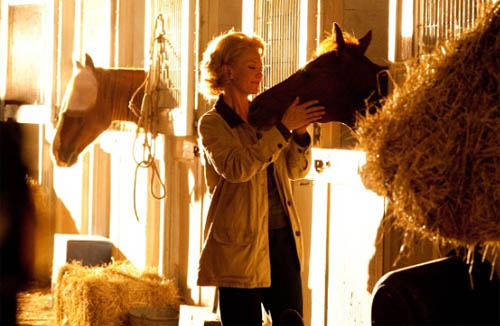
In his heyday, the racehorse Secretariat was a national celebrity. The 1973 Triple Crown winner -- the first in 25 years -- achieved fame far beyond the rarefied world of horse racing, appearing on the covers of Time, Newsweek and Sports Illustrated and gaining millions of fans. Secretariat's blazing times in the Kentucky Derby and Belmont Stakes are records that still stand today, and he's generally considered the greatest racehorse of all time.
Unfortunately, the movie Secretariat is a tepid tribute to its titular horse. For a film about the inherently exciting and unpredictable sport of horse racing, Secretariat is surprisingly dull and predictable.
According to my research, the film (opening today in wide release) is a generally accurate account of the real Secretariat's backstory. Homemaker and mother of four Penny Chenery (Diane Lane) takes over her ailing father's Virginia horse farm, Meadow Stables, thus entering the entirely masculine world of horse breeding and racing. After a complicated series of breeding agreements culminating in a fateful coin toss (consult Wikipedia if you’re really interested), Chenery ends up owning an unborn foal with a prized bloodline. Soon the colt is born and -- this being a thoroughly Disney film -- shows great promise immediately by standing up and talking his first halting steps less than a minute later.
Fantastic Fest Review: Rammbock
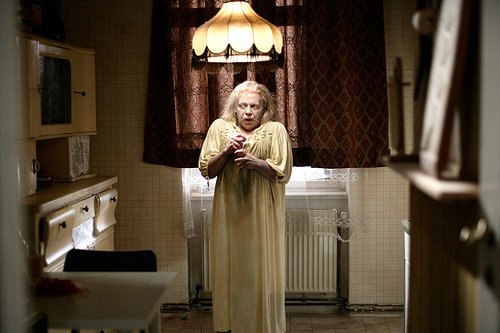
Let's face it: Zombie movies can be stumbling messes with running times that are so lengthy that many genre film festival programmers and fans want a break from the subgenre. It's not that I don't like zombies, but when it comes to celluloid it's zombie overkill. However, when a film as tight as writer Benjamin Hessler and director Marvin Kren's Rammbock comes along, I'll definitely make an exception. The film clocks in at 61 minutes due to pressure from the producer to keep the budget down and a format that would be conducive to television broadcast in Germany. Yet the story engages viewers so quickly and keeps a steady pace that my only complaint about the brevity of Rammbock is what happens in the next chapter of this story.
The central protagonist of Rammbock is Michi (Michael Fuith), who becomes a reluctant hero by being at the wrong place at the right time. Just as he arrives for a surprise visit to his ex-girlfriend's apartment in Berlin to rekindle their romance, a zombie outbreak occurs. Instead of finding Gabi in her apartment, Michi encounters repairmen in her apartment, one of whom has been infected. Michi winds up trapped in the apartment with the younger and uninfected repairman Harper (Theo Trebs). The pair soon discover other survivors within the apartment complex, and begin communicating to others across the courtyard. Some folks are in need of help, and promise food to Michi and Harper if they can help. Others make a desperate attempt to escape, only to be ravaged by the fast-moving zombie hordes who are attracted to noise and activity. In the meantime, Michi just wants to find Gabi and make things right.
Fantastic Fest Review: A Somewhat Gentle Man
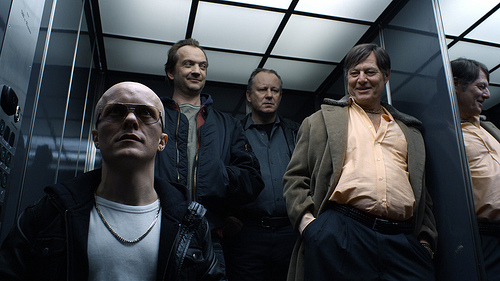
Chances are, you've never seen a Norwegian film. Unlike other Nordic countries, Norway isn't exactly known as a cinematic powerhouse. Thanks to a simmering little film starring a Swedish actor, that may start changing.
A Somewhat Gentle Man (En ganske snill mann) is a fair description of a small-time criminal released from prison after serving a 12-year sentence. Whatever he was in his pre-prison days, the now passive Ulrik (Stellan Skarsgård) has the opportunity to start his life over, only there isn't much of a life for him on the outside. He has no job, his wife left him, and his son is busy with a life of his own. Reliant on the charity of his old crime boss to find housing and gainful employment, Ulrik is not so much a broken man but a diminished one, a stranger in his own life. For all his passivity, Ulrik is the unlikely catalyst for change in the lives around him who use him for their own gain.
Ulrik's old boss Rune (Bjørn Floberg) gets to pretend he's still a crime boss, despite driving a cranky older car and working with an often-abused sidekick (Gard B. Eidsvold). He benevolently reminds Ulrik of the fact he financially supported the family that's disowned him and the importance of revenge as finds Ulrik a place to stay and a job. Ulrik ends up in Rune's sister Karen Margrethe's basement, with a job in Sven's (Bjørn Sundquist) garage, where the lovely and surly Merete (Jannike Kruse) lurks. Karen Margrethe (Jorunn Kjellsby) is a worn battleaxe of a woman, hard used by men, but finds an unlikely opportunity in Ulrik. Sven just wants Ulrik to keep fixing cars and to stay away from Merete. Ulrik obliges them all until his reticence to get even with the snitch who landed him in prison forces Ulrik to start taking somewhat gentle steps into regaining control of his life.
