

DVD Review: Restrepo
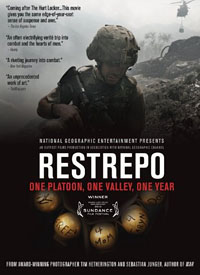

Fortunately, there are outstanding documentaries like Restrepo to remind us all that while U.S. combat operations in Iraq may have officially ended, the war in Afghanistan drags on. And like all wars, it's a brutal and bloody hell.
Now available on DVD

The platoon's mission is hazily defined at best: Take control of the valley (what "control" means isn't quite clear) by exchanging fire with a Taliban outpost on a nearby hill and patrolling the area to root out Taliban supporters. The patrols are often nail-biting, frustrating affairs; the Taliban wear no uniforms, so it's almost impossible to tell who the enemy is.
When 2nd Platoon isn't exchanging fire or on patrol, the soldiers' world is surprisingly mundane. They spend much of their time dealing with the difficult logistics of their harshly rustic home, where they live in plywood shelters, have no running water, and must burn their waste. The order of the day usually combines backbreaking labor with endless boredom. When not hauling supplies or maintaining their crudely built outpost, the soldiers entertain themselves with the most juvenile of horseplay and antics, wrestling each other and engaging in amusingly profane, boys-will-be-boys trash talk.
The company officers also meet regularly with local officials – wizened, bearded men who could not be more different from the platoon's fresh-faced recruits – to explain that despite all the bloodshed and mayhem, the U.S. military is indeed trying to help them. Not surprisingly, the locals mostly resent the military's presence and are reluctant to help with their mission, for fear of Taliban retaliation. Despite the officers' attempts to explain the situation, there is little understanding between the two groups.
This lack of understanding is a constant underlying theme in Restrepo. It's hard to explain the point of the war to the Afghan people when the troops themselves don't seem to get the point, although they fight as if they do. And then there is the more basic question that no one in the film wants to ask, much less answer: Is there a point? Day after day, the men of 2nd Platoon exchange fire with a Taliban outpost on another hill, but never seem to finish the job; is there a point? They poke around in primitive mountain shacks, looking for an enemy they can't easily identify; is there a point? A soldier dies in a firefight; is there a point? They come upon civilians bloodied and killed by American bombing attacks; is there a point?
This essential and unavoidable question aside, Restrepo has no overt political agenda. As I've said in my reviews of The Messenger and other war-related films, any honest war film like Restrepo is inherently anti-war. But although the muddled objectives and jarringly intimate combat footage virtually trumpet the war's pointlessness, there is no preaching about its futility; the tone is completely journalistic, rather than activist. This is not surprising, as Junger is an award-winning journalist. What is surprising is that Restrepo is less graphically violent than many films in its genre. There is enough carnage to remind us that war is deadly, but the film is less about the bloodshed than about the soldiers' sometimes surreal daily lives, which are powerful metaphors for the surreality of war itself.
Restrepo breaks no new ground in terms of its structure, but its sharp editing, uncommon candor and raw, riveting imagery still add up to one of this year's finest and most relevant documentaries. A critical darling and winner of the Grand Jury Prize for Best Documentary at this year's Sundance Film Festival, it's on my list of must-see films of 2010.
Extras: The DVD and Blu-ray bonus features include extended and deleted scenes, extended interviews, updates on the soldiers featured in the film and a photo gallery montage.