

Reviews
Review: I Am Number Four

If I Am Number Four feels something like a Smallville episode, it should come as no surprise to learn the screenplay was penned by Smallville creators Alfred Gough and Miles Millar. This is compounded by the small-town high school setting, the orphaned-alien-with-superpowers plotline, and a lead actor -- Alex Pettyfer -- who bears an uncanny resemblance to Smallville's Justin Hartley (The Green Arrow). In fact, it plays like an extended pilot for a TV show that would develop a gigantic following on Fox only to be cancelled before the end of the first season. It's directed by D.J. Caruso, who also brought us Disturbia (the teen Rear Window) and Eagle Eye.
Evaluated by its big-screen merits, I Am Number Four still holds up as a strong film, which draws on familiar elements. The movie begins with an exciting bit of what I can only describe as "jungle parkour," which I could have watched for an hour alone. Another short scene at a beach party follows before the action moves to small-town Paradise, Ohio. John Smith (Pettyfer) has been dragged there, on one of many relocations, by his guardian and father-figure Henri (Timothy Olyphant). Rebelling against Henri's strict make-no-waves policy, he enrolls in the local high school where he picks up a new girlfriend (Glee's Dianna Agron) and picks a fight with her ex. From there, we're in standard teen romance territory until the bad guys eventually catch up to them.
Review and Panel: For the Love of Movies
 An unsettling aspect of Gerald Peary's 2009 documentary For the Love of Movies: The Story of American Film Criticism is that so many of the critics interviewed are identified as "ex-critics" of print media such as The New York Times.
Yeah, things aren't so rosy for film critics these days, at least for critics seeking paychecks from traditional newspapers and magazines. Film criticism jobs are disappearing as fast as the classified advertising that once funded them. In the face of falling revenues and online competition, periodicals are jettisoning everything from foreign news bureaus to op-ed columnists to local arts coverage.
But all is not hopeless, as For the Love of Movies tells us. Film critics are adapting to the brave new media world, and as long they remain passionate about movies, the century-old tradition of reviewing them will continue.
The future of film criticism was no doubt on everyone's mind at a February 10 screening of For the Love of Movies presented by the Austin Film Society at the Alamo Drafthouse on South Lamar. Peary was in attendance for a brief post-screening Q&A, followed by a panel discussion moderated by UT professor Thomas Schatz and featuring local critics Marjorie Baumgarten of the Austin Chronicle, Charles Ealy of the Austin American Statesman, Slackerwood's own Jette Kernion, and Austin Film Critics Association founder and president Cole Dabney.
Review: The Eagle

With a screenplay adapted by Jeremy Brock from the 1954 novel "The Eagle of the Ninth" by author Rosemary Sutfcliff, The Eagle provides light entertainment for the sandals-and-swords film buffs. This pre-holy Roman Empire tale that was written for young readers has been brought to the big screen for a wider adult audience.
The Eagle centers around the young Marcus Aquila (Channing Tatum), a Roman soldier who attempts to restore his family name. His father had been stationed in the northern wilderness of Britain 20 years prior, and had led the the famous Ninth Legion, which disappeared behind Hadrian's Wall and was presumed dead. The symbolic golden eagle of the legion was lost, bringing shame to the Aquila family.
After receiving a promotion to Centurion, Aquila is sent to the northern reaches of Britain to head a fort. Aquila is critically injured while rescuing his men during an attack, for which he is honorably discharged from the army. Recovering at the home of his Uncle Aquila (Donald Sutherland), he struggles with his injuries and frustration at not being able to restore his family's reputation -- being a soldier is all that he has ever desired and known. However, after rescuing the British slave Esca (Jamie Bell), the young Aquila takes up his goal: to cross Hadrian's Wall, confront the savage tribes of the Highlands and bring back the golden eagle.
Review: The Illusionist

Sad and beautiful, that's The Illusionist in a nutshell. This animated movie is not geared toward small children -- it's from the same filmmaker who brought us The Triplets of Belleville, Sylvain Chomet. But where his previous film was riotous and joyful and just plain insane at times, The Illusionist is quieter, more structured and not afraid to venture into melodrama. It may not be upbeat, but that doesn't mean it was disappointing, at all.
The Illusionist originates from a script by the late French actor/filmmaker Jacques Tati. If you've seen The Triplets of Belleville, you know Chomet is a big fan of Tati -- there are a few Tati references sprinkled throughout the film, and the humor matches some of Tati's more chaotic comedy. But Tati's standard "M. Hulot" character also had a more dramatic side, which prevails in this movie.
Dialogue is minimal, the characters barely have names, and the storyline is uncomplicated. The title character (Jean-Claude Donda) is a French magician whose illusions are no longer in fashion by the late 1950s. Music halls in Europe prefer Beatles-like boy bands that draw crowds of groupies. He lands a gig in a remote Scottish village, where he delights crowds in a small pub ... including young Alice (Eilidh Rankin), the hotel maid. He's kind to Alice, so she follows him when he leaves the village and tries to make his living in Edinburgh.
Review: Gnomeo and Juliet

Midway through Gnomeo and Juliet is the line, "I wish I could quit you."
Ahem. This probably is a first for an animated family film: a slightly altered quotation of the most famous line in Brokeback Mountain.
Yeah, I know: Wink, wink -- here's yet another slightly risqué adult pop cultural reference designed to entertain us grownups while sailing harmlessly over the kiddos' heads. Such references are now fundamental to the animated family movie formula, invariably a mix of endless 3D action sequences, ADD-friendly bits of dialogue, a chaste romance that blossoms to a soundtrack of insipid pop songs, and adult-oriented references to The Matrix, Scarface and/or CSI. Oh yeah -- there also may be a cutesy dancing thing at the end.
Sometimes this formula works smashingly well, as in the Toy Story franchise. But it's hit or miss in Gnomeo & Juliet, a frenetic, too-cute tale very loosely based (emphasis on very loosely) on Shakespeare's tragic love story.
Review: Sanctum
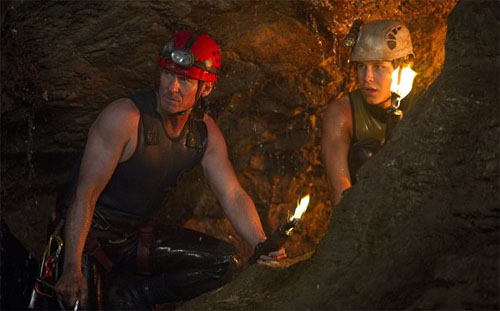
If all you've seen of Sanctum is in the TV spots, you probably think as I did that it was directed by James Cameron. His name is all over it, along with "3D Experience," "Titanic" and "Avatar." That's not surprising, given the virtually unknown director (Alister Grierson) and cast. The most recognizable faces here are Richard Roxburgh, best known as the Duke in Moulin Rouge, and Ioan Gruffudd, who has a steady following for his role as Horatio Hornblower and for playing Reed Richards in the Fantastic Four movies. If you watch the trailer (and I strongly recommend against that, as it spoils some of the most striking moments in the film), the words "executive producer" do appear above Cameron's name, but it feels almost like rewatching Avatar.
I expected Sanctum to be a grand 3D adventure shot with the same fantastic technology as Avatar. Instead, the moviequickly began to feel more like a combination of Alive and Jurassic Park (even using the phrase "spared no expense"). The 3D work at the beginning of the film was difficult to watch, forcing me at times to close one eye or another due to rapid close-up movement and shifts in perspective. Once everything had moved underground to more confined spaces, it became bearable and allowed me to focus on the action.
Review: The Company Men

In this crappy economy, you'd think that a movie about how people are dealing with layoffs and corporate consolidation and difficult economic situations would be compelling and fascinating. Unfortunately, if the movie is The Company Men, it fails to engage and in fact feels oddly out of step with today's world.
Bobby Walker (Ben Affleck) is a savvy sales director -- or something along those lines -- who finds himself unexpectedly laid off when the large corporation where he works consolidates his division down to nothing. Shipbuilding isn't what it used to be, you see. His boss, Gene McClary (Tommy Lee Jones) is just as angry -- CEO James Salinger (Craig T. Nelson) waited until Gene was out of town to take care of the consolidations and mass firings. Bobby's coworker Phil Woodward (Chris Cooper) worries he'll be next, and where is an over-50 guy who needs to keep working to keep his kids in college going to find another job?
One difficulty here is that all these guys are so very privileged at the beginning of the movie that it's difficult to feel much sympathy for them. Poor Bobby has to sell his Porsche! And his wife has to go back to work to support the family! And they can't cover the mortgage on a nurse's salary, so they're going to lose the house. Eventually things grow even worse for the family, but by that point it feels too late to be very sympathetic.
Review: Another Year

I'm a longtime fan of director Mike Leigh. From Naked to Happy-Go-Lucky, his films are completely naturalistic, populated with entirely human characters and emotionally powerful.
That said, I'm not quite a fan of Leigh's latest work, Another Year. Yes, it's the sort of high-quality cinema we expect from Leigh, a thoughtful and thoroughly believable collection of character studies with plenty to say about how we view our lives, ourselves and each other. But while Another Year is unquestionably well made, it's so relentlessly drab and dour that I just couldn't bring myself to like it.
The movie centers on Tom (Jim Broadbent) and Gerri (Ruth Sheen), middle-aged Londoners who have enjoyed many years of marital bliss, personal fulfillment and professional success. However, most of their family and friends are anything but content with their lives. From their lonely son, Joe (Oliver Maltman), to their lonelier, hard-drinking friend Mary (Lesley Manville), Tom and Gerri find themselves surrounded by unhappiness, disappointment and spiritual ennui.
Review: The Mechanic
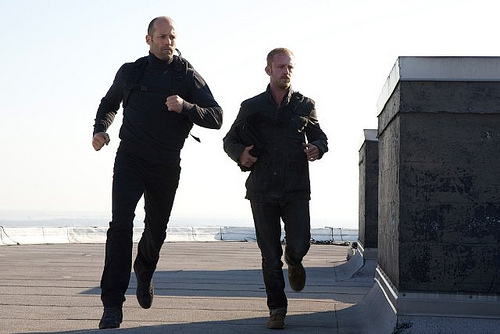
I hope this confession doesn't impact my credibility, but I have no shame in admitting I enjoyed the action film Con Air with veteran actors Nicolas Cage, John Malkovich and John Cusack. Despite the over-the-top Velveeta cheesiness and explosions, this film has just the right balance of action, violence, and melodrama that it continues to entertain me even today. A lot of credit goes to director Simon West, and therefore I was excited to see how West would handle a remake of a Charles Bronson action movie. The result is The Mechanic, another testerone-charged film that lacks the balance and strengths of West's previous film projects.
Arthur Bishop (Jason Statham) answers vague advertisements for a mechanic, which translates to fixing things by cleanly taking out targets as a professional elite assassin. His assignments come from a company that is partly controlled by his close friend and mentor Harry McKenna (Donald Sutherland). Bishop has no difficulties remaining detached from his targets until his assignment is to eliminate Harry. The company is not happy with Harry after a botched job in Capetown, and his ailing health and wayward drug-addicted son Steve (Ben Foster) isn't helping matters. With his skills and close attachment to Harry, Bishop accomplishes his mission quite easily and cleanly -- until Steve shows up on his doorstep. Steve wants to seek revenge on the "carjackers" that killed his father, and he is determined to have Bishop teach him the skills of the trade. Whether out of guilt or loyalty to Harry, Bishop takes on the impulsive hot-headed student who jeopardizes Bishop's typically deadly silent method and things get messy.
Review: Biutiful

Believe it or not, early in his career Javier Bardem was known for his smouldering good looks, and not his outstanding performances; he didn't even get credited for being in No News From God (an underrated gem of a film starring Penelope Cruz). In the last decade, that's all changed, and his latest Oscar-nominated performance in Biutiful is no exception, a movie seemingly made for someone who can entrance an audience just by his presence.
Alejandro González Iñárritu (Babel, 21 Grams) has a penchant for examining the less glamorous aspects of the human condition and finding incredible beauty in it, in the send of a flower that forces its way through cracked pavement to produce a small, startling bloom.
In Biutiful, Uxbal (Bardem) is a man doing what he can to care for his family, a middle man on the edge of legality and realities. Uxbal sees what most of us don't: people struggling to make a living in sweatshops, selling knockoffs on the street, and even the souls of the recently passed. He makes a living from those he tries to help, and the irony does not quite competely escape him. When Uxbal gets unwelcome news, it seems every decision in his life is coming back to haunt him, from helping the employers of illegal immigrants find work, to his schizophrenic ex trying to return to the family she abandoned.
