

Review: Mao's Last Dancer
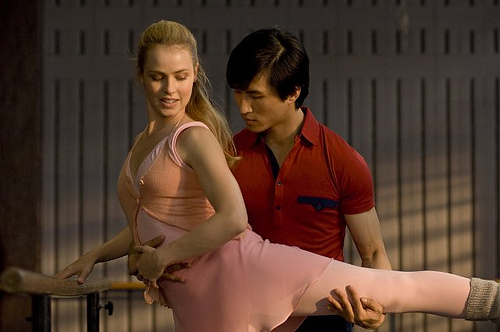
While living in Houston over 20 years ago, I became acquainted with some of the principal and soloist male dancers from the Houston Ballet Dance Company. To me their lives were glamorous and dramatic. Their passion on stage with their pas de deux partners often extended beyond the stage to fiery romances. I also remember one young Chinese dancer who was friendly enough but more restrained than his boisterous British and American counterparts. I had no idea at the time what led to his employment with the Houston Ballet, but the less-than-glamorous circumstances were captured in Li Cunxin's 2003 autobiography adapted by Jan Sardi (Shine, The Notebook) for the screen in the biopic Mao's Last Dancer. Directed by Academy Award nominee Bruce Beresford (Driving Miss Daisy, Tender Mercies), this film captures the politics and drama involved in Cunxin's remarkable journey from rags to international stardom.
Mao's Last Dancer spans several decades through a series of flashbacks. At the height of China's Cultural Revolution in 1972, Jiang Qing -- also known as "Madame Mao" -- revived the Beijing Dance Academy. Mao's cultural advisors traveled through the country to select those children who not only had the physical attributes of a dancer but also devotion to serving in Chairman Mao's revolution. Li Cunxin was the sixth of seven sons born to peasants in the poverty-stricken Qingdao province, and his family welcomed the opportunity for Li to pursue a better life. At the age of 11, he left home to begin seven years of harsh training regimen at the Academy.
The movie itself doesn't actually begin in 1972, but in 1981 as Li (played as an adult by Birmingham Royal Ballet Dancer Chi Cao) arrives in Houston to begin a three-month cultural exchange with the Houston Ballet. He is greeted by his host and artistic director Ben Stevenson (Bruce Greenwood), whom he met in China two years earlier while Stevenson visited as part of a cultural delegation. Li experiences culture shock as Stevenson takes him driving through Houston and shopping at the Houston Galleria. He's later reminded by the Chinese consulate not to fall prey to Western influence and stay true to the Communist doctrine.
Things become complicated for Li as he experiences the freedoms of his host country, and he begins dating a young aspiring dancer, Elizabeth Mackey (Amanda Schull). After the male principal dancer is injured during a rehearsal, Li is called in to perform as Don Quixote with less than three hours' notice. The success of his performance fuels his desire to stay in America -- the dance technique in China is stiff and passionless. While attempting to defect, Li is imprisoned in the Chinese Consulate and negotiations begin between the Chinese and American diplomats.
The performances of the cast of Mao's Last Dancer are a bit uneven but decent overall. Cao is quite convincing in his debut role as Li. However, Schull's performance ranges from flat to overly dramatic. The rest of the supporting cast performed well, but it's Greenwood as Ben Stevenson that really stands far above the rest. Portraying the legendary Stevenson, who shaped countless dancers and the company itself for twenty-seven years and garnered international acclaim, is no easy feat, but Greenwood embraces the role magnificently.
Director Beresford has found great success with period pieces, and Mao's Last Dancer is no exception. I had to continuallly remind myself that the intermitten scenes depicting Houston in 1981 were shot in 2008-2009. Familiar locales such as Miller Outdoor Theater, Houston Galleria and the Wortham Center were effectively captured as if out of time -- I even swore the discotheque was the same as one I remember in Houston from 1989! Interestingly enough, much of the film was shot in Australia but the composition was done so well I couldn't differentiate between continents.
The well-done cinematography of Mao's Last Dancer covers a diverse range including long and sweeping shots of the Chinese rural province -- with the obligatory Great Wall -- and fast action shots of Cao's grand jetes and fouettés. Although I thought the art design effectively captured the time period, the overabundance of cowboy hats and Texas drawls was unnerving. The most overdone Texas accents were from supporting actors Aden Young as Dilworth, husband of the company's principal ballerina, and Kyle MacLachlan as Cunxin's lawyer. Young came to my attention in the 1991 dramatic film Black Robe, which was directed by none other than Bruce Beresford. Another interesting piece of trivia from Mao's Last Dancer is that Chi Cao's parents were two of Li's former teachers at Beijing Dance Academy. Li specifically requested that Cao play him in the movie adaptation.
Mao's Last Dancer has the airs of an epic film, but I categorize it more as a modest film. I don't expect it to garner many awards or critical acclaim, but it's an enjoyable and inspiring enough film to see in a theater. At the very least, I recommend reserving this film to your "videos to rent" queue.