

Review: Gnomeo and Juliet
Midway through Gnomeo and Juliet is the line, "I wish I could quit you."
Ahem. This probably is a first for an animated family film: a slightly altered quotation of the most famous line in Brokeback Mountain.
Yeah, I know: Wink, wink -- here's yet another slightly risqué adult pop cultural reference designed to entertain us grownups while sailing harmlessly over the kiddos' heads. Such references are now fundamental to the animated family movie formula, invariably a mix of endless 3D action sequences, ADD-friendly bits of dialogue, a chaste romance that blossoms to a soundtrack of insipid pop songs, and adult-oriented references to The Matrix, Scarface and/or CSI. Oh yeah -- there also may be a cutesy dancing thing at the end.
Sometimes this formula works smashingly well, as in the Toy Story franchise. But it's hit or miss in Gnomeo & Juliet, a frenetic, too-cute tale very loosely based (emphasis on very loosely) on Shakespeare's tragic love story.
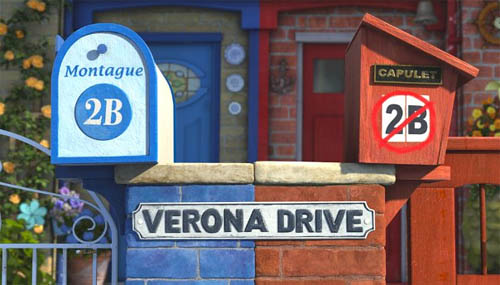
Depending on your appreciation of yard statuary, the idea behind Gnomeo & Juliet is either promisingly clever or completely ridiculous. Set in a present-day British suburb, the film reimagines the Shakespearean lovers as anthropomorphic garden gnomes living in adjacent back yards. Like their 16th century counterparts, Gnomeo (voiced by James McAvoy) and Juliet (voiced by Emily Blunt) are young lovers whose love dare not speak its name, especially in front of Gnomeo's mother, Lady Bluebury (voiced by Maggie Smith), and Juliet's father, Lord Redbrick (voiced by Michael Caine).
The lovers' parents and their allies -- separated by a wooden fence and conveniently identified by their red or blue gnome hats -- have been feuding for years. At its least harmful, their feud is a heated rivalry involving gardening and lawn mower races; at its worst, the two camps live on the edge of mutual annihilation. Of course, any notion of a mixed-color (that is, red and blue) relationship is strictly forbidden, so Gnomeo and Juliet must meet secretly. The only character privy to their clandestine dalliances is Juliet's friend Nanette, a brash frog statue gregariously voiced by Ashley Jensen.
The lovers are soon outed, infuriating their parents and inflaming anti-red and anti-blue passions. Gnomeo disappears after a series of tragic events, and the rest of the story follows the continuing feud, Juliet's virtual house arrest by her father (with her feet glued to a pedestal), and a desperate search for her missing lover.
Some parts of Gnomeo & Juliet work well, such as Gnomeo's encounter with a statue of Shakespeare (given an appropriately sonorous Shakespearean voice by Patrick Stewart), who warns that the original story of Romeo and Juliet ended tragically. (I was happy to hear this explanation; without it, I'm sure many in the audience might think the Bard's star-crossed lovers lived happily ever after.) The action sequences are breezily directed and edited. And there are some very funny moments, including clever references to other Shakespearean plays. (One character is a foul-tempered bulldog whose owner refers to him as "damned Spot.")
But aside from these bright spots, Gnomeo & Juliet is mostly mediocre. The story is unevenly paced, with an obvious script-by-committee feel; indeed, 10 writers share scriptwriting credits, including The Bard himself. (Given his mildly revered reputation, I'm not sure he would want to be credited.) There is almost zero character development, with little explanation for the characters' actions. And some characters, such as a plastic pink flamingo named Featherstone (voiced with an odd accent by Jim Cummings), simply aren't funny or likeable.
Also, the movie often lumbers under its own dumbed-down, Disneyfied cutesiness. There are a lot of oh-so-precious moments, and the tacked-on, happily-ever-after dance number at the end is especially annoying. This probably is inevitable in a film about garden gnomes, although the filmmakers obviously tried to temper the sugary-sweet tone with the aforementioned snarky adult humor.
Gnomeo & Juliet's animation is fine, but not memorable. The film is in 3D, but why? The 3D effects are almost unnoticeable, reminding me how much I wish Hollywood would give up on this gimmick entirely, or at least use it very judiciously. It adds little or nothing to most films and only inflates already high ticket prices.
In another nod to adult pop culture, the Gnomeo & Juliet soundtrack consists mostly of Elton John songs; I assume this is because the film's executive producer is ... Elton John. As a longtime fan of the singer, I'll be the first to say there are far worse musical choices for a soundtrack. But the songs don't always fit well with the action and sometimes distract from it. Between the soundtrack and several visual jokes featuring the bespectacled, sequined pop star, the film sometimes feels like an Elton John vanity project.
At the free public screening I attended, Gnomeo & Juliet held the audience's interest and garnered its share of laughs, although the crowd apparently missed most of the Shakespearean references. So, if you want to keep the little ones occupied and aren't looking for another Up or Toy Story 3, I suppose Gnomeo & Juliet fits the bill. But more demanding viewers will be disappointed, especially given the film's stellar source material.
Featherstone flamingos
Did you wonder why the flamingo is named Featherstone? Answer: A guy named Don Featherstone invented the original pink flamino yard ornament in 1957. (Note: You can still buy authentic Featherstone flamingos today, although there are tons of cheap offshore-produced imitations.)