

New Releases
Review: Anonymous
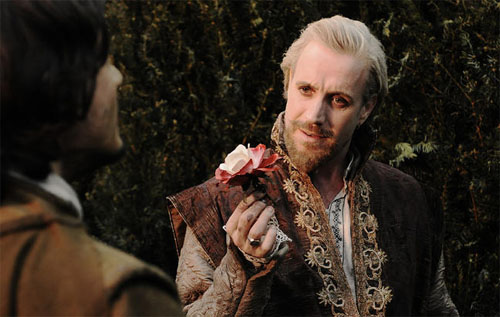
"To be or not to be?" might be regarded as one of the greatest questions ever asked. But the topic raised on whether or not William Shakespeare actually wrote the words credited to him might be a better question, according to the film Anonymous. Roland Emmerich (Independence Day, The Day After Tomorrow) takes a break from showcasing all of the ways our world could come to an end by directing a movie that offers up a theory that could very well shatter the world of many an aspiring writer and/or playwright. Anonymous is a very well acted film, and if you're a fan of Shakespeare, it does put the viewer in the shoes of those who first witnessed plays written by ... well, I suppose whomever they might have been written by.
Anonymous opens in the present day, on a Broadway show where a lone man stands onstage and ponders the question of whether Shakespeare wrote the words attributed to him. He offers evidence such as the lack of actual historical manuscripts as proof that the question is a legitimate one.
We're then transported to the time in which we know Shakespeare lives. This is a time in which a play that might offer up a sarcastic word about the royalty of the country or others who may be in charge could be considered seditious, and the playwrights would be arrested on sight. On one occasion, the Earl of Oxford (Rhys Ifans) witnesses a rather impressive play and he bails out the writer but offers a condition -- he will allow this writer to put his name on his manuscripts so someone will get to witness them. As it turns out, the plays are amazing, and jumping on an opportunity, an illiterate actor named William Shakespeare (Rafe Spall) steps in to accept credit from an adoring crowd.
Review: Puss in Boots
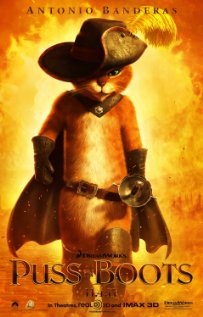
Puss in Boots comes to us during a fall film season with a paucity of releases for children. It's a clever if not brilliant work from Dreamworks Animation and a spinoff/prequel to the title character's entry in the Shrek series. Fortunately, there is no mention of Shrek, and the movie works very well alone without the need for prior knowledge of that world.
Antonio Banderas and Salma Hayek frequently work together, and this is their fifth collaboration (after Desperado, Frida, Spy Kids 3-D and Once Upon a Time in Mexico). They are joined by Billy Bob Thornton (Jack), Amy Sedaris (Jill), and Zach Galifianakis (Humpty Dumpty). Galifianakis is either brilliantly cast or terribly wasted. Personally, his characters always seem to grate on my nerves, but he delivers some of the best one-liners in Puss in Boots. As a family film, though, it's a very light, vanilla creme flavor of humor compared to The Hangover series.
Part origin story, part adventure-heist, Puss in Boots earns points for encompassing an actual story rather than simply throwing pop culture references at the audience, the modus operandus of Shrek. Sadly, a predictable plot is so transparent it doesn't need the incessant telegraphing of every potential surprise move. This is likely more a problem for those who have already seen Puss in the Shrek films. His aresenal is exhausted, and he has no new tricks. You know at some point he'll pull out the big kitty sad eyes, but it's been done before.
As with Shrek, Puss's best moments are when he has a strong character to play against, and those moments here are with Hayek's Kitty Softpaws. Had Puss in Boots been more about a cat-and-mouse game between them and less about Humpty Dumpty, it would have been more interesting.
Besides the Banderas-Hayek chemistry, the brightest spot in the movie was an engaging soundtrack performed by Mexican/gypsy/folk duo Rodrigo y Gabriela. Unfortunately, the soundtrack does not yet appear to be available on iTunes or Amazon.
Review: Margin Call
 In the first decade of this century, rocket scientists who ruled the back rooms of Wall Street discovered something they touted as a real Philosopher's Stone. Through financial alchemy, they created Frankenstein's monster. This monster was named Collateralized Debt Obligation (CDO). CDO's were created using something known as The Formula. The Formula theorized that packages of mortgages could be mashed together and sliced apart into "good" parts and "bad" parts. The problem is that The Formula relied on a base set of assumptions that history shows were faulty to the core.
It is not possible to turn lead into gold and a sow's ear will always be a sow's ear no matter how much you want it to be a silk purse. Margin Call illustrates what happens when a financial institution realizes that the bag of gold they hold is in reality a bag of lead.
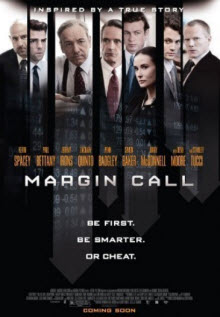
Margin Call opens with a scene that could have been straight taken from Up in the Air. Employees are called into managers' offices where HR awaits with bad news that has been all too common these days. One of the employees being "let go" at this financial institution is Eric Dale (Stanley Tucci), a manager in the risk management department. As Dale is leaving, he hands Peter Sullivan (Zachary Quinto) a USB drive with some of his latest work. He implores Peter to continue this work instructing him to be careful with it. Peter Sullivan burns the midnight oil completing Dale's work.
It's at this point we know the company is in deep Bandini (extra credit if you know what that means). Sullivan immediately raises the red flag and calls in his manager Sam Rogers (Kevin Spacey), who brings in the upper management of the company, one by one, to deal with this crisis.
Review: Take Shelter
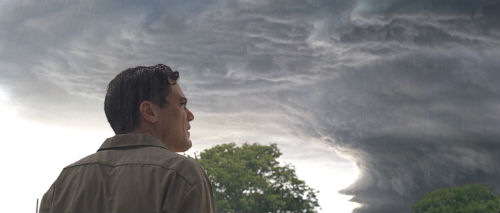
What's the bigger nightmare: Extreme violence, or an ambiguous but growing sense of threat to all your hold dear? Austin's Jeff Nichols proves it's the latter in Take Shelter, as a family man becomes increasingly obsessed with visions of storms, putting all he holds dear at risk as he tries to keep them safe.
Curtis (Michael Shannon) is an upstanding guy with a devoted wife Samantha, an adorable daughter Hannah, a responsible job and a comfortable home. Life isn't perfect, but they all happily weather the storms of life until Curtis's nightmares start interfering with waking life. The more Curtis tries to protect his family and regain a sense of security, the faster it erodes.
There is nothing to substantiate Curtis' fears, which is both the foundation and the power of Nichols's script. Nichols (Shotgun Stories) deliberately doesn't distinguish reality and nightmare; there is no discernible change in film stock and nothing to indicate which is which. As the film progresses, it's harder for the audience to distinguish between the two, increasing the tension despite the movie's slow and steady pace. But instead of being distracting, it makes it easier for the audience to relate to Curtis' plight. Even the CGI is minimal, and only enough to enhance the story. The overall effect is nearly exhausting as the audience gets caught up in Curtis' plight.
Review: Paranormal Activity 3
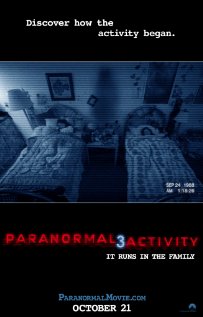
[Note: This review is based on the cut screened during Fantastic Fest, which we were told was not final, and which might feature differences from the theatrical release.]
Just two years ago, on an impossibly small budget, Oren Peli started the biggest new horror franchise of the decade. The writing of this marks the first year of my contributing to Slackerwood which began with a review of Paranormal Activity 2, a clever prequel penned by Christopher Landon. Now Landon continues to extend the franchise and expand on the mythos of Katie and Kristi with another prequel set this time in the 1980s: Paranormal Activity 3. This time, his script is directed by Catfish filmmakers Henry Joost and Ariel Schulman.
This setting provides a challenge for a series of found-footage films, as the home security camera technology featured in the first two movies was not yet available back in the Eighties. (However, large, clunky B/W cctv options were available and could have been used.) To work around this, the girls' father is written as a professional videographer who just happens to have a studio full of the newest VHS camcorders he can bring home to record the strange events that have been occuring around the house. In a very clever feat of duct-tape engineering, he even fixes up one camera on top of an oscillating fan so it can cover both the living room and the kitchen. (Through a feat of magical engineering, these VHS cameras are also able to capture widescreen high-def images.)
The strength of Paranormal Activity 3 is the weakness of the series. The "events" are more aggressive, more powerful and scarier than ever, but with each movie we're moving more into the past. Thus, looking at the events in chronological order, the demon that's tormenting Katie and Kristi is apparently growing steadily weaker even as it appears to grow angrier until at the end someone has to die. While we learn a little more about the sisters and their family with each film, Landon is painting himself into a corner. If there is ever to be a Paranormal Activity 4, it can't stick to the same formula and try to extend even deeper into the past. Yet an attempt to jump the story forward in time could present some difficulty in reconciling with the events seen in previous films.
Review: The Thing
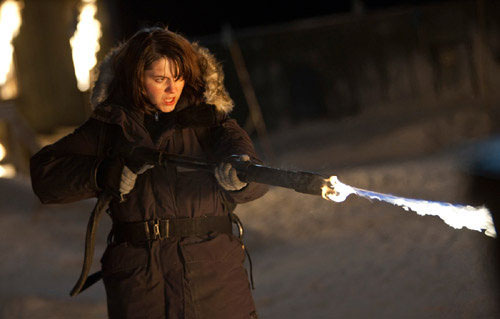
There's a funny thing about 2011's The Thing. A few things, actually. It's funny that the film is almost a carbon copy of its original, which itself was a remake of another film. Yeah, this is essentially a remake of a remake. Though it's marketed as a prequel, and we'll finally get to see what exactly happened to the Norwegians whose station lay abandoned in John Carpenter's class film from 1982, The Thing is still pretty much exactly the same movie from 1982. It's funny how when a movie like this is almost an exact replica of its original how much it makes that film almost unwatchable, but it does. If this film had any other name, it might have been an all right standalone horror film, but The Thing burdens itself with the weight of its predecessor, and it collapses under all that pressure.
During a routine expedition in Antarctica, a group of Norwegians come across a remarkable discovery, something that has never been seen before by human eyes. The man in charge of the expedition seeks out Kate Lloyd (Mary Elizabeth Winstead), a young but surely experienced paleontologist. Upon arriving in Antarctica, it's clear that this is no normal discovery, but once they get their find back to camp, strange things start happening to the crew.
Review: Footloose
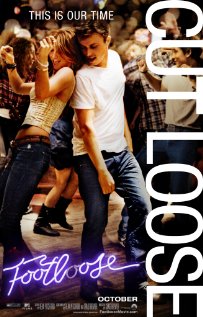
Director Craig Brewer has two critical hits to his name. Both Hustle & Flow and Black Snake Moan were exceptional works from a natural talent. Now, Brewer has taken on the challenge of remaking an 80s classic with Footloose, but the real challenge for him has been one of marketing a fantastic work that people are too ready to dismiss as a blasphemy without having even seen it. In fact, Brewer is perhaps the world's biggest fan of the 1984 movie that made Kevin Bacon a star. He has taken the film on the road, touring cities around the US and stopped in Austin a couple of weeks before Fantastic Fest to present the movie along with star Kenny Wormald. (see photos here)
Brewer has realized an updated yet timeless version of the story about a city boy who brings dance back to a small town paralyzed with grief. Fans of the original will find it hard to dislike this one. Footloose is the same movie in almost every way, but with a couple of background adjustments that result in a better presentation. Nothing revolutionary, but I won't spoil them. You may not even notice consciously, but the result is stronger character motivation and a better film.
Dennis Quaid is much more relatable as a grieving father than the unflinching fire-and-brimstone preacher portrayed by John Lithgow in 1984. This is where Brewer's vision departs from the original. This isn't a story about religious intolerance, and the script makes a pointed remark on that if it wasn't already clear. Kenny Wormald's Ren is a richer, more complex portrayal, still headstrong but more of a golden boy than Bacon's take on the role, and he has a strong relationship with his uncle Wes Warnicker (Ray McKinnon)
Footloose is a movie about dancing, of course, and the cast reflects that. Wormald has been dancing since the age of 6, is an instructor, and was previously seen in You Got Served. Costar Julianne Hough, who plays preacher's daughter Ariel Moore, is best known from Dancing With the Stars. It is Miles Teller's performance as Willard, however, that makes the biggest impression. Following up a strong dramatic performance in last year's Rabbit Hole, he shows breadth as the comic relief here in a very demanding physical role. In fact, the only weak character was Andie MacDowell's Vivien Moore, a part written with the belief in mind that a reverend's wife should be seen and not heard. In most scenes, she smiles and is silent.
Review: The Way
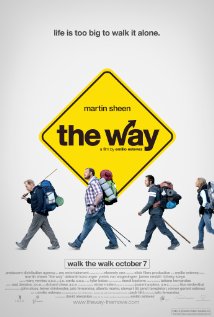
Separation and loss of a loved one, particularly that of a child, is the greatest cause for grief. Until we can learn to accept and deal with that grief, it can be crippling. In Emilio Estevez's latest film, The Way, his father Martin Sheen's character undertakes a task of enormous difficulty to pay homage to the memory of his son and come to grips with his loss.
Tom Avery (Sheen) is a widower, an opthalmologist who spends his free time on the golf course. His relationship with son Daniel (Estevez) is strained as Daniel is having something of a mid-life crisis and drops his graduate studies to travel and see the world. In France, he undertakes a pilgrimage along El Camino d Santiago, a walk of over 800 kilometers to Santiago de Compostela in Spain. But he is killed on the very first night of his journey when a freak storm arises in the Pyrenees.
Summoned to France by the authorities, Tom recalls their last conversation and decides to pick up Daniel's backpack and complete the pilgrimage in his son's place. Along the way, he encounters several people who are themselves coming to grips with personal demons, and they form an unlikely support group.
The Way is a poignant movie, shot along the length of the Camino de Santiago and full of breathtaking views of remote mountain villages, farmlands and cathedrals. The scenery alone is enough to elicit tears, without the grave import of Tom's journey. At key places along the route he stops to spread his son's ashes.
As if planting the seeds of his own redemption, Tom's personality begins to bloom with the help of his companions. The first, Joost (Yorick van Wageningen) is a Dutch bon vivant who hopes the walk will help him lose weight, though he can't help sampling heavily of the local cuisine at each stop. The second, Sarah (Deborah Kara Unger), intends to quit smoking at the end of the journey. The last, Jack (James Nesbitt) is an Irish travel writer stuck in a career rut.
Review: Weekend
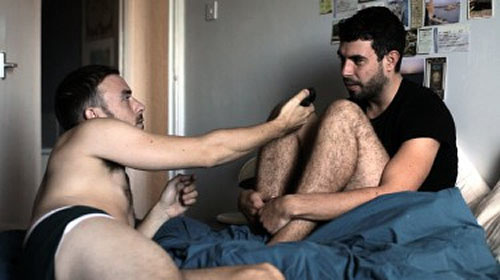
We've all seen love stories that make us wish we had the chance to be as happy as all of the beautiful people on the magnificent big screen. Often times the stories are cheesy, way too impossible to ever happen, or simply too perfect to ever happen to anyone, much less you. Andrew Haigh's film Weekend tells a (sort of) love story between two guys over who meet over a weekend hookup in October in England. It's a seemingly honest look at a burgeoning relationship between two gay men and the issues and/or topics that come up for discussion as they contemplate going public.
Russell (Tom Cullen) goes out to a gay club one night after hanging out with his straight friends and he catches the eye of Glen (Chris New). Fast forward to the next morning where Glen very enthusiastically wants to chat about the night they just shared, while Russell is very sheepish about it.
Review: Fireflies in the Garden
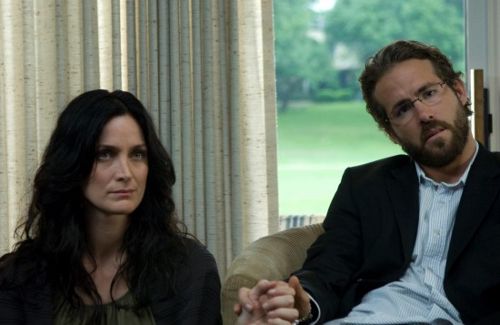
On a surface level, Fireflies in the Garden looks like a film that could easily be ignored amongst the myriad of options that filmgoers have to choose from. Cheesy tagline, a poster reminiscent of a Lifetime Channel movie, and Ryan Reynolds with a beard, which means he'll be serious and not that funny. As life should have taught us all by now, you never judge a book by its cover and Fireflies in the Garden is a good example why. Illustrating the sad and unfortunate way that life has a tendency of being when it shows a family what's really important, this film examines how one family deals with the pain of a sudden loss -- the loss of the one piece of the family that didn't deserve to leave in the first place.
Michael Taylor (Reynolds) is a famous author on a plane to visit his home for his sister's college graduation. In between consciousness on the plane, he flashes back to his childhood to a memory where his father Charles (Willem Dafoe) is berating him for "being so God-damned smart," while his mother Lisa (Julia Roberts) coddles and defends Michael. On the way to celebrate the graduation of their daughter Ryne (Shannon Lucio), Michael's cousin Christopher is playing in the street and when Charles swerves to miss, they run into a pole instantly killing Lisa. This causes a rift in the family bigger than the rift between Michael and Charles.
