

New Releases
Review: Man on a Ledge

Man on a Ledge is one of those films where the reaction you have toward it will be based upon the mood you're in going into it. On the one hand, you've got a cliché-ridden mess that at times seems like it took pages out of a screenwriting textbook and put them up in a theatrically released movie. On the other hand, you've got a cool, tense and more importantly fun heist flick starring some good actors.
What's funny about Man on a Ledge is that the first two acts of the film are the type of cliché-ridden piles filled with plot holes the size of the Grand Canyon that might make your head explode, but the third act is good enough and original enough to save the movie in the end. It's an impressive debut from director Asger Leth, and he has proven he can get a lot of out of a sizable cast.
While escaped convict/former police officer Nick Cassidy (Sam Worthington) seems to have found his freedom, he inexplicably checks into a very nice hotel room with a great view, sits down for a nice meal and then promptly walks out onto the ledge of his room. As the requisite circus gathers underneath, he asks the NYPD for his own negotiator. They figure out that he checked into the room under an assumed name and begin scrambling to figure out his identity. All the while across the street, a diamond heist is taking place and Nick's motives become clearer to the audience.
Review: Albert Nobbs
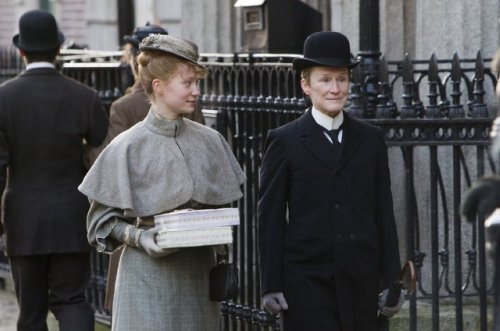
Academy Award nominations were announced earlier this week, and the gender-bending period film Albert Nobbs garnered multiple nominations including the Best Actress category for Glenn Close. Close won an Obie in 1982 for her off-Broadway performance as Albert Nobbs, and had worked since then to bring the character to life onscreen. She was so passionate about this role that she also co-produced, co-wrote the screenplay, and wrote the lyrics for the movie's main theme music, an Irish lullaby "Lay Your Head Down."
In one of the most challenging roles of her career, Close plays a woman who for 30 years represented herself as a man in order to have a "life of decency" in 19th-century Ireland. Albert Nobbs survives by working as a servant in a hotel, nearly invisible to the upper-class guests and thought of as an odd and curious fellow by co-workers. Albert is so distanced from others in her attempt to fade into the woodwork, that she lacks intimate contact with others.
Albert finally decides to marry and settle down, setting her dreams on opening a tobacconist shop with chambermaid Helen (Mia Wasikowska) as counter-girl and "wife." However, Helen has her heart set on another, the handsome but rough boilerman Joe Macken (Aaron Johnson). Joe has intentions for Albert as well -- as the means to escape to America when he realizes that Albert must have a small fortune tucked away. Joe convinces Helen to go along with the courtship to pilfer money from Albert, but complications occur that thwart everyone's well-laid plans.
Review: Red Tails
 The 332nd Fighter Group of World War II was known as the Tuskegee Airmen. Toward the end of the war they became known as the "Red Tails" for the painted tails of their P-51 Mustang Aircraft. This fighter group is well known for several reasons: Its pilots were all African-American men, who served with distinction and were some of the most highly decorated fighter pilots in World War II. The 332nd has appeared in a number of documentaries, films and television shows. Red Tails is the latest attempt to tell the story of these airmen.
Red Tails has been a work in progress by executive producer George Lucas for over 20 years. Sadly, that 20 years of effort went to waste. This movie fails on so many levels, it boggles the mind -- how could 20 years of effort produce such an amateurish piece of work? Red Tails tries to tell the story of the 332nd through a series of non-believable and sometimes stereotypical caricatures.
A number of areas are problematic in this movie. The first and primary problem is with the screenwriting. The dialogue is pedantic, boring and many times simply ridiculous. In one scene, the new P-51 Mustangs arrive and the pilots decide to paint the tails red (hence their nickname). One of the pilots exclaims, "Let's paint the tails red like the Red Baron!" Hey dumbass, the Red Baron was German, you know the guys we are fighting. I cannot count the number of times that characters German and American exclaim, "Look, the pilot is African. Look, the pilot is black." This coming from people flying at 150 knots plus.
It's really difficult to know whether the writing issues come from screenwriters John Ridley and Aaron McGruder or the emperor himself, George Lucas. It's hard to tell who put in a character with the call sign "Ray-Gun" who actually has a Buck Rogers raygun with him. Has to make you wonder.
Another major problem concerns the performances themselves. Every performance seemed forced and unbelievable. With a cast of great actors like Cuba Gooding Jr, Terrence Howard and Bryan Cranston, you would think director Anthony Hemingway could draw out some great acting. He fails on every level. During combat, no one breaks a sweat. Even the injuries are laughable. Think Paul Reubens' death in the movie Buffy the Vampire Slayer. The big difference is we were treated to over 40 minutes of that weakness.
Review: Extremely Loud and Incredibly Close
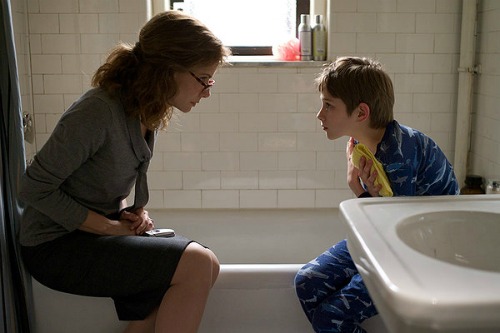
Some of my favorite movies happen to feature wonderful child actors, such as A Little Princess (the Cuarón version), About a Boy, Mostly Martha and Little Miss Sunshine. I say that to preface this statement: I can't recall the last time I've been so annoyed by a child actor as I was during the preview screening of Extremely Loud and Incredibly Close. This is a problem, as precocious Oskar Schell (played by newbie Thomas Horn) is in most of the film. And it may have been the character as much as (if not more than) the actor that made me want to walk out of the theatre halfway through.
Oskar is a very troubled child. His father Thomas (Tom Hanks) was killed on 9/11, and they had an extremely close relationship. Thomas had told his son about a lost sixth borough of New York, and Oskar began investigating what had happened to it. A year after 9/11, Oskar stumbles upon a hidden key in his dad's closet, and determinedly sets out on a search into what this key will unlock. The key was in an envelope with "Black" written on it, so Oskar meanders around the city and its boroughs talking to anyone with the last name Black that he can find, shaking his tambourine along the way.
This kid has Asperger's-like symptoms as well as various phobias. He yells at his mom Linda (Sandra Bullock), talks to grandma (Zoe Caldwell, The Purple Rose of Cairo) across the street via walkie-talkie, chides the doorman (John Goodman, pretty much wasted in this movie) and confesses his story to the elderly mute man (Max von Sydow) renting a room from his grandma. His aggression towards himself and others is hard to watch. I couldn't understand his motivation for keeping certain things secret, and found it a challenge (nigh impossible) to emotionally connect to the young character.
Review: The Iron Lady
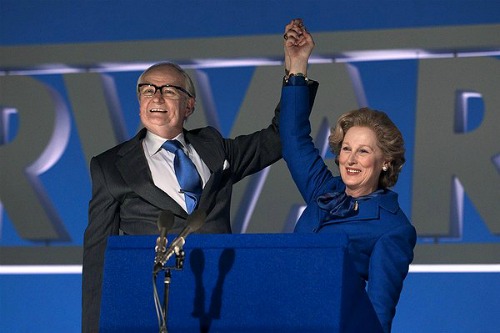
The Iron Lady attempts to depict the rise and fall of Margaret Thatcher, the first female Prime Minister of the U.K. It does so in a less than cohesive manner, but the acting by Meryl Streep and Jim Broadbent shines through.
A significant portion of the film occurs in 2011 (at least this is my assumption from hints given), with an octogenarian Margaret Thatcher (Streep) under the sway of dementia and visions of her dead husband Denis (Broadbent). Quick flutters of memory, such as holding hands during The King and I, are interspersed with longer flashbacks of growing up a grocer's daughter and her eventual entrance into the political world. For the present, her daughter Carol (Olivia Colman) and Thatcher's household staff are waiting for her to clean out Denis' wardrobe since he has been dead for eight years.
Phyllida Lloyd's first non-musical film seems dependent on the use of angled shots (to illustrate confusion? I'm not really sure why) and many montages. About a sixth of the film is Thatcher walking around various places followed by a group of white guys (I exaggerate slightly). Some of the flashback moments are edited so hurriedly that the viewer doesn't have much of a chance to connect or react.
Review: Contraband
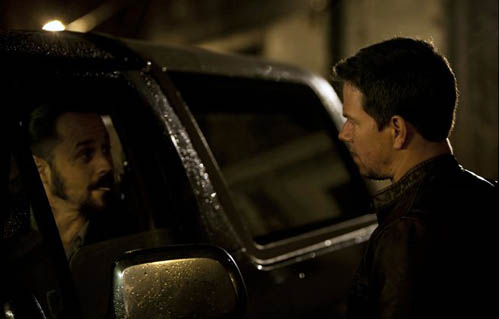
Moviegoers don't ask for much in the month of January. For the most part, they understand what they're in for and don't have very lofty expectations. However, when they see ads for a film like Contraband with a cast lineup including Mark Wahlberg, Giovanni Ribisi, Kate Beckinsale, Ben Foster and J.K. Simmons, the expectations might be a little high, even for January. Director Baltasar Komákur manages to helm a competently made action movie that has a few minor problems with it, but is actually a halfway decent January release.
In the port town of New Orleans, legendary smuggler Chris Farraday (Wahlberg) has long since retired and leads a modest life running his own business and living with his beautiful wife Kate (Beckinsale) and their two sons. When his brother-in-law gets in trouble with local drug dealer Tim Briggs (Ribisi), Chris must take it upon himself to come out of retirement and make "one last run" in order to save his brother-in-law and prevent any danger from happening to his own wife and children.
All of that is fine and dandy and has the makings for a very exciting film. The trouble is, Contraband doesn't have enough faith in its viewers to know where all of the chess pieces are placed before the action takes place. You hear someone call Chris Farraday the "Houdini of smuggling" several times and thankfully each time they have a different example of why he's given that moniker, but after the second time, we get it, dude is good at smuggling things.
Review: The Divide
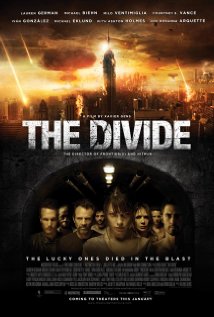 Imagine looking out of the window of your high-rise apartment building and seeing a blast of nuclear hellfire coming your way. After having your breath taken away, what would you do? In a post 9/11 world, your reaction should come naturally: You would get the heck out of Dodge.
You make for the stairwell and are greeted by fellow tenants making their way to the ground floor. As you reach the ground floor, the door flies open, exposing you to heat that feels like the force of a thousand suns. Oh crap, now what? Head for the basement! Lucky for you, there is a basement, and only a few of your fellow tenants have made for the basement door. By the skin of your hair you force your way into the basement. You have made it to salvation as the metal door shuts behind you.
You are safe, but for how long? You will soon find out what it is like to be a survivor. You have entered the world of The Divide.
The threads that make up the fabric of civilized society may not be bound as tightly as you think. Given the right catalyst the threads can come unbound rather quickly. The Divide illustrates what happens when a patchwork of people are thrown together in a confined space, with a low amount of resources and no idea of whether the world they inhabit even exists. The movie, which originally screened in Austin during SXSW 2011, provides a fresh angle on how people react to a post-apocalyptic world.
Alexander Graham Bell once said, "Before anything else, preparation is the key to success." In this story, the survival of the basement denizens can be attributed to Mickey (Michael Biehn), the building supervisor. It seems Mickey has been preparing for some type of terrorist attack and already stocked the basement with supplies. We quickly understand that it was not Mickey's intention to share his shelter and food with others, but he now does so reluctantly.
Screenwriters Karl Mueller and Eron Sheean have constructed a rich set of characters who waste no time understanding the reality they will face. What will they eat? How will they deal with human waste? When will they be able to return to the surface? Along with practical issues, it doesn't take long for the characters to establish a pecking order. Mickey asserts his position immediately; this is his world and he makes that very clear. Eva (Laura German) and Sam (Ivan Gonzalez) are a married couple with issues, Marilyn (Rosanna Arquette) is a mother with a a young child. Josh (Milo Ventimiglia) and Adrian (Ashton Holmes) are brothers accompaniedby Bobby (Michael Eklund), Josh's lover.
Review: Joyful Noise
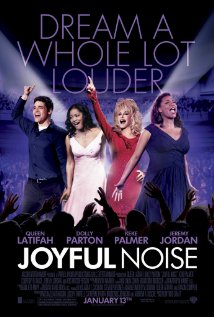 This week marks the return of Dolly Parton to the big screen for the first time since Straight Talk, 20 years ago (though she voiced a character in 2011's Gnomeo & Juliet). Joyful Noise pits her against Queen Latifah in a battle of the busts I like to think of as "Gospel Glee."
All joking aside, Joyful Noise is a family-friendly comedy in the same vein as Footloose with a wholesome message that doesn't get in the way of the fun. Writer/director Todd Graff (Bandslam, The Beautician and the Beast) has a definite hit in this movie.
The Pacashau Sacred Divinity Choir is in the middle of a performance when long-time director Bernard Sparrow (Kris Kristofferson) suffers a fatal heart attack. In order to continue to the annual Joyful Noise gospel competition, the church leaders must choose between his wife, G.G. (Parton) and Vi Rose Hill (Latifah), who has been his second for many years.
The return of G.G's grandson Randy (Jeremy Jordan) increases the tension between the two women as Randy, a misfit with a bad reputation, immediately begins to charm Vi's daughter, Olivia (Keke Palmer). Much like Kenny Wormald's Ren in Craig Brewer's 2011 remake of Footloose (my review), Randy is a perfect gentleman who never does anything to earn his poor reputation, and the characters, particularly Vi, must overcome their predispositions as with his great musical talents he remolds and modernizes the choir. (Another Footloose connection, actress Ziah Colon, has a small part in one scene.)
A number of subplots in Joyful Noise bring to light each supporting character, such as Vi Rose's son Walter (Dexter Darden) dealing with social awkwardness due to Asperger's syndrome, or Caleb (Andy Karl), who fears losing his job at the hardware store owned by his own father. The most engaging of these characters is Earla (Angela Grovey). Earla has a particular problem that is best left a surprise, but the character is charming and truly funny.
Review: Carnage
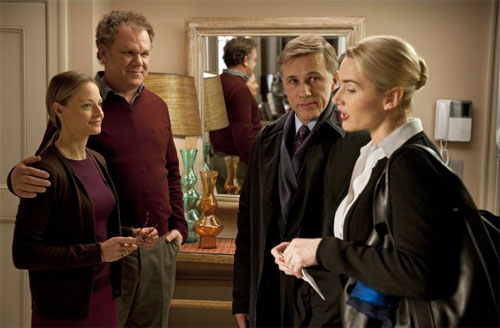
Will these two couples ever part, I wondered? Will the hosts finally close the door behind their guests? The characters tease us by lingering at the door jamb, even stepping into the hall and pushing the elevator button. But if you know Carnage is based on a stage play, Yasmina Reza's God of Carnage (which just finished a run at Zach Scott), you figure most of them can't travel too far away. Perhaps they'll leave and return later ... or on the other hand, the four of them could be trapped in the same room forever, evoking shades of No Exit.
The suspense about this situation is only part of the tense and occasionally comic interaction that infuses Carnage with more energy and humor than you might expect from a stage-based, occasionally stagy adaptation. End-of-year "award bait" dramas aren't usually quite this funny, although the twisted humor takes awhile to get going. It's not at all what I would have predicted from a film directed by Roman Polanski starring Jodie Foster, Kate Winslet, Christoph Waltz and even the often-amusing John C. Reilly.
Review: Pariah
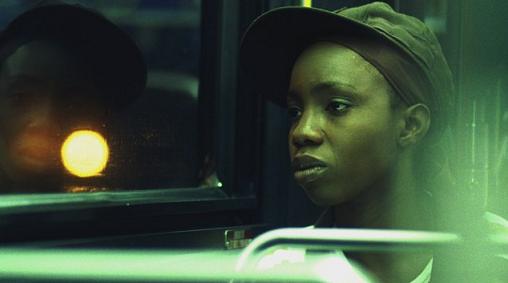
In a word, Pariah is authentic.
So authentic, in fact, that I didn't understand some of the dialogue. Pariah's characters, most of them African-American teenagers living in Brooklyn, discuss sex and relationships with a refreshing frankness, if in a vernacular that middle-aged Texan white guys like me can't always decipher. But I easily understood the gist of their conversations from the context; having been a teenager in the late Mesozoic era, I had no trouble relating to the characters' struggles with relationships and sexual identity.
Based on writer/director Dee Rees's 2007 short film of the same title, Pariah follows 17-year-old Alike (pronounced ah-lee-kay and superbly played by Adepero Oduye), a gifted student who is openly lesbian among her friends but hasn't found the courage to come out to her parents, Audrey and Arthur (Kim Wayans and Charles Parnell).
