

New Releases
'Pinetop Perkins: How Long' World Premiere at Antone's
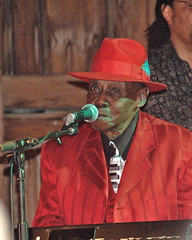 We just received a press release (reprinted below) for this upcoming screening and concert, which we know you won't want to miss.
Tone Poet Productions presents Pinetop Perkins: How Long, a short film documenting the last studio recording made by American blues legend and Antone's fixture Pinetop Perkins. The film will have its world premiere screening on Friday, March 23 at the famous blues stage Antone's, 213 West 5th Street, Austin, TX 78701 at 9 pm. Tickets available at the door for $15, or in advance for $10 through Antone's online. The evening will also feature a host of musicians who will play Pinetop's music as a special anniversary tribute concert in memory of his passing in 2011.
ABOUT THE FILM:
A moment in music history was recorded in Austin, Texas in September 2010 at Yellow Dog Studios: the last recording session of blues singer, piano player and multi-Grammy Award winner Pinetop Perkins. The recording sessions were produced by award-winning guitarist Jake Langley.
It was a project inspired by Langley’s love of the blues genre, and was his attempt to pay homage to one of the genre’s originators and recognize this artist's legacy; a legacy that has been passed on through generations of musicians around the world. These historical sessions brought together some of Austin’s finest and brightest young rising stars to play alongside Mr. Perkins: Emily Gimble, Gary Clarke Jr., Caroline Wonderland, and Cindy Cashdollar.
Review: Jeff, Who Lives at Home

I missed Jeff, Who Lives at Home when it screened at last year's Austin Film Festival, so was happy to check out a preview screening during my short break between SXSW activities. After some projection issues -- which made the audience at the Arbor giggle and obscured the starting quote before anyone had a chance to read it -- got resolved, the latest movie from Jay and Mark Duplass began. The viewer first views our protagonist Jeff through a talking head as he dissects why Signs is such a great movie (and reminded me that Abigail Breslin was in it). This on-the-toilet rumination is not as insignificant as it might seem.
Jeff, played by Jason Segel, is an unemployed stoner who lives in his mother's basement. One assumes his days tend to bleed into each other, but this day kicks into gear when he answers a cryptic wrong-number call. Jeff believes this is a sign and strives to interpret the message.
Meanwhile his mom Sharon (Susan Sarandon), who frets that her sons are "assholes," wants one thing for her birthday: for Jeff to fix a louvre on a cabinet door. She talks to her friend Carol (Rae Dawn Chong) at work about Sharon's new secret admirer, and Carol responds, "I'm super jelly." Regardless of this ridiculous phrase, which I've never heard anyone use before, points go to Jeff, Who Lives at Home for an honest portrayal of women over 40! Sarandon's Sharon is disappointed in her current life, yet still slightly optimistic and hopeful. She's a joy to watch as her eyes light up at the possibility of new romance.
Review: 21 Jump Street
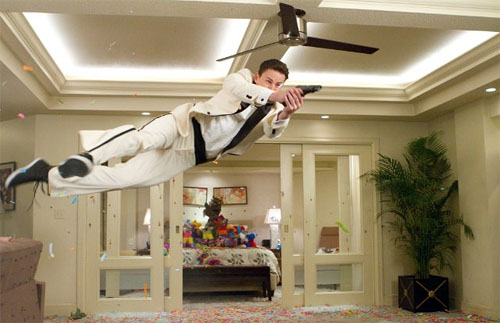
Sometimes when you watch a movie that you end up loving, you can pinpoint the exact moment that you say to yourself, before the film is even done, "Yeah, I'm gonna like this." 21 Jump Street has a moment like this. It pokes fun at the idea of Hollywood being so unoriginal it has to churn out remakes by rehashing, and it's done so in such a flippant way that it couldn't have possibly be delivered by anyone other than Nick Offerman. This is the moment where you'll either check out of the film, or you'll be totally on board.
You won't have to buy into the concept so much as just appreciate the comedic stylings of Channing Tatum and Jonah Hill, and it may seem hard to believe but yes, Channing Tatum does indeed have some great comedic chops under his emotionless face.
Schmidt (Hill) and Jenko (Tatum) are two former high-school classmates who didn't run in the same circles back in high school. Fast forward a few years when they both join the police academy and realize they can help each out because of their different skill sets. When they eventually make their first arrest, they manage to spectacularly botch it and they get assigned to an undercover unit as a form of punishment. Their mission is to stop a new drug that is currently contained to one school from spreading and making it harder to eliminate. They're not supposed to drink or do drugs with the kids, but it's been established at this point that they're not very good cops, so what else would you expect?
Review: Casa de mi Padre
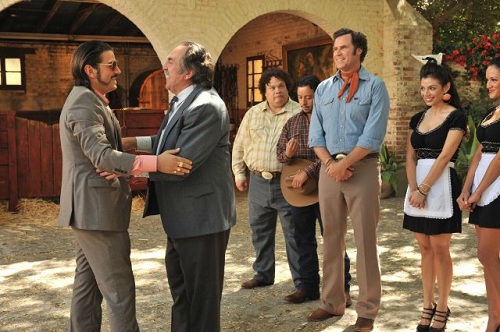
I watched more soap operas than I care to admit with my mother and grandmother when I was young, but it wasn't until I spent a college summer break in Costa Rica that I sat through an entire Spanish telenovela. Without exception, the acting was overly dramatic and the sets were cheaply constructed, yet I found myself hooked by the plight of heroes and heroines who were often at the mercy of a moustached villian. Plus, it was a great way to brush up on Spanish. If you've not watched a telenovela on Univision or another Spanish language channel, you can experience the melodrama on the screen with the parody movie Casa de mi Padre starring Will Ferrell in a Spanish-speaking -- and singing -- role.
Ferrell portrays Mexican rancher Armando Alvarez, the eldest of two brothers who must save his family's failing ranch while dealing with drug traffickers. His younger brother and successful businessman Raul (Diego Luna) returns home with his vivacious fiance Sonia (Genesis Rodriguez), much to the delight of their father Miguel Ernesto (Pedro Armendáriz Jr.). However, Raul's true intentions are to take on the local drug lord, Onza (Gael Garcia Bernal), putting the Alvarez family and their farm in even more danger. Things become even more complicated for the Alvarez brothers as Armando falls for Sonia, and must save both her and the family's business with the help of his trusty sidekicks, Esteban (Efren Ramirez) and Manuel (Adrian Martinez).
Review: John Carter
Everyone is familiar, whether they know it or not, with the work of Edgar Rice Burroughs, thanks to the popularity throughout the 20th century of Tarzan in film and TV. Burroughs was a highly prolific pulp author until his death in 1950, with many other series and stand-alone works. You may also be familiar with another popular film adaptation of his work, The Land That Time Forgot.
Now, 100 years after the publication of Burroughs' A Princess of Mars, and after more failed attempts at flight than the Wright Brothers, the novel has finally been successfully adapted for the silver screen.
Of all the great works of science fiction and fantasy, none has cried out for a film adaptation more than Burroughs' Tales of Barsoom series. Even Tolkein’s Lord of the Rings had an animated adaptation by Ralph Bakshi in the 1970s. The John Carter novels were arguably as powerful an influence on 20th and 21st century fiction as Tolkien. If you are unfamiliar with the source, you can find A Princess of Mars freely available on the Project Gutenberg website.
The series tells a story about a man who falls asleep in a cave and wakes up on a planet he assumes to be Mars, where due to lower gravity, he has comparatively greater strength than the inhabitants and is able to jump vast distances, not entirely unlike the earliest incarnation of Superman. He’s a superhero on Barsoom (the local name for the planet) but from time to time has to return to his body on Earth. Each return visit to Barsoom is chronicled in a different book of the series.
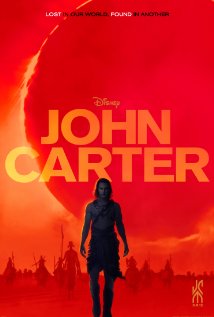
This Disney-produced feature was not only wildly enjoyable, it was also a much more faithful adaptation than anyone had generally expected. While there are of course a few changes to specifics, broadly everything in the movie John Carter is clearly recognizable as very close to the events of the book. It is a striking, even perfect match visually for everything described in the book, including even the description of Woola, John Carter's pet Martian dog (best described as a "puppy-lizard").
Taylor Kitsch, in the title role, fits the part well, as does Lynn Collins as Carter’s love interest Dejah Thoris. For his first time directing a live action film, Andrew Stanton shows he's just as capable working with people as with Pixar creations.
Review: Friends with Kids

In 2001 Jennifer Westfeldt starred in Kissing Jessica Stein, an indie darling she wrote about a neurotic New Yorker whose frustration with the dating scene resulted in a romance with another woman. She returns to the big screen with her third feature script and her directorial debut, Friends with Kids. Unfortunately the self-conscious charm of Kissing Jessica Stein hasn't returned; instead Friends with Kids is almost entirely self-consciously awkward.
Westfeldt stars as Julie Keller, a thirtysomething so close to her best friend Jason (Adam Scott) they even live in the same building. Unlike their other friends, their coupling is always temporary, and with other people. In the meantime, Leslie and Alex (Maya Rudolph and Chris O'Dowd) are on their second child, and the nymphomatic Ben and Missy (Jon Hamm and Kristen Wiig) are raising their son. Eventually, after too many baby pictures spamming their email and too many snarky comments on what their friends have lost, they decide to have a baby together but not be a couple. The obvious ensues.
Review: Project X
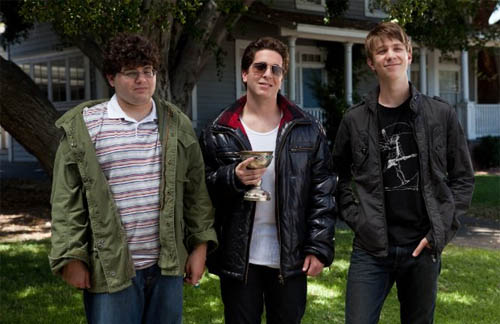
I have a pretty hard and steady rule for movie reviews I write: I don't like to talk about myself. It doesn't matter what I have to say about Project X though, because there's an audience for this film, and that audience is certainly not critics. This film is a teenager's wet dream. It's got raging hormones, beer, drugs, naked women, adults to revolt against, and of course naked women. What's there not to like? Well depending on your age, there's either plenty to like, or plenty to hate. I didn't think I was an "uncool" old guy until I saw this movie, it's kind of disheartening to think I was putting myself in the adults' shoes and all I wanted was for those damn kids to get off my lawn.
It's Thomas Kub's (Thomas Mann) birthday, and he's kind of a shy kid. Not all that unpopular, but not one of these kids who's making high school the time of his life. Not like his friend Costa (Oliver Cooper), who's that kid that we all knew in high school who could always talk us into trouble. He's slick, knows everyone, and you should never listen to him ever. So when it comes time to plan Thomas's birthday, guess what happens? They embark on a mission, and that mission is to thrown an epic party and if possible, get laid.
Review: Coriolanus

In 1996, Baz Luhrmann updated Shakespeare's Romeo and Juliet with modern imagery and a menagerie of hot young talent. In doing so, he produced a magnificent movie that, love it or hate it, everyone must admit was a grand spectacle. It made Shakespeare's most famous and beloved work accessible to Generation Y with rich visuals, Luhrmann's unique direction, and a cast with many soon-to-be household names. Now, in his first feature-film directing effort, Ralph Fiennes stars as the titular character in a similar though less successful effort to update Coriolanus, Shakespeare's least-produced and probably worst-known play.
While this movie is by no means unworthy, Coriolanus is not a work that really captures the imagination or emotion. Several factors contribute to this, both in the source material and in Fiennes' production. There are barely two scenes in the entire film that don't include Coriolanus, one of the most unrelatable and unsympathetic heroes in English literature. The production design is best described as 1960s Soviet Afghanistan, more bleak and less colorful than most concentration camp scenes ever set to film.
If ever a modern take cried out for a classical reimagining, it is this one. Rome, at the height of its power, is depicted with all the pomp and flair of North Korea five minutes after the death of Kim Jong-Il. The melange of accents is distracting and includes Scottish, English, vaguely Italian, and American, and I even noted one character credited as "Jamaican Woman."
The largest mistake Fiennes made with Coriolanus was in casting himself in the title role. Not only did I feel an immediate antipathy watching him, as he appeared completely uncomfortable and out of place in his uniform, but as a first-time director, the demands of the job are in conflict with portraying a role that is in front of the camera for 99 percent of the movie. At times, Fiennes seemed to be acting more the part of Voldemort than a Roman general, and I quickly found I did not care what the character did nor what would happen to him. The saving graces of Coriolanus were the score and the performances of Vanessa Redgrave and Brian Cox.
Review: The Lorax

There's a scene in Hannah and Her Sisters wherein Max von Sydow utters one of the best lines of his career: "If Jesus came back and saw what's going on in his name, he'd never stop throwing up."
There are those who probably feel the same way about the good works of Dr. Seuss. One one side there are those who say The Lorax is socialist propaganda aimed at indoctrinating our children into rejecting the free market. On the other side is a camp of people who think capitalism got its greedy claws too deep into the good Doctor's work and are horrified to see he who speaks for the trees hawking sport utility vehicles. There's controversy enough to keep the news networks and Lou Dobbses busy for a few days at least.
But what matter? The film adaptation of The Lorax is delightful. Like Seuss' other works and their cinematic derivatives, when the shallow political hullaballoo has passed, what remains will be memorable entertainment -- the best of the modern Dr. Seuss movies yet.
Review: Crazy Horse

When I was asked to check out Crazy Horse, I wasn't really sure what to expect -- except for the obvious nudity that would appear in a movie about a French burlesque. I hadn't seen any of director Frederick Wiseman's previous work, so his documentary style was very surprising and slightly jarring. Where were the talking heads to give me background on the subject? Or the narration to provide a hint of explanation? Not in this movie! Wiseman's trademark style is to thrust the viewer in the midst of a situation with no exposition or interviews. In this film, we spend a couple of hours at "the best nude dancing show in the world," Le Crazy Horse in Paris.
Throughout Crazy Horse various acts from the venue's new spectacle, "Désir," are interspersed with footage from behind-the-scenes. The show, choreographed by Philippe Decouffle, uses lights and dance to create an experience that is at times hypnotic and entrancing. Mirrors are used for a number -- accompanied by a cover of Britney Spears' "Toxic" (I think it's this one) -- while upside-down legs flow in and out of sight. Another act features two women painted by kaleidoscopic lights as they perform crazy acrobatics. One woman performs with ropes -- a far more erotic act than you'll see in Cirque de Soleil. I found myself simultaneously amazed at the talents on display and dismayed at the lack of vocal talent (not really a problem until the ladies sing songs like "Baby Buns" and "Désir").
We also glimpse behind-the-scenes meetings between staffmembers and Decouffle as he asks the club to close for a short time before the show opens (the owners say no). Thus, we have the theme of art vs. commerce. Decouffle has a certain artistic vision for the show, but is limited by the budget, time and staff available. Or so I assume -- this was the theme I pieced together from discussions Decouffle has with others during the film.
