

New Releases
Review: Rampart
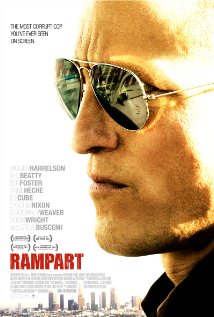
Writer James Ellroy, asked about the film adaptation of his novel White Jazz in a 2009 interview, replied, "No I didn't like that movie. White Jazz is dead. All movie adaptations of my books are dead." The author of The Black Dahlia and L.A. Confidential seems to have an antagonistic relationship with film adaptations of his novels, or rather with their producers, directors and cast. This is probably because they are so much better known than the books, but of such lesser quality.
This rule holds true for the latest adaptation, Rampart, based loosely on the Rampart Scandal of the CRASH anti-gang unit of the LAPD in the late 1990s. The movie stars Woody Harrelson and a bevy of other names in mostly small, even unrecognizable parts: Ice Cube, Tim Russ, Ned Beatty, Robin Wright, Sigourney Weaver, Steve Buscemi, Anne Heche, Cynthia Nixon, Ben Foster, and Jon Bernthal, most of them appearing for just one scene. Adapted and directed by Oren Moverman (The Messenger), the film looks as though it were shot like a mid-90s VHS porn flick. It is gritty and ugly as its subject matter.
Woody Harrelson is "Date Rape" Dave Brown, one of the last old-school LAPD officers, a holdout from before the Rodney King era. His fellow officers look up to him and affectionately gave him the nickname "Date Rape" for the 1985 killing of a serial date rapist, an act for which he should have been prosecuted or at least relieved from duty. However, Brown has a guardian angel, Hartshorn (Ned Beatty), an old friend of his father's with powerful connections who covers for him and advises him.
Plagued with anger management issues, new troubles for Brown start when he is caught on tape beating nearly to death a driver who accidentally rammed into his car. The department is already under siege from Rampart lawsuits, and the lawyers he needs to defend himself are cleaning out his savings. To help with his money problem, Hartshorn advises him the time and place of a high-stakes poker game, which he can break up, pocketing the money he seizes. The situation only gets worse when two gang members also show up to rob the players, and he shoots and kills one. Now faced with prosecution not just for the beating but also for murder, he begins to believe he was set up by forces working to find a scapegoat and clean up the department's reputation.
Review: Wanderlust
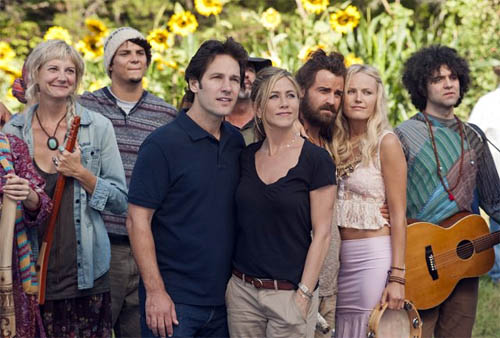
If David Wain fans have one thing to be thankful for, it's the fact that the usual cast of character actors in his projects must genuinely like each other if they work together so much. It shows in the comfort level they have with each other and makes it so they can make comedies that get bolder and bolder. Wanderlust certainly is bold.
Unfortunately, that comfort level and willingness to cross the line might have been too much, resulting in a movie that just feels kinda flat. I don't know if moviegoers who aren't familiar with some of David Wain's other films will quite be ready for what seems at first like a good-hearted comedy about a down-in-the-dumps couple discovering themselves in a hippie commune. Wanderlust is definitely good hearted, but it's also a joltingly graphic film.
George (Paul Rudd) and Linda (Jennifer Aniston) are a young married couple looking to take that next step in their lives, owning a tiny apartment in New York City. George isn't so sure, but Linda really loves the place and feels it's where they need to be. They're in a good place in their lives: George has a good job, and Linda is getting ready to sell a documentary about penguins to HBO, so it makes sense to buy property at this point. Well, when HBO passes on Linda's documentary and George's job lays him off, they don't have much choice but to go to Atlanta to live with George's irritating brother Rick (co-writer Ken Marino).
Review: This Means War
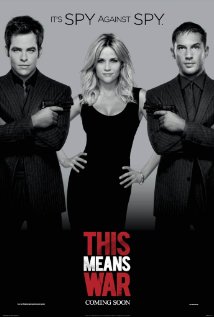 Whether you're looking for an action movie, a raucous comedy, or a chick flick for date night, This Means War satisfies as all three. Directed by McG, my favorite of his films to date follows on the heels of his worst, 2009's Terminator Salvation.
Chris Pine and Tom Hardy star as best friends and CIA partners who inadvertently find themselves dating the same woman, Reese Witherspoon. While she remains unable to decide between them, they go to ever more extreme lengths using their CIA skills and resources to learn about her and outdo each other in their efforts to win her affection.
Writers Timothy Dowling and Simon Kinberg have a mixed record. Dowling is credited on Role Models, and Kinberg, who penned screenplays for Sherlock Holmes and Mr & Mrs Smith, was also responsible for Jumper and X-Men: The Last Stand. With This Means War, they have penned an enjoyable romp that could be a cousin to True Lies, with a similar tongue-in-cheek take on the spy world, albeit considerably smaller in scope.
Though Chris Pine and Tom Hardy seem an unlikely pair, the choice of casting works. It is becoming difficult to see Pine as anything but Captain Kirk, and this role as hotshot ladykiller spy FDR Foster is a planetbound Kirk. Hardy (who himself once played a clone of Jean-Luc Picard), is thoughtful and sensitive as Foster’s partner Tuck. The characteres each represent polar opposites but equal in attraction for Reese Witherspoon’s Lauren. Even with the help of her best girlfriend Trish (Chelsea Handler), she is unable to decide between the two men who inevitably tie in every game she devises for them.
This Means War was a fun escape from reality for a couple of hours: not too serious, not too silly. Some of the dialogue is quite witty, though Pine seems a bit tongue-tied at times. Angela Bassett makes an all-too-brief appearance as Tuck and Foster’s handler, and I felt the biggest thing missing from the film was a final scene with her, something which may be on the editing room floor.
Review: Bullhead
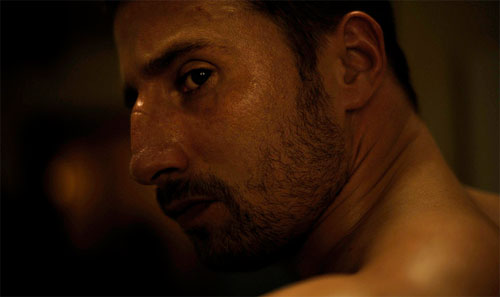
One of Bullhead's production companies is aptly named "Savage Film." The name fits because Bullhead (Rundskop) is entirely savage, a grim and brutal story about, as director Michael Roskam describes it, "people being driven to extremes."
Distributed by Austin's own Drafthouse Films and nominated for a Best Foreign Language Film Oscar, the Belgian import Bullhead is extraordinarily intense, a gripping and often unpleasant tale of organized crime in the Flanders area of Belgium. The story follows Jacky Vanmarsenille (Matthias Schoenaerts), a young, impressively muscular cattle farmer with a penchant for steroid abuse and an outlook haunted by a long-ago trauma. A veterinarian coerces Jacky to make a crooked deal with an equally crooked Flemish beef trader; as Bullhead is an intricate thriller, it's impossible to say much more without spoilers. I'll say only that the story involves gangsters, a stolen car, a murdered cop and confrontations with characters from Jacky's painful past.
Review: Safe House
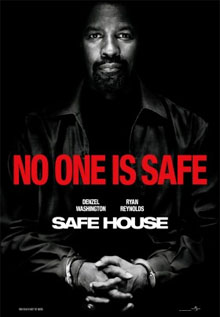 It's hard to imagine a movie starring an ass-kicking Denzel Washington and a non-comedic Ryan Reynolds would be something of a chore to get through, but Safe House is at times. It's not really the actors' fault, though. When you've got a story that isn't the most original, and therefore has to be filled with cliche after cliche, you can't really end up with anything other than just an okay film that has a few good fleeting moments and that's about it. It's not to say that Safe House is terrible, because it's not -- it's a more than competent effort from a director at the helm of his first American feature. Daniel Espinosa even proves here that he directs action very well.
Matt (Reynolds) is a young C.I.A. officer who hopes to one day be an active duty field agent. For now he's been relegated to being a "housekeeper" of a South African safe house, meaning he spends hours upon hours in an empty building that the C.I.A. might one day use, but usually never will. On this eventful day, a known international fugitive and former agent Tobin Frost (Washington) has turned himself in to the C.I.A. in order to escape some people trying to kill him. This is the first action Matt has seen, and Tobin Frost is his responsibility, but there seems to be nobody Matt can trust, not even the C.I.A.
Ryan Reynolds is certainly not out of his element in Safe House, but the movie missed the mark by not allowing his sense of humor to come through. Reynolds is certainly capable of holding his own in an action film, but when he isn't being funny while doing it, he comes off as stiff and unnatural. Of course, the argument can be made that that was the way the character was written -- trouble is, the film isn't that deep. Denzel Washington is an unrelenting badass, yeah, but he's not doing anything here that you haven't seen in any Tony Scott film that Washington has been in. Speaking of Tony Scott, it's clear that his visual style served as an influence on the look of the film, which should please fans of films like Man on Fire and The Taking of Pelham 123.
Review: Journey 2: The Mysterious Island
 In 2008, Josh Hutcherson starred in a rape of the classic Jules Verne novel Journey to the Center of the Earth. This week he returns for sloppy seconds in an almost completely unrelated vehicle, Journey 2: The Mysterious Island, aka The Death of Michael Caine's Career. Hutcherson's character Sean Anderson is the only common thread connecting the two films as he again goes in search of a missing family member trapped in a 3D theme-park caricature of a Jules Verne environment.
This time it is Sean's grandfather, perhaps the worst role ever written for Michael Caine, who has sent a secret radio message from Verne's Mysterious Island. Joined unwillingly by his stepfather Hank (Dwayne "The Rock" Johnson), Sean sets out for a weekend round-the-world trip of adventure and male bonding. Along the way they pick up down-on-his-luck pilot and single parent Gabato (Luis Guzman) and his daughter Kailani (Vanessa Hudgens), who becomes Sean's love interest because apparently she's the first girl he's ever seen.
Calling Journey 2: The Mysterious Island a rape of Verne's work is not entirely accurate, since the movie really makes no effort to actually include any of his storylines instead of simply mining them for tiny elephants and giant insects seen in the trailer. These are used to populate a story so inept it appears to have been written by members of its target 13-year-old audience. It was actually penned by brothers Brian and Mark Gunn, whose prior feature film credits include only the screenplay for direct-to-video Bring It On Again. It was directed by Brad Peyton, who brought us Cats and Dogs: The Revenge of Kitty Galore.
Forget about the blatant misuse of the word "science," the characters themselves are weak and inconsistent. Hutcherson's Sean Anderson, an insufferable juvenile delinquent, is so intent on finding his grandfather that he's willing to run away from home ... but as soon as he meets Kailani, his motivation becomes entirely the need to impress her.
Review: Pina

I've never claimed to be a fan of modern dance. While I have great respect for dancers' and choreographers' creative talents, physical abilities and dedication, I've always thought of modern dance as an art form that's more entertaining to do than to watch. Admittedly, I've seen only a handful of modern dance performances. Perhaps I'm but a mere philistine -- frankly, I just didn't get most of them.
After seeing Pina, however, I have a newfound appreciation and understanding of modern dance. The captivating new Wim Wenders documentary about German choreographer Pina Bausch is a feast of striking imagery that makes the art of dance come alive like no other movie I've seen.
Pina is a film of great beauty, although one that stems from great tragedy. After a long and distinguished career as a dancer, choreographer, teacher and ballet director, Bausch died suddenly of cancer at age 68 in 2009. Her death came only days before shooting for Pina was scheduled to begin, so what was to be a film about an aging artist still at the height of her career is instead a moving tribute to her artistic legacy.
Review: Chronicle

If there's one trend in Hollywood that has worn out its welcome pretty quickly, it's the "found-footage" genre of filmmaking. Since The Blair Witch Project in 1999, Wikipedia lists 79 other film projects in the genre. In the grand scheme of things, 79 films in 13 years may not seem like that many, but when you consider that the biggest problem with the genre is that the movies are on some level all the same, therein lies the issue. We need something different, and we need it badly.
Cloverfield and Paranormal Activity deviated from the formula a little bit but at the heart, they weren't that different. Chronicle promises something different, but can it deliver on that promise? Director Josh Trank and writer Max Landis certainly have had a hard task before them.
The plot of Chronicle is pretty simple. Andrew (Dane DeHaan), an unpopular loner, decides to document everything in his life as a way of opening up. Naturally, everyone thinks it's weird, including his cousin Matt (Alex Russell). One day while at a party in an abandoned part of town, Andrew, Matt and their friend -- the popular Steve Montgomery (Michael B. Jordan) -- discover a weird hole in the middle of a field. Of course, in abandonment of all sensible logic, they go down the hole and discover something mysterious. The next day after their discovery, they've figured out that they have the ability to move things with their mind, and that they're getting stronger by the day.
Review: The Woman in Black

I've mentioned before Stephen King's nonfiction Danse Macabre, in which he delineates three levels of the horror genre: terror, horror and revulsion. He states that terror is the "finest element," the suspenseful moment before the actual monster is revealed -- horror occurs when we actually see the monster. He equates revulsion with the gag reflex, a bottom level that he considers a cheap gimmick. With films like Human Centipede and other visceral gory films pushing the boundaries of revulsion, fans of the classic horror of H.P. Lovecraft are welcoming the latest film in the horror genre, The Woman in Black, based on the novel by Susan Hill.
Opening with the death of three young girls, The Woman in Black is one tragedy after another for the entirety of the movie. Young and nearly penniless lawyer and widower Arthur Kipps (Daniel Radcliffe) reluctantly leaves his four-year-old son with his nanny in London to travel to an isolated village to settle the estate of a deceased recluse. Kipps learns quite quickly that his presence is not welcome in the village, and despite warnings he travels to the remote estate surrounded by the sea during high tide.
While at the estate, he learns of the death of a young boy who was trapped in the family carriage during a rising tide. Kipps spots a mysterious woman dressed in black, and upon his return to the village a young girl dies after intentionally drinking lye. Local superstition believes that whenever the woman is seen, a child's death will soon follow.
Review: We Need to Talk About Kevin
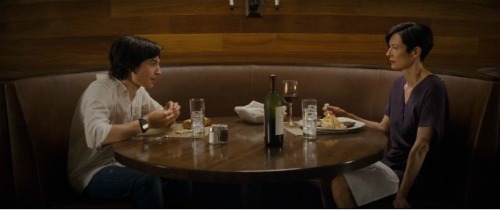
What if you were scared of your own child? We Need to Talk About Kevin, based on Lionel Shriver's award-winning novel, is an intense glance at the relationship between Eva Khatchadourian (Tilda Swinton) and her son Kevin (played in teenage form by Ezra Miller). The editing is stream-of-consciousness style, as memories of Eva's pre-motherhood life mix with Kevin's childhood mixed with her current life as a social outcast. The viewer has to piece together why she's now living alone in a town full of people who detest her so strongly.
Through glimpses/flashbacks, we see Kevin's antipathy towards others start at a young age. Try as she might, Eva cannot connect with him. She rolls a ball to her toddler son and he just blankly stares back at her. Her husband Franklin (John C. Reilly) seems to have no problem getting along with their son, and is oblivious to Eva's worries. They later have a daughter Celia (Ashley Gerasimovich) who is much freer with her affections and easy to please.
As he grows older, Kevin displays more antisocial tendencies, killing his sister's pet (we assume) and orchestrating an attack at his high school. Unlike in Gus van Sant's Elephant, we don't see the violent acts being carried out against fellow students. The movie is from Eva's POV, so we see her having to deal with the fallout of Kevin's actions.
