

Review: The Woman in Black
I've mentioned before Stephen King's nonfiction Danse Macabre, in which he delineates three levels of the horror genre: terror, horror and revulsion. He states that terror is the "finest element," the suspenseful moment before the actual monster is revealed -- horror occurs when we actually see the monster. He equates revulsion with the gag reflex, a bottom level that he considers a cheap gimmick. With films like Human Centipede and other visceral gory films pushing the boundaries of revulsion, fans of the classic horror of H.P. Lovecraft are welcoming the latest film in the horror genre, The Woman in Black, based on the novel by Susan Hill.
Opening with the death of three young girls, The Woman in Black is one tragedy after another for the entirety of the movie. Young and nearly penniless lawyer and widower Arthur Kipps (Daniel Radcliffe) reluctantly leaves his four-year-old son with his nanny in London to travel to an isolated village to settle the estate of a deceased recluse. Kipps learns quite quickly that his presence is not welcome in the village, and despite warnings he travels to the remote estate surrounded by the sea during high tide.
While at the estate, he learns of the death of a young boy who was trapped in the family carriage during a rising tide. Kipps spots a mysterious woman dressed in black, and upon his return to the village a young girl dies after intentionally drinking lye. Local superstition believes that whenever the woman is seen, a child's death will soon follow.
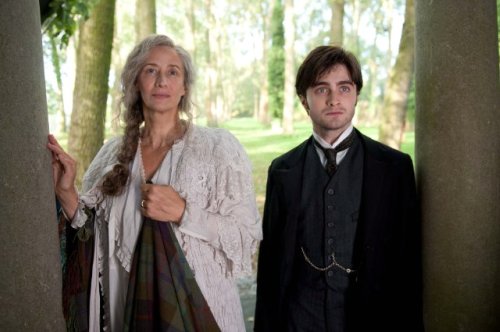
Kipps is befriended by Mr. Daily (Ciaran Hinds), the one resident who discounts the stories despite the death of his own son at a young age. The grief-stricken Mrs. Daily (Janet McTeer) believes in the legend so strongly that she claims her son communicates from beyond the grave -- demonstrated by an episode of being possessed by his spirit. Kipps learns that there is more to the story of the boy who died in the tide many years before, and the true connection and reason behind the omen cast by the Woman in Black. Realizing that his own son who is due to join him in the village may be in danger, Kipps races against time to bring peace to the village's inhabitants, both living and dead.
The casting of The Woman in Black is solid, with lead actor Radcliffe effortlessly maturing into an adult role after his run as Harry Potter and his more controversial role in the revival of Equus. Hinds as the wealthy resident who befriends Kipps is also well-suited, but once again it's Academy Award nominee Janet McTeer whose versatile and graceful talents set up an almost morbidly funny scene. The costume and set design are elegant and lovely with sweeping landscapes and dark interiors of the estate and local inn.
Although the dialogue in The Woman in Black is par for the course, the exposition is a bit too fast without much focus on character development. More importantly, the pacing was slightly off. I didn't feel engaged as the story neglected to strap in passengers before starting the rollercoaster ride that I can only describe as "boo scare buckshot" -- fire enough off at once and a couple are bound to hit.
However, after repeated frights I felt a bit de-sensitized and lost focus on the character, instead playing "Where's Waldo?" for the next appearance of the Woman or another apparition. Perhaps it was also a distraction from the presence of Radcliffe in nearly every shot of the film, or the result of Jane Goldman's strengths as a screenwriter for the fast-paced action X-Men First Class and Kick-Ass not translating as well to the slow burn and build up of terror in classic horror.
The Woman in Black should please fans of Daniel Radcliffe or classic horror fans wanting a change of pace from the gore and shock of most horror films nowadays. However, don't expect the tension or complexity of The Others, Sixth Sense or The Orphanage.