

Review: Rampart
Writer James Ellroy, asked about the film adaptation of his novel White Jazz in a 2009 interview, replied, "No I didn't like that movie. White Jazz is dead. All movie adaptations of my books are dead." The author of The Black Dahlia and L.A. Confidential seems to have an antagonistic relationship with film adaptations of his novels, or rather with their producers, directors and cast. This is probably because they are so much better known than the books, but of such lesser quality.
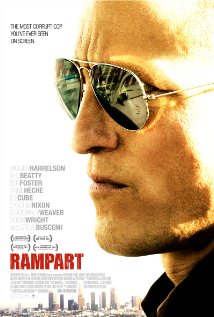
This rule holds true for the latest adaptation, Rampart, based loosely on the Rampart Scandal of the CRASH anti-gang unit of the LAPD in the late 1990s. The movie stars Woody Harrelson and a bevy of other names in mostly small, even unrecognizable parts: Ice Cube, Tim Russ, Ned Beatty, Robin Wright, Sigourney Weaver, Steve Buscemi, Anne Heche, Cynthia Nixon, Ben Foster, and Jon Bernthal, most of them appearing for just one scene. Adapted and directed by Oren Moverman (The Messenger), the film looks as though it were shot like a mid-90s VHS porn flick. It is gritty and ugly as its subject matter.
Woody Harrelson is "Date Rape" Dave Brown, one of the last old-school LAPD officers, a holdout from before the Rodney King era. His fellow officers look up to him and affectionately gave him the nickname "Date Rape" for the 1985 killing of a serial date rapist, an act for which he should have been prosecuted or at least relieved from duty. However, Brown has a guardian angel, Hartshorn (Ned Beatty), an old friend of his father's with powerful connections who covers for him and advises him.
Plagued with anger management issues, new troubles for Brown start when he is caught on tape beating nearly to death a driver who accidentally rammed into his car. The department is already under siege from Rampart lawsuits, and the lawyers he needs to defend himself are cleaning out his savings. To help with his money problem, Hartshorn advises him the time and place of a high-stakes poker game, which he can break up, pocketing the money he seizes. The situation only gets worse when two gang members also show up to rob the players, and he shoots and kills one. Now faced with prosecution not just for the beating but also for murder, he begins to believe he was set up by forces working to find a scapegoat and clean up the department's reputation.
As a character piece, it felt like Rampart was attempting to do for Harrelson's Dave Brown what The Wrestler did with Mickey Rourke's character. It fails, however, as Brown never evolves, never fights, never even makes the effort to improve or change. Instead, he is frozen, unapologetic and rationalizing every misstep to justify his misdeeds. I could never get behind the character, because he is repugnant, alcoholic, selfish, mean, racist, and unlikable in every way. Scorned by his ex-wife, and in the end by his daughters as well, he devolves into a portrait of crazy, attacking his girlfriend, the only one who still cares for him.
Rampart ends on a flat note, with Brown's trial looming, every ally dead or estranged, his funds exhausted, and nowhere to go. The movie simply ends there, as if nobody thought to shoot a third act. It was absolutely frustrating and things were already bad thanks to a ridiculous scene where he throws a temper tantrum in the rain in his girlfriend's swimming pool. Definitely not one of Harrelson's finer performances. Only a week after its release, Ghost Rider: Spirit of Vengeance has competition for the worst film I've seen this year.