

New Releases
Review: Argo
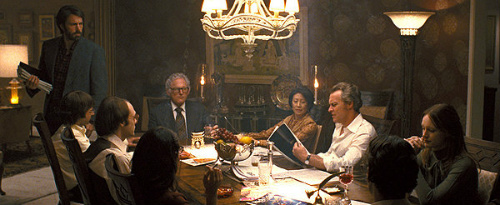
Ben Affleck's latest drama, Argo, is set in 1979-80 during the Iran Hostage Crisis. The first moments of the film establish the setting for us with a quick look at the country's recent history (and the U.S. involvement in it) preceding the attack, and then we are thrown into the protests leading to the attack on the American embassy in Tehran. Argo is practically tension-filled from these first glimpses of protest until the last few minutes of the movie.
As the embassy is overtaken, six American employees escape and are taken in by a Canadian diplomat (Victor Garber). While the rest of the embassy employees are front-page news as hostages, the CIA and State Department quietly work on ways to get the six out of Iran. Exfiltration ("exfil") expert Tony Mendez (played by director Affleck) comes up with the idea of claiming these Americans as Canadian filmmakers checking out Iran as a possible setting for a sci-fi pic named "Argo." A bizarre notion to be sure, but it's "the best bad idea" of the bunch the government was considering.
With the approval of his boss Jack O'Donnell (a craggy-faced Bryan Cranston), Mendez meets up with Hollywood make-up artist John Chambers (John Goodman) and producer Lester Siegel (Alan Arkin) in LA and they start a plan in motion. Goodman and Arkin's scenes add just the right amount of levity to the otherwise taut Argo.
Review: Taken 2
 It's one thing for a movie to be bad. That happens. It's the risk you take when you take the time to venture out of your home and into the streets of your city. A bad movie can be forgivable most of the time, a lot of effort goes into filmmaking and most civilized moviegoers realize that. Sometimes it's kind of a cop-out to label a movie with a one-word descriptor, but if ever a movie could be described in a single word, it would be Taken 2, and that word would be "lazy."
Taking place a couple of years after the events in the 2008 movie Taken, we find that Brian Mills (Liam Neeson) is still being overprotective -- although, after the first film, maybe just appropriately protective -- of his young daughter Kim (Maggie Grace). His ex-wife Lenore (Famke Janssen) tells him to back off slightly -- everyone is grateful for him having saved Kim's life, but they each need to move on in their own way. And hat better place to move on than returning to Europe, where the surviving family members of the criminals Brian killed in the first film are plotting their revenge? Sure enough, kidnappings happen, and Liam Neeson gets to do what he does best.
After the dreadfully long first act, once the action finally takes place, it's just stale. The action never feels tense, the writing is horrible, the action is shot so close that you can't discern anything happening.
That's the generalized statement of how bad Taken 2 is. For more specific criticisms, the situations unfolding onscreen are so mind-numbingly dumb, it's a wonder anyone greenlighted the screenplay. We have Kim -- you know, the kidnapped victim from the first film who should be in some way permanently traumatized on a non-functional level -- put in a position where she isn't kidnapped this time. Instead, she has to help her father figure out where he's been stashed because both he and his ex-wife have been taken. He instructs her to detonate grenades all over Istanbul so he can figure out how far away and from what direction she'll be coming from.
In addition, Kim also inexplicably is still young enough to be an inexperienced driver even though she is clearly 30 years old. Yet she is also given the task of leading a high-speed chase through busy streets and causing all sorts of destruction with no penalty.
Review: The Oranges

There is an old saying: "Show me a family, and I will show you dysfunction." Human beings living in close proximity are a formula for dysfunction, and The Oranges kicks open locked doors so we can take a look at this ailment firsthand.
The Oranges tells the story of two families, the Wallings and the Ostroffs, across-the-street neighbors in the small suburban town of Orange, New Jersey. One holiday season Nina Ostroff (Leighton Meester) returns home after a rough breakup with her fiancé and is thrown into the fetid routine she tried to escape. Almost immediately, Nina's mother attempts to set her daughter up with the dashing Toby Walling (Adam Brody). Things don't go as planned with Toby, and Nina finds herself falling for the head of the Walling clan, David Walling (Hugh Laurie). This is where a new level of dysfunction is reached. This "Lolita"-like relationship threatens to break apart decades of marriage and close friendships. We have The Oranges.
Review: Hello I Must Be Going

Where have you been, Melanie Lynskey? Lynskey and Kate Winslet co-starred in Heavenly Creatures in 1994, and while Winslet's career has been extremely easy to follow, Lynskey has been a challenge to find on the big screen. She had a delightful role in Ever After, but then made sporadic and brief appearances as The Wife or The Girlfriend or in Up in the Air, The Sister. There have been few chances to see her in a lead role until now, with Hello I Must Be Going, and her performance is so strong that it seems ridiculous she isn't in the lead more often.
Lynskey and Blythe Danner carry Hello I Must Be Going -- they take a storyline that often treads familiar ground and blow it out of the water with two amazing performances. Lynskey plays Amy, a thirtysomething woman living -- excuse me, staying -- with her parents after a very messy divorce. Her mother (Danner) badgers her to buy more clothes, go out on dates and perhaps even take an antidepressant. (The movie may be worth watching just to hear Danner pronounce "antidepressant" as thought it were French.)
Review: Won't Back Down

When I was in elementary school and middle school, we were shown movies like Stand and Deliver or Lean on Me in class. These 1980s-era films were inspired by real men who worked within the strains of the educational system to make a difference. Somehow, although this movie says it's "inspired by real life events," I doubt Won't Back Down will enter this canon. School reform is a touchy issue for many, especially within our current political climate when Wisconsin's governor signs an anti-union law, and Chicago teachers strike.
In Won't Back Down, single mother Jamie (Maggie Gyllenhaal) frets over the way her dyslexic daughter is being taught in her local public school. Which is to say, she's basically not being taught. The girl's teacher leaves a shopping website open on her desk computer, plays with her cell phone during school and punishes kids by not letting them go to the bathroom. My history teacher friend referred to this character as the "Col. Tavington" of this film (that's a reference from The Patriot). She's so despicable that she's unbelievable. This teacher is tenured, and can't be fired in the current school setup. The principal won't let Jamie transfer her daughter to another class, so she's stuck.
Meanwhile, teacher Nona (Viola Davis, who I think is wonderful in anything) is frustrated by her son's slow learning style. Nona and her husband Charles (Lance Reddick, Fringe holla!) are mutually disappointed with each other, and she's pretty much given up in her classroom. She and Jamie meet and eventually team up in an attempt to turn their school around.
Review: Pitch Perfect
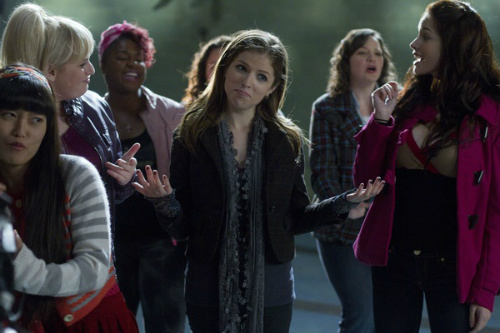
Barden College must be the ultimate blow-off school. This fictional institution is the setting for Pitch Perfect, and none of the main characters seem to attend any classes (although I did catch a quick glimpse of one character reading a textbook). For our protagonists in this musical, college is all about a cappella.
Oscar nominee -- and Tony Award nominee, lest you doubt her singing chops -- Anna Kendrick (Up In the Air) stars as Beca, an angsty newcomer to Barden. Her hobby is creating audio mashups, and her dream is to be a DJ/record producer. Her dad, a professor at Barden, is making her attend the school for a year before he'll finance any trip to L.A. Dad tells her to get involved with some campus activity, so she auditions for the Barden Bellas, the all-girl a cappella group.
Her new friend/obvious love interest Jesse (Skylar Astin, who was in Spring Awakening on Broadway) makes it into the Treblemakers (puns, this movie haz them), the award-winning male singing group led by the annoying Bumper (Adam DeVine). The feud between the Barden Bellas and the Treblemakers is the main conflict of Pitch Perfect. Will the relationship between Jesse and Beca survive the antagonism between their groups? Of course it will. This movie isn't really breaking any new ground here.
Fantastic Fest Review: Looper
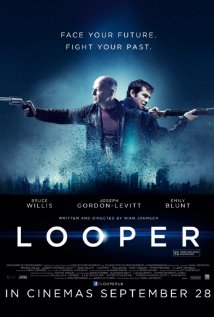 If you haven't already seen Brick or The Brothers Bloom, then Looper is certainly a great way to introduce yourself to writer/director Rian Johnson. A frequent visitor to Austin, Johnson premiered Looper before a Fantastic Fest audience on Sunday night at the Alamo Drafthouse, the same location where he introduced The Brothers Bloom in 2007.
Looper is an unusual combination of sci-fi action and thought-provoking drama. This duopoly is fitting for the story, in which Joseph Gordon-Levitt plays an assassin, aka a "looper," who must execute his older self -- portrayed by Bruce Willis -- as a condition of his employment and continuing survival, a task known as "closing the loop."
With a team of his fellow assasins hunting him, young Joe's only hope to survive and enjoy the wealth he has saved is to complete his mission, but his older self also has a mission to preserve the life he has lived. As he faces himself, young Joe is decisive and quick to act, with the advantage in the knowledge that he can't be killed by his older self. Old Joe, however, has the benefit of 30 years of training and experience as well as memories, though they are in a state of flux caused by his presence in the past.
Though time travel is essential to the existence of this story, it is not a hardcore time travel story. Old Joe speaks on behalf of Johnson to the audience when he says, "I don't want to talk about time travel!" If you pick it apart, Looper could unravel, but a deep exploration into the effects of changing the timeline isn't the story Johnson wants to tell.
Old Joe is no android sent back to ensure the destruction of humanity. He's absolutely human and operates based on ultimately humane motives. Even Abe (Jeff Daniels), the head of the Looper organization, is not a malevolent agent. He has chosen and fostered unwanted young men who would otherwise face a short life of poverty, providing a father figure to them. Technology and time travel serve only as enablers for the human elements of the story.
Review: Trouble With the Curve
 Clint Eastwood talked to an empty chair at the Republican National Convention this summer. He begins his new film, Trouble With the Curve, talking to a toilet ... so maybe that was his idea of a clever marketing campaign. Aside from that oddity, the movie is actually a fun, sometimes sober, oddball look at growing older and coming to terms with past regrets.
Penned by first-time writer Randy Brown, Trouble with the Curve is directed by Robert Lorenz, likewise sitting in the director's chair for the first time, though he has assisted on many films.
The story, which could be called an answer to Moneyball, centers around Eastwood's character Gus. An aging baseball scout, Gus operates in a technology vacuum, making him a target for ladder-climbing Phillip Sanderson, played true to type by Matthew Lillard. With the end of his contract nearing, Gus embarks on what may be his last scouting trip.
Fearing for Gus, best friend Pete (John Goodman) asks Gus's daughter Mickey (Amy Adams) to accompany her dad on his scouting trip. She takes a break from her law practice to join him, and they soon encounter Johnny (Justin Timberlake), an old recruit of Gus's who is now a scout himself. The story then splits its focus as it explores a budding romance between Mickey and Johnny as well as the tensions between Gus and Mickey.
Trouble with the Curve is a solid, fun film that doesn't try to make any big statement other than perhaps "Growing old sucks, so you'd better make the best of it." Eastwood seems to be having fun with the role, knocking one-liners out of the park. The cast includes a number of other notable character actors including Chelcie Ross, Bob Gunton, and Robert Patrick. Look also for Clint's son Scott Eastwood, who appears in a scene with his father.
But it is Amy Adams who carries this picture. Lovely as ever, the Oscar-nominated actress is at the center of both storylines in Trouble with the Curve, essentially performing in both a romantic comedy and a light drama.
Review: Dredd 3D
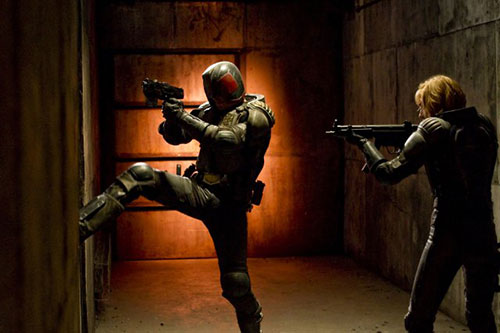
Movies based on comic-book characters can run the gamut from campy to straight action, and often have the greatest critics within the comic fanbase. British science-fiction anthology 2000 AD's best known and longest-running fictional character is Judge Joe Dredd, a law enforcement officer in Mega City One, a violent post-nuclear city that stretches from Boston to Washington. Chaos reigns within the streets, and drones are used to target suspects. With so many crimes occurring every minute, law enforcement officers have been given the title of "Judges" with the authority to arrest, sentence and exact punishment -- whether condemned to iso-cubes or executed on the spot.
Dredd 3D features Judge Dredd (Karl Urban) as he assesses rookie Anderson (Olivia Thirlby), who despite her marginal scores on the judge aptitude exams is a highly desirable candidate due to her psychic abilities. A "routine" call to investigate a homicide scene in the Peach Trees block becomes a fight for survival as the two judges stumble into a drug turf war. People are addicted to a new drug, Slo-Mo, which makes the user feel as if time has slowed down to an ultra-slow speed.
Three gangs struggle for control of the Peach Trees block, but it is the ruthless ex-prostitute and drug lord Ma-Ma (Lena Headey) and her gang who reign in the 200-story vertical slum. When Judge Dredd and his trainee attempt to leave the complex with a pivotal member of Ma-Ma's clan, the pair become trapped within and marked for execution by Ma-Ma. The residents of Peach Trees eagerly become vigilantes in order to be allowed out of the locked-down complex by killing the judges on the run.
Review: End of Watch

David Ayer is the master of creating movies that explore the seedy underworld of police corruption. Ayer’s genesis of Detective Alonzo Harris in Training Day was genius enough to help Denzel Washington win an Academy Award. With End of Watch, Ayer takes us on an exploration of the white-hat side of law enforcement -- we get to hang out with the good guys this time.
End of Watch follows the life of Brian Taylor (Jake Gyllenhaal) and Mike Zavala (Michael Peña), two run-of-the-mill beat cops who patrol one of the rougher neighborhoods in South Central Los Angeles. Taylor and Zavala find themselves in the crosshairs of a Mexican drug cartel after they arrest one of its members transporting narcotics and firearms.
