

New Releases
Review: Keep The Lights On
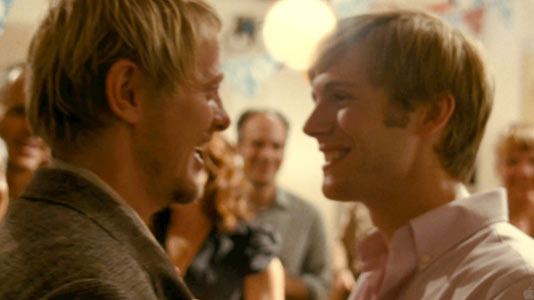
"Hello. What's up?" the protagonist of Ira Sachs' new feature film Keep The Lights On whispers into the phone to an unknown man on a sex chatline. After repeating the same lines to the same faceless souls desperate for human connection, Erik Rothman (Thure Lindhardt) finds what he thinks he has been looking for in Paul Lucy (Zachary Booth).
Keep The Lights On follows Erik and Paul's journey of mutual and self-discovery beginning in 1997 in New York City. Their relationship is tested by drug, alcohol and sex addiction, playing like a broken record (or the film's similar-sounding, albeit enjoyable soundtrack) over the course of a decade.
AFF Review: Flight
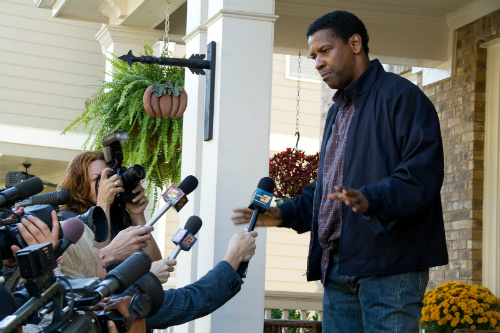
Movies like Flight are why reviews are necessary. I had seen the trailer and expected the film to be a legal thriller: what happened to the plane Denzel Washington's character pilots to cause it to crash? And how was he able to land it with only a small number killed in the process? Well, the laugh was on me, because you discover the answers to these questions in the first 30 minutes of the movie. Instead of being a thriller, Flight -- which screened at Austin Film Festival and opens in wide release Friday -- is a drawn-out drama about alcoholism.
The movie kicks off with the Barenaked Ladies song "Alcohol," which pretty much tells you what you need to know about this movie. All the late-1990s music in the soundtrack had me wondering if the movie really was based in the 21st century. Pilot Whit Whitaker (Denzel Washington) lounges in a hotel bed, chatting on a cell phone as his flight attendant ladyfriend (Nadine Velazquez) walks around s-l-o-w-l-y getting dressed for the day and lighting up a joint. Whit finishes up a beer, snorts some coke and walks to his plane as Joe Cocker's "Feelin' Alright" plays. And then disaster strikes, and Whit is able to overcome it.
Review: Cloud Atlas
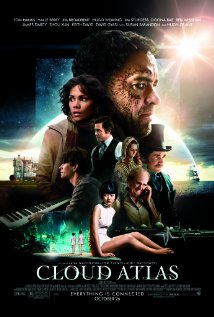 Last year critics hailed Hugo as a "love letter to film." This year, you could say Cloud Atlas is a love letter to love and human relationships. Filmmakers Andy and Lana Wachowski and Tom Tykwer have adapted a book it was thought would be impossible to bring to the screen, and in so doing crafted a masterpiece many are calling the year's finest film.
Spanning centuries, six stories are woven together as souls reborn into new lives play out adventures, love stories and tales of treachery. Each tale is linked to the next by a message in the form of a diary, love letters ... even a screenplay. Together, thanks to a monumental work of editing, the synchrony between each story becomes apparent, and the whole truly is greater than the sum of its parts.
A mentor tells me that a film critic should only write about what's on the screen, but that pre-supposes a film can be left behind when you leave the theater. It makes no allowance for the effect a movie has on the audience and thus eliminates half of the equation. Film is an art form and thus a communication between the filmmakers and the audience. Therefore, knowing the background of the filmmakers, the context of this communication, can help the audience better understand this message.
There is no shortage of Lana Wachowski's personal struggle visible in Cloud Atlas, where the actors are chameleons playing characters of different ages, races and sexes from one scene to the next. This is done with such effectiveness that not only is it difficult for the audience to recognize actors, they reportedly did not always recognize each other on set. Tom Hanks is always recognizable, as is Hugo Weaving, but Halle Berry, Jim Broadbent, Jim Sturgess, Doona Bae, Ben Whishaw, James D'Arcy, Keith David, Hugh Grant and even Susan Sarandon turn up in surprisingly unexpected places.
Review: Chasing Mavericks
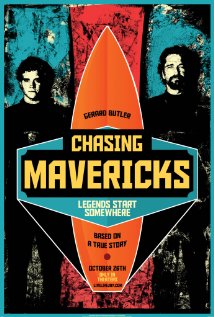 Chasing Mavericks chronicles the heroic efforts of a teenage surfer to prepare himself for challenging the "mythic" wave known as Mavericks, and the father-son bond with his mentor that develops. Poignant and inspirational, it is a solid family film that tugs the heartstrings. Written by Kario Salem and directed by Curtis Hanson (8 Mile, LA Confidential), the movie is is based on the true-life story of Jay Moriarty, who became world famous when his attempt to surf Mavericks landed him on the cover of Surfer magazine.
Jonny Weston (John Dies at the End) closely resembles his character Jay, a blonde-haired blue-eyed proverbial golden boy obsessed with surfing. Abandoned by his father and raised by an alcoholic mother, Jay is forced to grow up early, even working to help pay the bills. His love of surfing leads him to the company of his neighbor Frosty Hesson (Gerard Butler), a roofer who spends every free moment surfing 30-foot waves in a hidden location. In Frosty, Jay finds a father figure, and through this relationship Frosty finds a resolution for his own issues dealing with the death of his father at a young age.
This bond between them is the center of Chasing Mavericks, which only briefly involves other characters. Elisabeth Shue plays Jay's mother Kristy, whom we hardly see but as his only family is the most important person in Jay's life. Abigail Spencer (Mad Men, Cowboys and Aliens) appears as Frosty's wife Brenda, who encourages their relationship and also encourages Frosty to stop surfing such dangerous waves before he leaves their child without a father. Finally, Leven Rambin (The Hunger Games) is Jay's childhood sweetheart Kim, the only thing he's more in love with than surfing.
Beautifully shot, Chasing Mavericks could inspire many children to become surfers. It's pleasant and relaxing (except when you find yourself counting to see how long you can hold your breath along with Jay). Fully family friendly, there isn't even strong language or strong conflict.
Review: The Paperboy
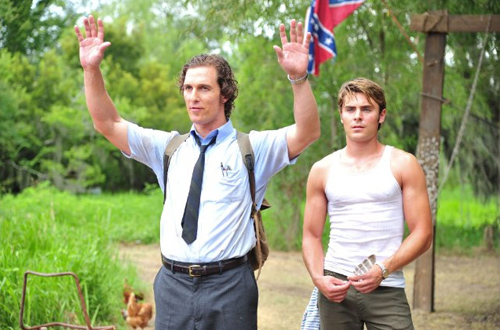
Filmmaker Lee Daniels's follow-up to the astounding Precious is, well, no Precious -- but The Paperboy may be just as memorable, if partly for the wrong reasons.
The Paperboy is an odd beast, a sweaty, gritty, bloody mashup of visual lyricism, noir clichés, social commentary and gratuitous everything. The film is nothing if not unique; not many movies combine an underwear-clad Zac Efron, retro split-screen effects, alligator guts and discussions of journalistic integrity. The problem is that The Paperboy doesn't combine these elements -- and so many others, many of them a bit off-putting -- terribly well. It's an intriguing story wrapped in sometimes ridiculous packaging.
Based on a novel by Peter Dexter, The Paperboy takes us back to 1960s Florida, where Miami newspaper reporter Ward Jansen (Matthew McConaughey) returns to his small and swampy hometown to chase a story about a sensational murder. With the help of his partner, Yardley Acheman (David Oyelowo), Ward tries to prove that career felon and death row inmate Hillary Van Wetter (John Cusack) was framed for the local sheriff's murder.
Review: The Revisionaries
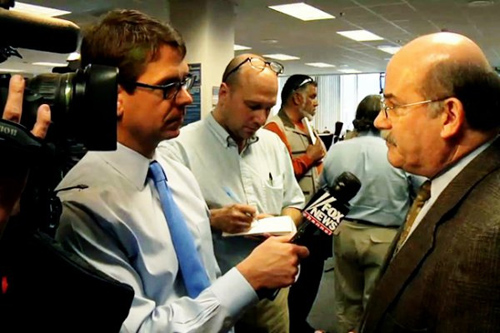
The Revisionaries is yet another documentary I find difficult to review. Like last year's gripping Incendiary: The Willingham Case, The Revisionaries is so politically charged -- and so completely infuriating -- that it's hard to set aside my political beliefs and objectively review the film's cinematic qualities.
I'll do my best to be objective, but I'm sure my political views will sneak into this review at some point. Don't say I didn't warn you.
The Revisionaries takes a generally painful look at the Texas State Board of Education, long notorious as a haven for extremely conservative Christians whose mission is to rewrite textbooks to reflect their beliefs in creationism, America's Biblical origins, sexual abstinence, unregulated free enterprise and so on. A clever lot they are, hoping to win the culture wars over the long term by influencing what children learn in classrooms throughout Texas.
Review: Paranormal Activity 4
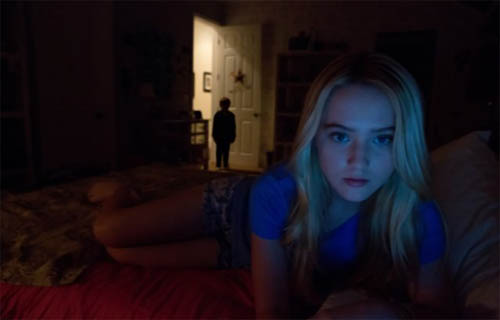
It's October, and there are no more Saw movies to occupy our ritualistic annual watching of horror movies, but we do have the Paranormal Activity franchise. The franchise up to this point has certainly been intriguing, and it turned the horror genre on its head in 2007 when it unexpectedly scared audiences in droves. The simplistic story has evolved into an intriguing tale of demonic possession that dates back to the childhood years of the people involved, specifically Katie (Katie Featherston) and her nephew Hunter. Paranormal Activity 4 at first doesn't seem like it will have anything to do with the previous three movies. It takes place in a different city and years after the events of the second film (the third film was a prequel).
It begins innocently enough, as these films often do. Alex (Kathryn Newton) is your typical 15-year-old teenage girl. She has fun filming everything with her camera and is a very responsible big sister to her adopted brother Wyatt. One day, while her and her boyfriend Ben (Matt Shively) are touring Alex's backyard, they encounter the strange boy from across the street, Robbie (Brady Allen). Robbie is quiet and awkward, and when his mom has some sort of accident across the street, he has to stay with Alex and her brother for a few days. That's when strange things start happening.
Review: Alex Cross
 "Tyler Perry should probably stick to comedy," was my initial reaction to his first feature performance in a dramatic role. With Alex Cross, director Rob Cohen (Dragonheart, xXx) delivers a cinematic weak tea. Based on the James Patterson novel Cross, this unremarkable film plays like one of Will Smith's rejected scripts.
Perry's performance is by no means the worst part of the movie. Cohen's use of shaky-cam here rivals J.J. Abrams' obsessive overuse of lens flare. A warning to anyone prone to motion sickness should be presented upon purchase of a ticket. Many scenes -- even non-action scenes -- look like they were shot from a helmet-cam worn on top of Richard Simmons's head. This spoils the view of some really interesting locations.
The showstopper, though, is Matthew Fox, who underwent an intense regimen of mixed martial arts to physically transform himself for a film that barely shows the results. He will be remembered for his role in Alex Cross as one of cinema's most absurd villians, known only as Picasso, a man who literally gets off on watching other people suffer. Fox alternates between a bug-eyed expression akin to someone suffering constipation when he's supposed to be angry (or thoughtful or anything else) and a disturbing beatific closed-eyes smile as if experiencing the big "O" moments after hearing someone scream in pain.
The script sets up the inevitable fight between these two characters: the aforementioned Picasso, a super-assassin who is supposed to be undetectable and untraceable, and Alex Cross, a super-detective who is supposed to be able to "tell you had scrambled eggs for breakfast from 100 yards away." But instead of a cat-and-mouse game, it's more like cat-and-cat food. Cross never has to struggle to track down the world's greatest assassin, who then has no trouble locating the hero and situating himself in a hotel room across the street with a sniper rifle anytime, day or night.
Review: Here Comes the Boom
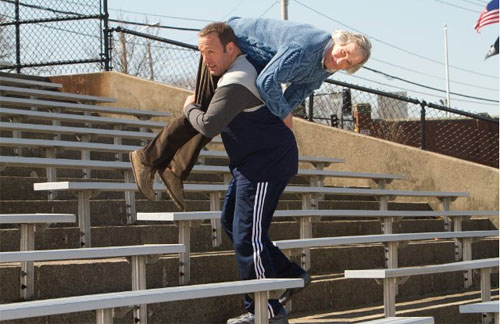
Actor Kevin James has starred in some pretty terrible movies. It's a shame that he's become a part of the Happy Madison team that has wantonly doled out dreck film after dreck film. He's a comedic actor that has some real talent, and he's capable of being physically funny while maintaining a sense of boyish vulnerability. Here Comes the Boom, which he also co-scripted, is the closest James has come to making a good film, and in it, he exhibits some of the strengths mentioned earlier. The trouble with Here Comes the Boom is that it has way too much of that Happy Madison brand of comedy, so any goodwill the film builds is diluted.
Middle school teacher Scott Voss (James) isn't a very good teacher. He rides the coattails of a Teacher of the Year award he won ten years ago and is a constant thorn in the side of school administrators with his tardiness and indifference. He's got one friend in the music teacher Marty Streb (Henry Winkler). When Marty gets in a potential financial bind, and it looks like the school is going to cut the music program, thus putting Marty out of a job, Scott valiantly stands up for what's right and declares that the teachers will help raise the money together. While trying to raise money, he befriends a former MMA fighter and enlists his help to train him to raise money in an incredibly dangerous and irresponsible way.
Review: Seven Psychopaths
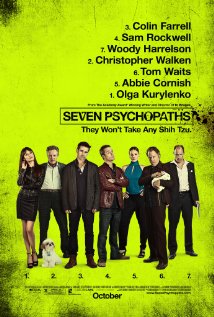
Seven Psychopaths, opening this weekend, is the second feature from writer/director Martin McDonagh (In Bruges). A hilariously dark comedy, the story revolves around Marty (Colin Farrell), a screenwriter caught up in a chase over a mob boss's stolen shih tzu. An alcoholic drinking himself into forgetfulness every night, Marty reluctantly accepts the screenwriting help of his friend Billy (Sam Rockwell), who happens to be a professional dog thief. Together they chronicle the ensuing shenanigans -- both writing, and narrating, the movie in which they're characters.
To detail the ways in which the rest of the characters are inroduced would be far too revealing of the plot. It should suffice to say that each player in this self-referential and often self-mocking movie connects in unique, interesting, and generally hilarious ways. While it's popular of late to cast well known faces against type, everyone here is decidedly playing himself, or in the case of Christopher Walken, an exagerrated version of himself. Among several subtle nods to their prior roles, I found references to Walken's part in The Prophecy particularly on the nose.
Woody Harrelson pulls off a unique performance as a completely bad-ass and at once equally pathetic mob boss who accounts for 50 percent of the comedic material in Seven Psychopaths. The other 50 percent being, of course, Sam Rockwell, and an entirely sublime additional 100 percent from Tom Waits' brief appearance. The female characters are poorly written, however, with nothing to say except one or two one-liners before they're killed.
The one exception is Linda Bright Clay as Walken's wife. Trapped in a hospital and dying of cancer, she receives daily visits from husband Hans (Walken). Her strong, resigned dramatic performance defines the matte against which McDonagh places the film's more ludicrous scenes, masterfully contrasting real life against the farce with which he has enveloped the audience.
Just as the script of Seven Psychopaths mocks itself, it likewise mocks the genre tropes on which it's built, giving viewers what they have been programmed to want to see and then yanking the rug out from under them and feeding them something completely different. The tone brings Quentin Tarantino to mind, but only in the vaguest sense. This is something wholly its own.
