

New Releases
Review: Bridesmaids
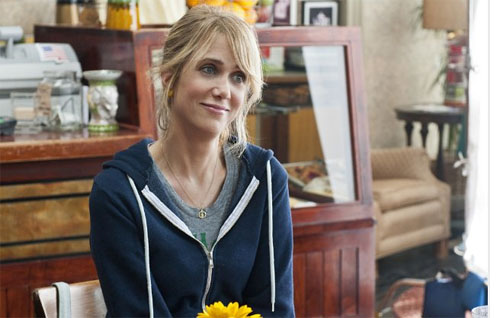
I'm resisting the very strong urge to write "OMG COMEDY WRITTEN BY SMART WOMEN GO PAY TO SEE IT THIS WEEKEND GO GO SO WE CAN HAVE MORE NOW NOW GO NOW." Let's face it -- we don't get many smart comedies written by women and starring women. Women are supposed to make do with comedies with a sexist and mean undertone, or ridiculously cliched melodramas, or those "women are all sisters" movies with bonding over shopping and/or Motown dancing scenes.
Bridesmaids has shopping and female friends being ridiculous and even wedding planning, all things that would normally have me running away as far as possible and begging someone else to please review the movie because I would rather clean the cat's butt than watch such a thing (unless it was made in the 1930s, but they understood wit back then). However, writers Kristen Wiig and Annie Mumalo have teamed up with director Paul Feig and producer Judd Apatow to bring us a comedy about women that is primarily meant to make us laugh, and secondarily meant to have strong and realistic female characters in it, and the result may not be perfect but it's damned refreshing.
Review: Everything Must Go
When it comes to choice of roles, Will Ferrell and Tom Cruise share something in common. They regularly choose roles that are safe and play in a limited range. In a Tom/Will movie Tom is Tom and Will is Will. But every once in awhile they break from their self-created molds and pick roles that color outside of the lines. For Cruise, the roles that color outside the lines include Frank T.J. Mackey in Magnolia and Les Grossman in Tropic Thunder. For Ferrell, the role of Nick Halsey in Everything Must Go is his departure from a typical Will Ferrell movie.
Nick Halsey is having a particularly bad day: Fired from his job, returns home to find all his worldly possessions strewn across the lawn ... and to add insult to injury, the locks to his house have been changed by his wife. But his misery doesn't stop there. I won't go into details. Let's just say that more bad stuff happens.
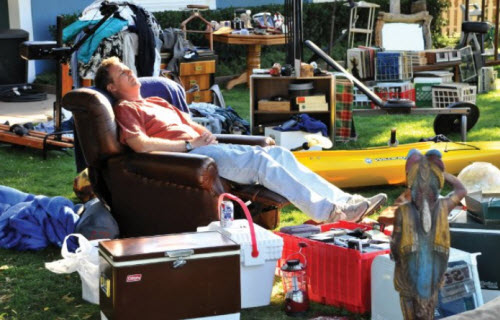
After these initial tragedies, Nick gets drunk on PBR (Pabst Blue Ribbon) Tall Boys and eventually crashes on the front lawn of his house in a recliner. Having nowhere else to go, he sets up shop on the front lawn. In a normal Will Ferrell movie this is the point where we get silly slapstick comedy laced with filler to take us to the next comedy skit. Not this time. Ferrell does a commendable job of showing the despair of a man that has just lost everything. He carries this emotional thread throughout the movie.
Review: True Legend
The name Woo-ping Yuen may not sound familiar to general filmgoers, but you don't have to be a martial-arts film fan to have witnessed Master Yuen's contribution to the action movie industry. Best known to the general populace for his contribution to The Matrix and Kill Bill series, Yuen is an international legend due in part to his action/fight choreography and martial arts direction. He's often credited with playing an integral part in action/martial arts star Jackie Chan's career by casting and directing him in the 1978 classic martial arts film Drunken Master.
One would think that with over 40 years of experience under his belt, the 65-year-old Yuen would be ready to rest on his laurels -- not so, as he returns to the director's chair for the first time in almost 15 years with True Legend, a Fantastic Fest 2010 selection that returns to Austin on Friday for a theatrical run at Alamo Drafthouse on South Lamar.
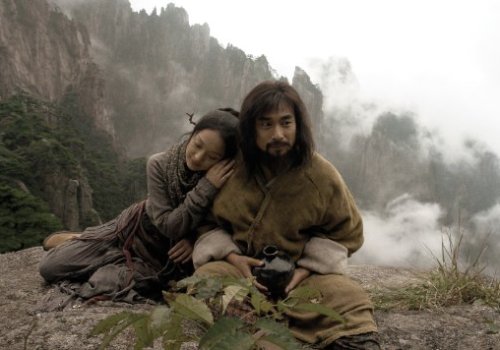
True Legend presents the "Chronicles of Wushu Masters: Beggar Su" in three parts. The short but remarkable intro shows how how Su Qi-Er (Man Cheuk Chiu), a renowned Qing dynasty general, saves a prince in a decisive battle. Su is offered the governship of a province, but he declines and turns over his troops to his foster brother, Yuan Lie (Andy On) instead. Su plans to retire from the military so he can start a family with his wife Yuan Ying (Xun Zhou) -- who is Yuan Lie's sister -- and open his own Wushu martial arts school.
Review: There Be Dragons
 In recent years, the Spanish Civil War has featured in a number of great movies, Guillermo del Toro's Pan's Labyrinth and The Devil's Backbone among others. To an American audience with little or no education on the subject, it can be difficult to follow or understand when the armies aren't wearing blue or gray. A few minutes reading the Wikipedia entry can be most helpful in at least providing a frame of reference.
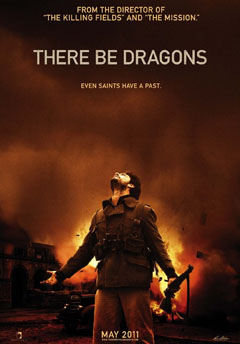
There Be Dragons, written and directed by Oscar-nominated director Roland Joffé (The Killing Fields, The Mission) follows two childhood friends in separate stories through the events of the war. Based on the true story of St. Josemaría Escrivá, There Be Dragons presents the founding and philosophy of Opus Dei, the organization he founded within the Catholic church (and which was depicted negatively in The Da Vinci Code).
Dougray Scott as Robert is researching Father Josemaría Escrivá (Charlie Cox) and learns that his estranged father Manolo (Wes Bentley) was not only from the same town, but had also briefly attended divinity school with the saint. After eight years of silence, Robert returns home to Spain to hear his father's story, including several unpleasant surprises (the figurative dragons from the title).
There Be Dragons begins with the unattributed quote "Every saint has a past, and every sinner a future," which neatly describes the plot and dichotomy between Manolo and Josemariá. In one of the ugliest periods of world history, I found the story of Josemaría more captivating (and the film dedicates more time to this story and the philosophy of Opus Dei) while the military path followed by Manolo was darker, more violent and disturbing. In the end, the stories reunite in a way that is almost touching enough to bring a tear to one's eye.
Review: Something Borrowed
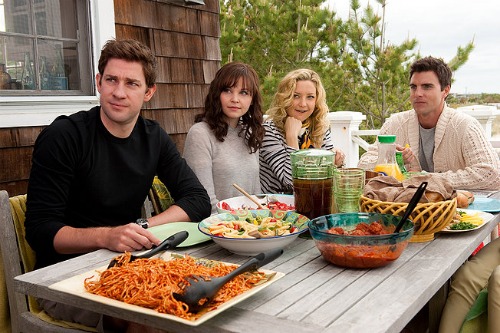
Something Borrowed is based on Emily Giffin's 2005 bestselling novel about old friends, romance, and betrayal. I likely wasn't the only one in the theatre for the screening who had read the book a few years back and forgotten it soon afterwards (although during the film, I did keep thinking about the book's sequel).
Rachel (Ginnifer Goodwin) and Darcy (a lively Kate Hudson) have been best pals since childhood. They love each other because they always have. We as viewers aren't exactly clear on why they are still friends, since they have little in common except love for Darcy's fiance, Dex (Colin Egglesfield, All My Children), but we'll come back to that. In Rachel's law office, a sampler hangs on the wall with the "Make new friends, but keep the old..." saying on it. She can't give up old friends, even if they are inconsiderate, selfish and slightly obtuse. She is just that big of a person.
Review: Thor
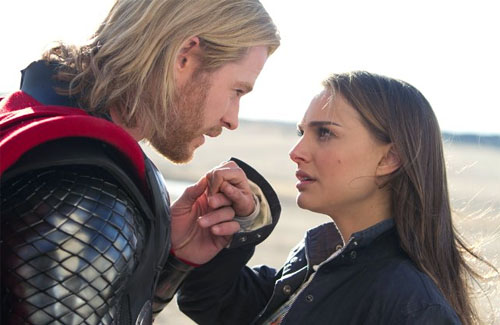
I remember first hearing Marvel was planning a series of films leading up to The Avengers some time around April 2008, just before the first Iron Man. I thought to myself "Huh, that's interesting," but had little other reaction. Iron Man proved an astounding success, taking what was to my mind one of the less-spectacular of Marvel's titles and giving it the star treatment. Robert Downey Jr. brought Tony Stark to life in a way that made his time outside the suit almost, if not more, interesting than his time in it.
Then later that year I refused to watch Hulk, because I thought it looked like a rehash of the 2003 Ang Lee version. (And finally after watching it this weekend, I'm convinced I was right. Hulk fights another Hulk at the end of both films.) Until Iron Man 2 was released last year, I didn't give much thought to The Avengers. Then, just a glimpse of Captain America's shield, and the teaser with Thor's hammer at the end, my imagination was captured, and I began to believe they would manage to pull it all together and create something great.
Now I have seen Thor, and I am completely enthusiastic about The Avengers and the rest of the films leading up to it. Kenneth Branagh has directed a show worthy of sitting on the shelf next to both of the Iron Man films and the rest of your favorite superhero titles. It may well prove to be his most popular movie.
Review: The Beaver
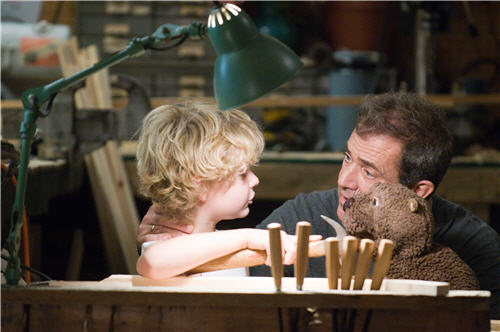
Despite the pun-magnet title, The Beaver is an unexpectedly dramatic film that succeeds in part because of -- and at times despite of -- its star.
When Walter Black (Mel Gibson) has a midlife crisis, he implodes more spectacularly than the average person. But Walter isn't an average person; he has a beautiful house, a beautiful wife Meredith (Jodie Foster), two children (Anton Yelchin, Riley Thomas Stewart) and a big family business that many would envy. Yet he cannot manage any of it and it slips away out of his unclenched grasp.
Instead of finding his inner child when he finally rallies, Walter creates the distance he desperately needs as well as the momentum to start moving forward through an alter-ego in the form of a old beaver hand puppet. Those around him seem to control their misgivings to different degrees, with his teenage son (Yelchin) clearly resenting it, his wife somewhat appalled but desperate to get her husband back, and the younger son who embraces it with the resiliency most kids show.
Review: Meek's Cutoff
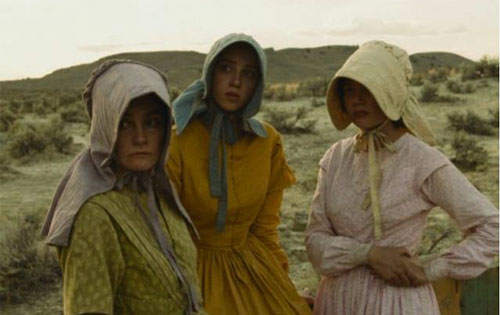
The Oregon most of us picture -- a place of lush forests and rugged coastline -- is not the Oregon of Meek's Cutoff. The film's setting is the scrubby and inhospitable desert in the state's southeast corner, which has more in common with neighboring Nevada than with green and rainy Portland.
But the unexpectedly arid and empty Oregonian vistas in Meek's Cutoff are totally appropriate, for the movie itself -- with its glacial pacing and thoroughly indie sensibilities -- is not what most moviegoers expect in a period Western. The latest movie from Kelly Reichardt (Old Joy) undoubtedly will try the patience of anyone looking for traditional horse opera shoot-'em-up action and moral clarity ... or, for that matter, anyone seeking an actual plot. But in its own rarely seen universe -- the lonely universe of meditative, character-driven Westerns -- Meek's Cutoff is greatly provocative and rewarding.
Meek's Cutoff is morally complex but structurally simple, following a small group of weary settlers crossing Oregon in 1843. From the film's onset, it's apparent that the group is hopelessly lost. Thanks to their guide, the ill-tempered and unlikeable Stephen Meek (Bruce Greenwood), they've taken an unmapped detour from the usual settlers' route. After travelling for several days with no idea how to reach their destination (an ambiguous locale somewhere west of wherever they are), their most immediate problem is their rapidly dwindling water supply.
Review: Legend of the Fist: The Return of Chen Zhen
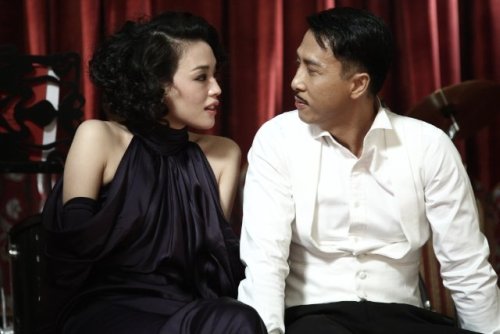
Fantastic Fest 2010 selection Legend of the Fist: The Return of Chen Zhen (Jing wu feng yun: Chen Zhen) is back in Austin on Friday night at Alamo Drafthouse Village. The movie brings together history with amazing action sequences and stunning sets of Japanese-occupied Shanghai during the First World War to re-invent the tale of a cultural hero, played by action star Donnie Yen (Ip Man). Director Andrew Lau (Infernal Affairs) attempts to serve up more than the usual martial arts action porn with a complex storyline featuring nationalism, brotherhood, espionage, romance and superheroes.
Yen portrays the legendary Chen Zhen, a character created by Bruce Lee in Fist of Fury and later portrayed by Jet Li in Gordon Chan's acclaimed 1994 remake Fist of Legend. Yen himself has played the character in a 1995 TV series. For Legend of the Fist, Yen teamed with writer/producer Gordon Chan and director Lau to continue the story of Chen Zhen as a World War I veteran, resistance fighter and masked superhero.
Zhen's heroism precedes the war, when as a member of the Jing Wu Athletic Association he defeated a formidable Japanese opponent at the Hongkou Dojo. In France in 1917, he and his fellow laborers carry ammunition to French soldiers in trenches, and during a climactic retreat, Zhen rescues both his fellow patriots and French soldiers as well. When a comrade is killed, he assumes his identity in order to gain anonymity.
Review: Even the Rain (También la lluvia)
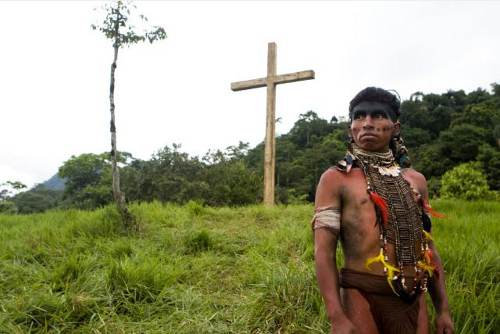
If today's political activists are seeking inspiration from history, they should look no further than the 16th-century Spanish historian, social reformer and Dominican friar Bartolomé de las Casas. As one of the early Spanish settlers in the West Indies, Las Casas participated in many of the atrocities -- slavery, torture and murder -- the settlers committed against the indigenous peoples. But Las Casas later saw the error of his ways, gave up his slaves, and devoted his life to fighting for the rights of the Indians, whom his fellow colonists considered less than human. Through his writings and activism, Las Casas is considered one of the first advocates for universal human rights.
Sadly, Las Casas probably would be very disillusioned by the state of today's world, where oppressed peoples continue to suffer in so many ways. But he also might find hope, for his modern-day activist brethren are still raging against their oppressors. The fight goes on.
This perpetual struggle for human rights is the backdrop for the stellar movie Even the Rain (También la lluvia), in which Las Casas is both a character and an inspiration. Spain's official Oscar entry for Best Foreign Language Film, Even the Rain is a brutal, beautiful and emotionally wrenching examination of how today's struggle for social and economic justice has deep roots in history.
