

Review: Meek's Cutoff
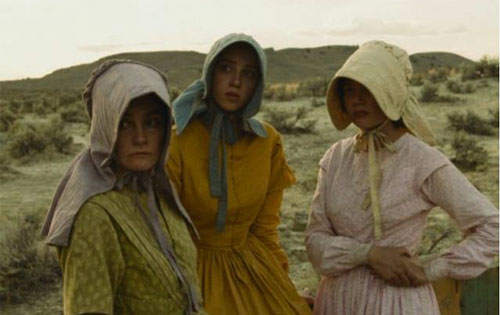
The Oregon most of us picture -- a place of lush forests and rugged coastline -- is not the Oregon of Meek's Cutoff. The film's setting is the scrubby and inhospitable desert in the state's southeast corner, which has more in common with neighboring Nevada than with green and rainy Portland.
But the unexpectedly arid and empty Oregonian vistas in Meek's Cutoff are totally appropriate, for the movie itself -- with its glacial pacing and thoroughly indie sensibilities -- is not what most moviegoers expect in a period Western. The latest movie from Kelly Reichardt (Old Joy) undoubtedly will try the patience of anyone looking for traditional horse opera shoot-'em-up action and moral clarity ... or, for that matter, anyone seeking an actual plot. But in its own rarely seen universe -- the lonely universe of meditative, character-driven Westerns -- Meek's Cutoff is greatly provocative and rewarding.
Meek's Cutoff is morally complex but structurally simple, following a small group of weary settlers crossing Oregon in 1843. From the film's onset, it's apparent that the group is hopelessly lost. Thanks to their guide, the ill-tempered and unlikeable Stephen Meek (Bruce Greenwood), they've taken an unmapped detour from the usual settlers' route. After travelling for several days with no idea how to reach their destination (an ambiguous locale somewhere west of wherever they are), their most immediate problem is their rapidly dwindling water supply.
As provisions dwindle and tempers flare, Meek is accused of incompetence and even deliberate deceit. Among his accusers -- all played by familiar arthouse and TV faces -- are Soloman Tetherow (Will Patton) and his wife, Emily (Michelle Williams), whose frustration with Meek strains their otherwise calm, no-nonsense approach to their difficult journey. Contrasting the Tetherows are the young and pensive Thomas Gately (Paul Dano) and his younger and far louder wife, Millie (Zoe Kazan). Joining them is the White family, William (Neal Huff), Glory (Shirley Henderson) and their precocious young son, Jimmy (Tommy Nelson).
When the settlers happen upon a lone Native American identified only as The Indian (Rod Rondeaux), they find themselves in a quandary: Should they let fear rule the day and kill him, or trust him to help them find their way out of their increasingly desperate situation? To avoid spoiling what little narrative arc there is in Meek's Cutoff, I'll just say that what follows is an intriguing study in how the characters' life experiences, cultural backgrounds and personalities shape their actions.
Again, I must emphasize the aforementioned "what little narrative arc;" Meek's Cutoff has all the plot of your average mumblecore indie (in other words, not much). But the film is hardly a mumblecore gabfest -- its characters often are reticent, as if rationing their words the way they ration their sparse food supply. Or maybe they just have little to say to each other after such a long journey. After all, you can spend only so much time discussing the two forces that seem to rule a settler's life, namely the Bible and the weather.
The traditional Western antidote to a lack of plot is plenty of action. But here again, Meek's Cutoff defies expectations; the film is more Terrence Malick than Sam Peckinpah. There is nary a galloping horse or gunfight; instead, the languid pacing begs us to contemplate the characters' world and enjoy the visual poetry in the lingering camerawork.
Such a quiet, plotless, actionless period film shouldn't work at all, but somehow Meek's Cutoff works very well. It's surprisingly suspenseful, mainly because the audience knows nothing more than the characters. We identify with the hapless, hungry, exhausted travelers because we're as completely lost as they are. The film gives us no clues about which direction they should go or whether there is water over the next hill. We know no more about the tantalizingly mysterious Indian than the settlers do. (In fact, given our scant modern knowledge of Native American history, we know far less.) Above all, we can't predict which characters (if any) will survive the journey.
Meek's Cutoff is also intriguing for its many ambiguities, from the group's vaguely outlined destination to the moral grey areas the travelers must confront. The Indian, of course, is the centerpoint of this ambiguity, personifying everything the settlers don't know about their situation. Is he friendly, or will he kill them? Can he -- and will he -- help them find their way? Complicating matters (and adding further layers of obfuscation) is the fact that The Indian speaks not a word of English, and the settlers don't speak his language, either.
My only major criticism of Meek's Cutoff is that some of the characters are underdeveloped, giving the actors relatively little to do. The movie is less an ensemble piece than a vehicle for the always excellent Williams, whose proto-feminist Emily -- the film's most fully realized character -- is fearless, tireless and guided by a startlingly progressive sense of morality. And although the crotchety Meek borders on a Western cliché (he's something of a cross between Rooster Cogburn and Yosemite Sam), Greenwood's nuanced performance fleshes out Meek in some surprising and thought-provoking ways.
Unfortunately, the other characters aren't quite three dimensional; they exist mostly to comment on the story's various conundrums and demonstrate the daily hardships, boredom and indignities of frontier life. (Meek's Cutoff will make you appreciate your TV, indoor plumbing and modern medicine.) But the actors do their best, giving the audience a great sense of how pioneers in the American West viewed their world and survived unimaginably harsh conditions. Dano (probably best known as the sullen teen Dwayne in Little Miss Sunshine) is particularly good as the intense but thoughtful Thomas. On the other hand, Kazan (the epileptic Ivy in The Exploding Girl) is all one-note histrionics as Thomas's loudly fearful wife, Millie, who probably will annoy the audience as much as she does her fellow travelers.
Director Kelly Reichardt, who also directed Williams and Patton in the wonderful Wendy and Lucy, deserves great credit for making the unlikely Meek's Cutoff work as well as it does. Again, the film definitely isn't for traditional Western fans looking for clearly defined good and bad guys in a showdown at high noon. But the arthouse crowd -- and in a stretch, fans of revisionist Westerns -- will appreciate Meek's Cutoff for its lyricism, powerful metaphors and provocative ideas.