

Review: Seven Psychopaths
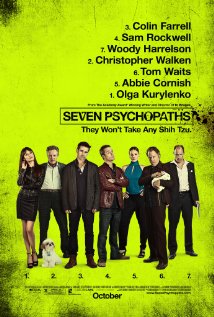
Seven Psychopaths, opening this weekend, is the second feature from writer/director Martin McDonagh (In Bruges). A hilariously dark comedy, the story revolves around Marty (Colin Farrell), a screenwriter caught up in a chase over a mob boss's stolen shih tzu. An alcoholic drinking himself into forgetfulness every night, Marty reluctantly accepts the screenwriting help of his friend Billy (Sam Rockwell), who happens to be a professional dog thief. Together they chronicle the ensuing shenanigans -- both writing, and narrating, the movie in which they're characters.
To detail the ways in which the rest of the characters are inroduced would be far too revealing of the plot. It should suffice to say that each player in this self-referential and often self-mocking movie connects in unique, interesting, and generally hilarious ways. While it's popular of late to cast well known faces against type, everyone here is decidedly playing himself, or in the case of Christopher Walken, an exagerrated version of himself. Among several subtle nods to their prior roles, I found references to Walken's part in The Prophecy particularly on the nose.
Woody Harrelson pulls off a unique performance as a completely bad-ass and at once equally pathetic mob boss who accounts for 50 percent of the comedic material in Seven Psychopaths. The other 50 percent being, of course, Sam Rockwell, and an entirely sublime additional 100 percent from Tom Waits' brief appearance. The female characters are poorly written, however, with nothing to say except one or two one-liners before they're killed.
The one exception is Linda Bright Clay as Walken's wife. Trapped in a hospital and dying of cancer, she receives daily visits from husband Hans (Walken). Her strong, resigned dramatic performance defines the matte against which McDonagh places the film's more ludicrous scenes, masterfully contrasting real life against the farce with which he has enveloped the audience.
Just as the script of Seven Psychopaths mocks itself, it likewise mocks the genre tropes on which it's built, giving viewers what they have been programmed to want to see and then yanking the rug out from under them and feeding them something completely different. The tone brings Quentin Tarantino to mind, but only in the vaguest sense. This is something wholly its own.
Communicating with the audience without ever actually breaking the fourth wall, McDonagh's skillful plot constructions are interrupted frequently with absurd moments of insanity that cleverly set or release emotional tension for the audience. Though in life some jokes may wear thin after the third or fourth telling, Seven Psychopaths feels more like something with unlimited rewatching potential.