

Reviews
Review: Alice in Wonderland
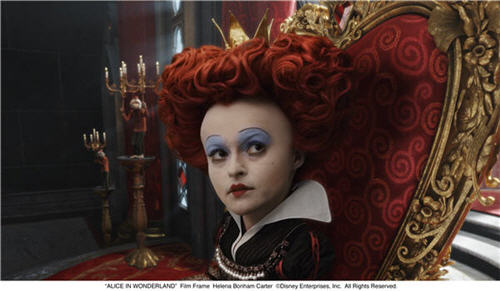
It seemed like a safe bet that Tim Burton's adaptation of Lewis Carroll's beloved Alice in Wonderland stories would be delightfully strange and gorgeous, with a cast that was sure to make it a beloved film. Unfortunately with a schizophrenic plot and murky imagery, it's likely to be the least favorite Burton film among those who call themselves fans.
A brief prelude of Alice as a nightmare-troubled child quickly turns into a garden party intended to announce Alice's engagement, only adult Alice is the last to know. Not surprisingly, she falls down a rabbit hole and proceeds to have adventures big and small with such unlikely allies as Tweedle Dum and Tweedle Dee, the Dormouse, and the Mad Hatter (Johnny Depp) while avoiding the decapitation-happy Red Queen (Helena Bonham Carter).
One would rightly expect such a fantastic tale to have vibrant colors and outlandish costumes, but the color palette is murky to the point of people questioning the quality of the projection. It seems to be intended, however, as Alice (Mia Wasikowska) is pallid and in pale blue, and even the Cheshire Cat is dark grey and blue, and hard to see. The 3D effects, what little there are, are wasted, and not worth the extra cost of a 3D screening.
Review: Brooklyn's Finest
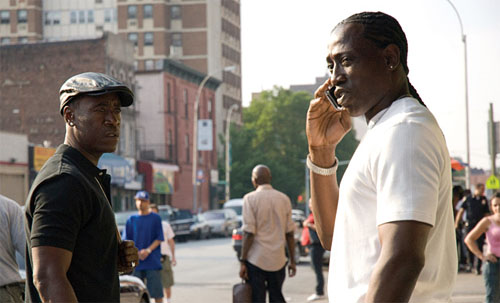
There were a few times during Brooklyn's Finest that I wanted to get up and leave, but I thought, well, maybe it will get better. The problem is: it never does. The film depicts three unrelated stories involving cops on the Brooklyn beat: Eddie (Richard Gere), an alcoholic cop seven days from retirement; Sal (Ethan Hawke), a detective trying to find a way to put a down payment on a new house; and Tango (Don Cheadle), an undercover cop who is unsure where his true allegiance should lie. Frankly, this movie could have used more Cheadle and less of everybody else. His scenes with Wesley Snipes, who plays a kingpin who once saved Tango's life, are about as good as the film gets.
The movie seems to deal in general stereotyping. For instance, the women in the film are either victims or bitches -- there's no in-between. Lili Taylor, playing Sal's ailing pregnant wife, is only in about two scenes of the film, but her illness fuels his desire to find money for a new house by any means necessary. Ellen Barkin's hardass Fed seems to mainly exist for Tango to play off as she makes ridiculously racist comments (and she's only in a couple of scenes herself). There's the coke-sniffing prostitute that Eddie (Richard Gere) wants to save -- but he also wants to sleep with her. The other women serve as scenery. They don't talk, they just serve drinks (topless), iron drug money (topless), work in a strip club (topless) ... you get the idea. And strangely enough, there are scant women (I only saw one) on the police force in Brooklyn's Finest. For a drama that yearns to be gritty and "real," this seems a huge misstep.
VOD Review: The Flying Scissors
 I've long been a fan of mockumentaries,
especially those that skewer deserving subjects while also skewering
the sometimes overly earnest art of documentary filmmaking. The
Flying Scissors, a mockumentary about the world of competitive
rock, paper, scissors, occasionally succeeds at both. But despite an
amusing premise and some likeably quirky characters, most of the
film's humor falls flat.
I've long been a fan of mockumentaries,
especially those that skewer deserving subjects while also skewering
the sometimes overly earnest art of documentary filmmaking. The
Flying Scissors, a mockumentary about the world of competitive
rock, paper, scissors, occasionally succeeds at both. But despite an
amusing premise and some likeably quirky characters, most of the
film's humor falls flat.
The Flying Scissors -- released this week on Austin's Time-Warner Video on Demand, Amazon VOD, and other online VOD sites -- follows a dozen or so competitors in a rock, paper, scissors championship tournament, developing each character via the standard documentary mix of interviews and scenes of them going about their daily lives. Per documentary (and thus mockumentary) convention, the characters are a diverse group of socially inept oddballs, lifelong underachievers, and hyper-competitive types who have little in common except their obsession with a "sport" that no one outside the group seems to appreciate. More importantly, they also share a desire to succeed at something in their lives.
For example, hapless real-estate agent Frank Johnson (Todd Susman) lives in a tiny, trashy apartment but proudly shows off the equally tiny trophy he won at a previous tournament. Emasculated househusband Phil Stevens (Mason Pettit) hopes that winning the tournament will give his pushy wife Amy (Kerry O'Malley) a reason to respect him. Ardent feminist Leslie Hanrahan (Susan O'Connor) wants a victory for womyn everywhere, and vapid Christian beauty queen Anna Carlson (Sarah Wheeler) hopes a victory will somehow jumpstart her nonexistent acting career and/or bring her closer to Jesus.
Review: The Crazies
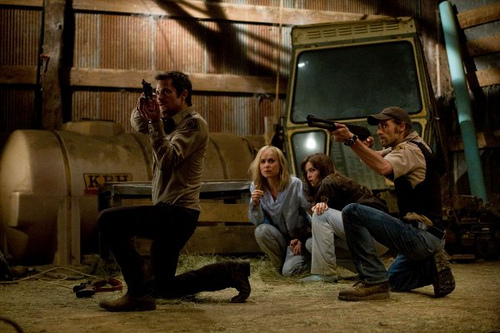
Based on the 1973 George Romero movie by the same name, the 2010 version of The Crazies, adapted by screenwriters Ray Wright and Scott Kosar, strips away the social and political aspects that were rampant in the original. Nowadays moviegoers don't need much convincing to believe that the military could seize a town and cover up bioweapons. Director Breck Eisner seems to pride himself on using as little exposition as possible to keep the plot cruising along. The result is a rollercoaster ride, as building tensions keep viewers on the edge of their seats and then out of them when the insanity and horror takes over.
The basic plot of The Crazies remains: Residents of the small Iowan town of Ogden Marsh are suddenly plagued by insanity and death after their water supply is contaminated. When the town drunk Rory Hamill (Mike Hickman) shows up to a high school baseball game with a rifle, he's shot dead by local sheriff David Dutton (Tim Olyphant) when he fails to respond and drop his weapon. It's assumed that Rory was heavily intoxicated -- only he's been on the wagon for two years and his blood alcohol content confirms it. While Sheriff Dutton along with Deputy Russell Clark (Joe Anderson) tries to find an explanation for Rory's strange behavior and also investigate reports of a plane crash in the local creek, his wife Dr. Judy Dutton (Radha Mitchell) attempts unsuccessfully to identify what's wrong with another resident. The man is almost catatonic, and later that night he sets fire to his house after locking his wife and son in a closet.
Review: Shutter Island
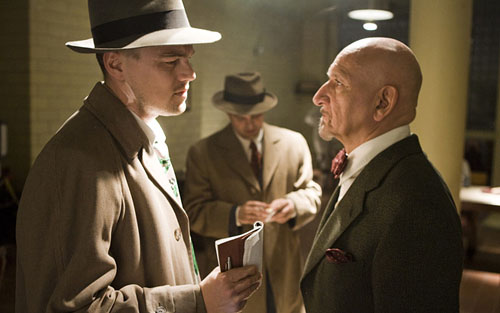
If you hadn't told me that Shutter Island was a Martin Scorsese-directed film, I wouldn't have guessed. I would have thought it was some lesser-known director who wanted to be Christopher Nolan, and who was also a huge Hitchcock fan. Maybe if you'd shown me Scorsese's Cape Fear first, I might have believed they were from the same filmmaker, someone who wants to revisit and rework classic thrillers, but who loves spending time with his characters so much that he doesn't tighten up the thrillers enough for maximum suspense.
The plot seems straightforward enough at first: In 1954, two U.S. marshals who are brand-new partners, Teddy Daniels (Leonardo DiCaprio) and Chuck Aule (Mark Ruffalo), travel from Boston to nearby Shutter Island to investigate a woman who has gone missing from a hospital for the criminally insane. However, nothing on Shutter Island or in the movie is that simple. Teddy starts having flashbacks to his WWII days, when he was was one of the soldiers who stormed Dachau, and dreams vividly about his late wife (Michelle Williams), who wants him to find and kill someone named Laeddis.
Review: The White Ribbon
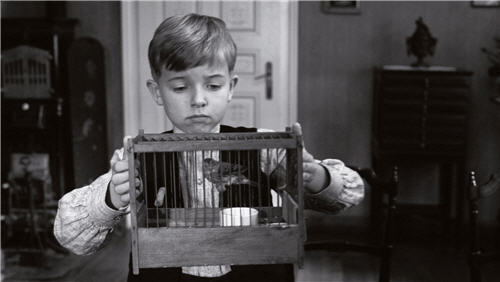
Michael Haneke's morality tale The White Ribbon (Das weisse Band - Eine deutsche Kindergeschichte) is racking up wins and nominations, including two Oscar nods and the Palm D'Or. Yet all the attention seems to be more of a nod to the roots of fascism than to the film itself.
Set in a seemingly bucolic German village prior to WWI, The White Ribbon reveals the town's ugly underbelly. An act of malice fells a horse and lands a village doctor in the hospital. Shortly after, a mill accident results in the death of a mother. The German village is full of secrets and malice, with few true innocents, showing everyone as either victim or culprit ... or both.
The director of Caché and Funny Games (both versions) enjoys deconstructing the bête noire in idyllic settings. The film covers roughly a year in the life of the village, but at 144 minutes, the observations are diffused and obscure instead of focused and observant. With long, silent, black-background opening credits, The White Ribbon is not a movie for the average movie fan. In fact, it will challenge even the cineastes among us to sit still through what feels like real time. While it's been nominated for cinematography awards, if seen on a less than perfect screen, The White Ribbon is hard on the eyes.
DVD Review: From Mexico with Love
 On the From Mexico with Love DVD box cover, E Latino Weekly describes the film as "a modern-day Rocky." The comparison is probably inevitable, as both films are about scrappy underdog boxers. Sadly, From Mexico with Love has as much in common with Sylvester Stallone's poignant masterpiece as Dear John has with From Here to Eternity; both films involve beach-related wartime romance, but that's where the similarity ends.
To be fair, the creators of From Mexico with Love probably had good intentions. The film -- released today on DVD
The film's protagonist, Hector (Kuno Becker), is an impoverished Laredo farm worker who supplements his meager income by boxing in unsanctioned and unruly low-rent prizefights. Hector's world includes the expected characters: cynical immigrant smuggler Tito (Steven Bauer), grizzled boxing trainer Billy (Bruce McGill), and the conveniently beautiful love interest, Maria (Danay Garcia). Hector is a devoted son to his ailing mother, who labors alongside him in the fields despite her persistent coughing and wheezing. When the callous farm boss (apparently, there are no noncallous farm bosses, at least in movies about migrant workers) cuts mom's pay because she can't pick the required daily amount of vegetables, Hector brawls with the boss and soon finds himself unceremoniously dumped on the Mexican side of the border.
DVD Review: Whip It
 As someone who closely follows Austin film news, it's impossible for me to talk about Whip It -- or to watch it -- without facing the issues of its setting and production. The rollerderby movie was written by a former Austinite, is set in Austin and a nearby small town, makes Austin practically a character ... and apart from a few days of shooting scenes of notable locations here, was shot in Michigan. Should we count it as an Austin film? Does it matter, especially for non-locals?
Regardless of where it was filmed, Whip It -- now available on DVD

Bliss (Ellen Page) is a high-school girl in small-town Central Texas. Her mom (Marcia Gay Harden) has pushed Bliss and her younger sister into the regional beauty pageant circuit, insisting that it will help them later in life. Bliss is also working part-time with her best friend Pash (Alia Shawkat) at a local diner with a giant pig on it. While in Austin shopping for clothes, Bliss finds out about rollerderby and is fascinated. She decides to sneak off to join a banked-track rollergirl team, the Hurl Scouts, lying about her age. A whole new world opens as she becomes Babe Ruthless.
Review: Valentine's Day
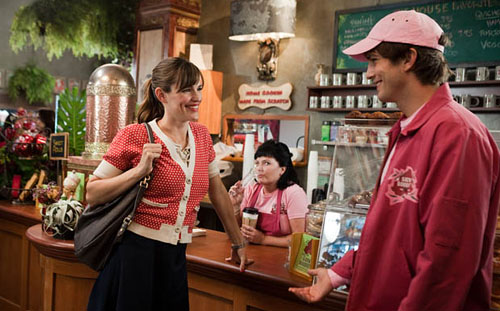
Being a single twentysomething gal sucks on Valentine's Day. Right? Because you spend the day wailing and whining, planning anti-Valentine's Day parties that no one RSVPs to, and scarfing down candy, since that candy is the closest thing to a soulmate you will find for the day. Or so the Garry Marshall-helmed Valentine's Day would have us believe, by having Jessica Biel's character do just this. Despite the ginormous cast, don't look for self-confident women in this film ... unless you count the all-too-brief appearances by Queen Latifah as a sports agent.
The main story -- what there is of it -- tends to focus on the plight of a confident, happy-go-lucky flowershop owner, Reed (Ashton Kutcher). Reed's best friend is an elementary-school teacher, Julia (played by a chipper-despite-all-odds Jennifer Garner). Both of them are dealing with their own relationship issues; it's Valentine's Day, after all -- at least that's what somebody seems to say every five minutes throughout the film. There are also various subplots: a football player (Eric Dane) making a big life decision, an army captain (Julia Roberts) flying home to see a loved one after 11 months overseas, a little boy trying to express his love for his valentine, an office temp/phone sex worker (Anne Hathaway) dealing with the possibility of a new relationship, an older couple (Shirley MacLaine and Hector Elizondo) taking care of their grandson, and more!
Review: The Wolfman
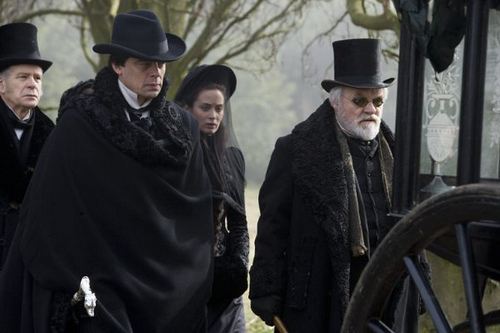
When I was a kid, every Saturday afternoon I loved watching classic horror films -- the Hammer Horror films of the late '50s and early '60s, including repertoire actors Peter Cushing and Christopher Lee, and Roger Corman and American International Pictures pulp flicks with Vincent Price. The predecessors that paved the way were the Universal Pictures horror films of the 1940s, most memorably The Wolf Man featuring Bela Lugosi and Lon Chaney, Jr. Dark and suspenseful, full of beasts and gypsies, the original Wolf Man identified many concepts about werewolves that extended beyond traditional folklore.
Directed by Joe Johnston (Jumanji, The Rocketeer), the 2010 version of The Wolfman embraces many of these concepts -- silver bullets, power of the full moon -- in what I'd hoped would be a true homage to the classic. The script written by Andrew Kevin Walker and David Self contains threads of the 1941 screenplay, but with a few added twists for this modern large-scale version.
