

This is Not Your Living Room: A Theatergoer's Primer -- Part One
Dear Austin,
I love Austin, and it's film geek heaven. But apparently fewer and fewer of us know how to properly behave in theaters. It seems Austin's movie audiences are getting worse, even at the Alamo.
The theater is not your living room. And you are not alone in it. It's past time for a Theatergoers Primer.
Stop Talking. Shut it. When you arrive in the theater, stop using your outside voice. It is acceptable to talk, but quietly, not like you're at a nightclub. When the lights dim, so should your conversation. Stop talking during the trailers, as some people are actually trying to enjoy those, even if they are available online. When the film talks, no one should be talking.
That's not to say you have to be absolutely quiet. Going to the theater is a communal experience where reactions are expected, and can actually make the experience even more enjoyable. Laughing, gasping, clapping are all okay -- excited utterances, as the TV lawyers say, are normal parts of the experience.
Scene-by-scene commentary, dialogue repetition, and requests for explanations are not okay. If you can't control yourself, limit your theater times to Baby Days at the Alamo. Or stay home and annoy your neighbors. I'm beginning to think that the Regal Arbor needs to schedule a Hearing Aid Couple Day as well.
So listen up, Mr. Repeater, Mrs. What-Did-He-Mean, Sir Talks-Back-to-Screen, Madam Grunt-Groan-Sob, and the rest of you who can't respect the film or the audience enough to keep quiet.
No Calls. Nothing in your life is so important that you need to take calls while in the theater. You are just not that important. No one is. Not even the director. Put the phone on vibrate if you really think there will be a call you absolutely must take. And if you get one, take it outside immediately. Taking a call to say you're at a movie makes you sound like an even bigger jerk than you probably are.

Screens Off. It's lamentable that the average American has the attention span of a goldfish. A little impulse control goes a long way. Stop messing with your phone once the trailers start. You do not need to check your text messages when the movie is on. Those few of you who at least attempt to hide the screen are failing miserably. That light is really bright in a dark room, and is a big distraction from the big screen. If the movie's that bad, walk out and let the rest of us enjoy or suffer in peace.
No Headsets. You do realize that wearing a Bluetooth headset all the time makes you look like a pretentious jerk, right? In the theater, that little blue light is a beacon to those in your row, and if your hair is short enough, to those sitting behind you. That's not to say those using devices that help their hearing should feel bad; that's a different story. The jury is still out on the experimental podcast commentaries; as long as the volume is low enough that no one else hears it, it's okay with me.
Death to Live Tweeting. Never mind the fact that you're likely spoiling the movies for others. Dismiss the fact that no one really cares what you think of a movie scene by scene. The only time live tweeting in a theater is ever acceptable is if 1) the theater organizes a live-tweet screening and 2) it's made clear to every single person in the audience. I don't care if there's only one other person in the theater and they're 10 rows away. It's like picking your nose; even if no one sees you it's an ugly habit, so stop.
Seat Hogging. Saving seats for friends is fine, but there are limits. If 10 people are in your party, more than one person should be showing up to save them, particularly at high-capacity screenings.
Seat Spacing. Leave two seat gaps, not one. This allows couples and pairs of friends to sit together if it's a high-capacity screening. Expecting no one to sit next to you, or invoking the single spacer seat because you're afraid to sit to close to other guys, is just silly.
You Snooze, You Lose. On the other hand, the more important it is to sit by your friends, the earlier you should arrive. Don't expect anyone to move to accommodate you if you arrive late, especially at the Alamo. Once someone orders their food, it's not just rude to expect them to move, it will wreak havoc on orders and bills.
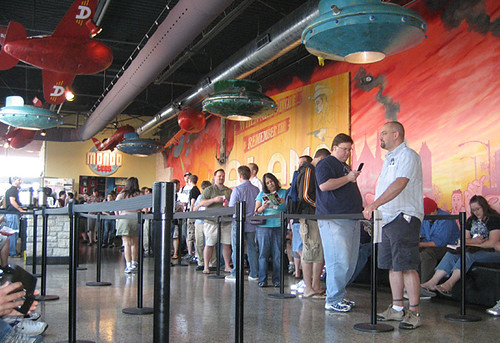
Line Leeching. This is one of the more ambiguous moviegoing etiquette rules. Line leeching, when people you know find you and join you in line, is relatively acceptable, especially if they've purchased tickets, and especially at film festivals. You're going to sit with your friends anyhow -- why not enjoy their company in line, where talking is acceptable?
However, there are limits: the more leeches, the less acceptable. This is especially true when the screening is expected to be over capacity, whether it's a festival or a free screening. In those instances, the closer to start time, the more leeching becomes rude and inconsiderate, and that's compounded by the number of leeches.
Line Jumping. Although line leeching can be acceptable, line jumping never is. Forcing your way in front of others without the anchor of friends is completely uncool. It's especially uncool when others have been waiting for hours to see something, and you don't have reserved seats.
I know, this is a lot to take. So I'm going to give you a chance to regain your composure before I continue with Part Two.
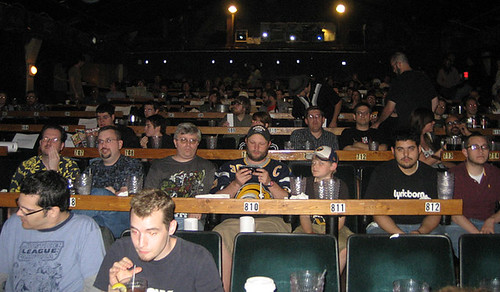
[Photo credit: Jette Kernion, who would like to note that the photo of the audience on their phones took place during a promotion at Texandance where everyone was invited to text a message. So those people are all innocent.]
Yes! And re: "excited
Yes! And re: "excited utterances...are normal parts of the experience." The exception being those nutbags who feel everyone needs to hear them make utterances, e.g. "Oh, no!" "That hurt!" "Look out!" And make loud, forced guffaws to let everyone know THEY thought that was funny!
norms for electronic devices
The norms for electronic devices are still evolving.
The "no talking on cell phones" behavior is pretty firmly established. Most theaters run a "no talking" bumper before the movie starts (which may or may not include threats to "take your ass out"). It wasn't always that way. It took a while for that norm to be settled.
While texting (or general device use) is just as disruptive, I don't think the "no texting" norm is fully set.
I'd like to say take the campaign to theaters, asking them to add "no texting" messages before the movies, but most are run by dipshits that don't show much concern for audience experience (otherwise those commercial reels would be dead).
Maybe this is a campaign that can be brought directly to cell phone companies. It's bad PR if people get pissed off at the use of their products. The cell companies have run campaigns to affect our device usage. Many even sponsor the "no talking" messages run before movies. Maybe they'd support a "no texting" campaign.
Or, maybe we can just tell the MPAA that all those texters might be recording copies of the movie.
No texting
Actually, many of the theaters are adding the "no texting" in the bumper. I saw it at the last screening I attended at Arbor theater just 2 weeks ago.
Now if the Alamo would ban
Now if the Alamo would ban texting...
I honestly have only really
I honestly have only really had issues in town at the dollar theater up on the north end. Maybe it's just the clientele that it attracts (not to be classist). Just tonight I had the older guy next to me checking his blackberry mid-movie, opening a can of soda during a quiet scene, the people in front of me doing a running commentary on the movie and at least two different cell phones going off. I mean, it's a cheap movie so I don't expect it to be the pristine environment the Drafthouse aims for, but at the same time, it's not a theater on 42nd St.
Live Tweeters Must Die
Is it overreacting to stop following someone on twitter because they were live tweeting a movie? Well, I did, and I think everyone should. People are waaaaaaaaaay too attached to their social networks. Step away from the phone!