

AFF09: Stewart Stern and 'The Ugly American'
 Please welcome guest contributor Linda Ball, who caught a special Austin Film Festival screening of the 1963 film The Ugly American, which included a discussion with the film's screenwriter, Stewart Stern.
I was curious to see the The Ugly American because when it was released (1963) and when the book was published (1959) I was quite young. However, I remember the phrase "the ugly American" being synonymous with new ideas about the face of colonialism and of the Cold War anti-Communist era. I may have even read the book in college. Certainly, this material was the part of the underpinning of the protests and new ways of looking at our place in the world that came along when I was in college and made me start to question the certainty of the 1950s culture of my childhood, basking in victory from what was considered a right and just war.
I was not prepared for the power of the movie The Ugly American and its relevance today or for the cogent and emotional remarks of Stewart Stern who, at 87, has witnessed so much of history. Describing traveling the world in the 1950s to see the work of Non-Governmental Organizations, he told a story that resonates today about how to help people around the world effectively. These lessons made their way into the movie. For example, the training of people to use sterile knives for cutting the umbilical cord (instead of contaminated sharpened bamboo sticks) was something he actually encountered in his research. He tested the script on people in Southeast Asia and discarded ideas that were clever but unworkable for helping people.
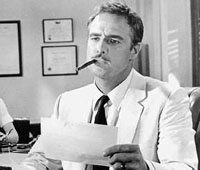
In the movie, the Macwhite character (Marlon Brando, pictured above right) is a cipher for the United States. The only hopeful note is struck when he realizes his mistakes, albeit after making a disastrous foreign policy. This glimmer of hope was dashed, however, in the final scene when the news from this fictional Southeast Asian country aflame is showing on a TV set. A man consults a TV Guide and walks over and shuts it off. "Nothing interesting on" is the message or, as we said back then with limited network stations: "There’s nothing on."
Stern, a WWII veteran of the Battle of the Bulge, talked about his lifelong concern about the relationship of the U.S. to the rest of the world by talking about how he only survived leading his infantry troops by singing a children’s song about the brotherhood of man. (Which included a phrase about Germans, etc.) He actually sang a few verses. He talked about how the Germans wore a belt buckle announcing that God was on their side and how every army ascribed to this.
It is clear that Stern is still thinking about our relationship to our world and The Ugly American is as relevant this minute as it was over 40 years ago because he made the story timeless. This movie is a classic that we should hold onto forever. Unfortunately, we won’t be able to hold onto Stern forever and I was honored to hear him and moved by his insights.
You can read more of Linda's writing on her blog, Visible Woman.
Ugly American
Good review, Linda. I'm glad that we attended this screening -- definitely the highlight of Austin Film Festival for me. I read that book in junior high -- 8th grade to be exact. Years later, as Vietnam exploded around our generation, I thought back about it many times. What a treat to hear this intelligent man talk about the film he wrote.