

Review/Interview: Paper Heart
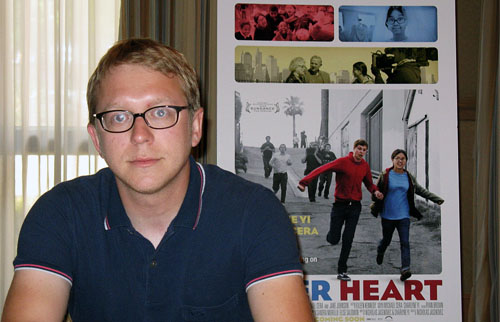
Paper Heart blurs the lines between fantasy and reality as Charlyne Yi explores the concept of the validity of Love and expectations before relationships even begin, with co-director Nick Jasenovec (pictured above).
Earlier this summer, Jasenovec was in Austin for a special screening of Paper Heart as well as for interviews. Mixing genres is dangerous enough, but Yi and Jasenovec mix documentary and narrative with surprisingly good results. Yi is not just the co-director, but the star, who interviews real people about the subject of love, as well as playing an alternate version of herself in a budding relationship with an alternate version of Michael Cera (played by Cera). Jasenovec is also a character, but instead of playing himself, Jake Johnson plays Jasenovec. And then there are puppets.
Confused, yet? Turned off? Believe it or not, it works, and works well.
Yi's earnest, awkward charm is disarming enough to give this melange a chance. It's a bit of an avalanche story, building from the initial concept of a documentary to wanting to work in a love story angle. Jasenovec points out that while it would have been great to follow Yi around as she fell in love, the chances of it happening at the same time as the production were statistically impossible. After choosing to add the narrative elements, having an actor play Jasenovec made sense because he felt more comfortable behind the camera.
Unlike Borat, which mocks the people the fictional character interacts with, Paper Heart respects the documentary subjects, even if they aren't completely truthful with them. During the Q&A, Jasenovec pointed out that they allowed some of the subjects to think Yi was in a relationship, but that was the extend of the deceit. It's clear seeing Yi interact with the people she interviews that she's genuinely interested in their stories. Some of the interviews include stories, which Yi interprets using crude animation and puppetry, giving them a primal, nostalgic feeling, and bridging the gaps between reality and fantasy.
Jasenovec talked a bit about the decision to add a narrative component to the film, and the intentional blurring of the lines. "We weren't intending on doing a narrative from the beginning, but once we came up on that idea we realized it became necessary to tell the story we wanted to tell. In terms of me, I'm just really uncomfortable being on camera and I'm not [a] good actor. We worked hard on creating this reality within those scenes, so that it didn't deviate from the tone or style of the actual documentary scenes, and I think if I was in the film it would be really obvious what scenes were fake and what weren't."
Among the people interviewed for the film include a chemistry professor from Texas Tech in Lubbock, and an Amarillo couple. The Lubbock location was a last-minute addition, but was moved to the front of the film to help establish the story as a quest and drive the story arc. The Amarillo couple, a family law judge and a lawyer, add a particular poignancy to the film, not just because of their particular story, but the hints of what they see in the line of their work.
Balancing the real-life interviews is the fictional relationship between Yi and Michael Cera. Jasenovec was writing a script for Judd Apatow with Bill Hader, who ended up being cast in Superbad. Yi and Jasenovec met Michael on the same night, and have become friends with many within the Apatow group, as evident in an LA party scene.
Says Jasenovec, "I had already kind of started hanging around that group quite a bit and hanging around the Knocked Up set and sort of just observed, like film school, basically. And it's a really tight group of friends and everyone's very supportive, and I met Michael right before filming Superbad and became pretty good friends, and made a short together ... he has the perfect acting style for this type of movie, and he also really enjoys playing with reality and audience perception and expectation."
Yi and Cera are friends, but Cera was willing to portray a version of himself to help out the film makers. Despite persistent rumors, Cera and Yi were never anything more than friends, athough watching them onscreen, they eerily mirror each other; if they ever did get involved romantically, they'd be one of those couples who start looking alike.
They also share an undeniable quirkiness that makes them more interesting to watch than the typical "couple" despite the familiarity most American audiences have with Michael Cera. With all the unorthodox mixing of film devices, Paper Heart works. It's a small, quirky, sweet movie that will likely remind you why you're a dorky romantic. Or maybe that's just me.