

Alamo's Fitting Tribute for Susan Tyrrell
 By Brandon Martin
The collage of photos of the late Susan Tyrrell (1942-2012) set up on an easel outside the entrance to the theater -- her distinct expression made more potent by a background of clustered house keys -- reminded the Alamo Drafthouse audience that this was more than a regular film screening. The mass of flowers and Tyrrell artifacts surrounding the podium inside made it very clear that this was going to be a fitting memorial for a woman who defied the traditional.
I wasn't familiar with the actress' body of work. I'd never even heard of Fat City before reading about her passing away in Austin last month. Going into the tribute, all I knew about the John Huston-directed film was that Tyrrell played a drunk. This is how a movie viewing should be experienced. You walk into a dark room knowing as little as possible. It's spontaneous, like falling in love, or dying in your sleep.
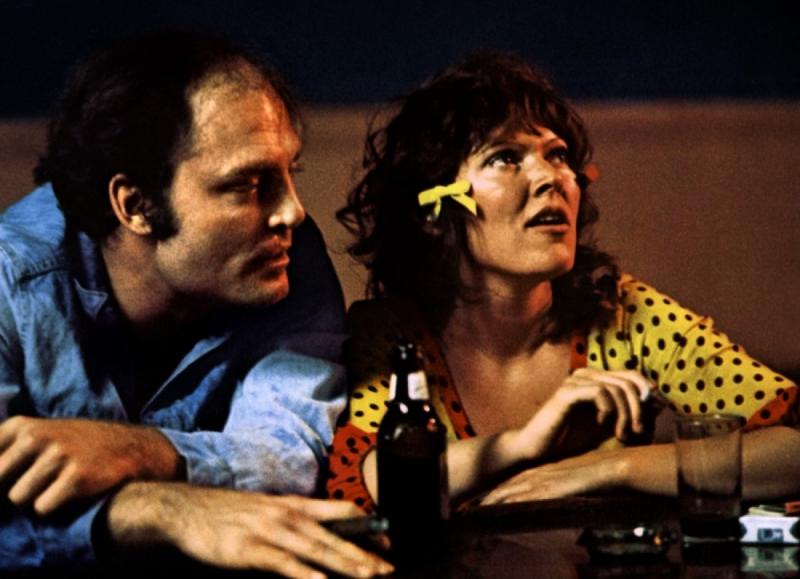
Fat City follows Billy Tully (Stacy Keach), a has-been boxer who inspires an amateur, Ernie Munger (a young Jeff Bridges), to pursue boxing. When Billy isn't doing day labor jobs picking crops, he's drinking. This is of course how he meets Tyrrell's character Oma, an eccentric alcoholic. We are introduced to her in true Tyrrell fashion. She sneaks into the scene almost unseen... until she opens her mouth, rambling about her boyfriend and why she can't get the bartender's attention. Someone get her a cream sherry!
The real scene stealer is her second encounter with Billy. She sits at the bar sulking, dress half unzipped, her only company a cigarette and a beer. It doesn't take long for her to fill his ear about her boyfriend being locked up, just one of the many tragedies in her long love life. The language and actions are familiar, but Tyrrell sells it so well, like a used car doused in new car smell. At the same time she brilliantly mocks the female love-interest archetype.
“Let's get out of this joint,” she says with a straight face, shortly before proclaiming her love for him no more than a few minutes after leaving.
The movie as a whole is a mockery of the comeback story. Billy doesn't start fighting again till almost mid-way through. We follow Ernie, but he loses the majority of his fights. By the end, Billy wins his first fight in years for only a hundred dollars. Shamed, he tries to win back Oma back, only to find out she's back with her man. He's soon back to his old drunk ways.
The end is almost kind of funny, if you don't think about how sad it is. I envision Tyrrell reading the last few sentences of the script, it going something like "Billy and Ernie sit at the coffee shop, looking miserable," and then she proceeds to laugh hysterically. Tyrrell was nominated for Best Actress in a Supporting Role for Fat City, but she never got caught up in seeking accolades, instead focusing on roles in films like Cry-Baby, Forbidden Zone and, most recently, the Austin film Kid-Thing, with uncompromising integrity and passion.
At the beginning, Alamo's Weird Wednesday programmer Lars Nilsen announced that Tyrrell never wanted her death to be a somber occasion but a celebration, even encouraging us to drink. Of course, the more this tone was defied, most notably with a posthumous rap song, the more conscious we were of the occasion's sadness. I saw this memorial as an effort to mock the tradition of memorials. If only Susan Tyrrell was here. It was a bold thought. Then again, this was a Susan Tyrrell memorial.
Brandon Martin is an intern with the Austin Film Society.