

Review: Drive
I'm generally not a fan of action films, but I bear no grudge against them in the conceptual sense. I appreciate a good car chase, gun fight or calamitous explosion, as long as these elements aren't the entire point of a movie. My beef with most action films is that violence and mayhem usually are the point; a typical mainstream action movie is mindless eye candy, lacking the plot surprises, sharp dialogue, character development and real-world relevance found in my usual arthouse fare.
And so I had high hopes for Drive, a film billed as a thinking person's action film, a smart crime thriller with indie sensibilities. But while Drive is better than most movies of its ilk, its cardboard-cutout characters, gratuitous gore and clichéd ending render it little more than a stylish and only occasionally fresh take on a tired genre.
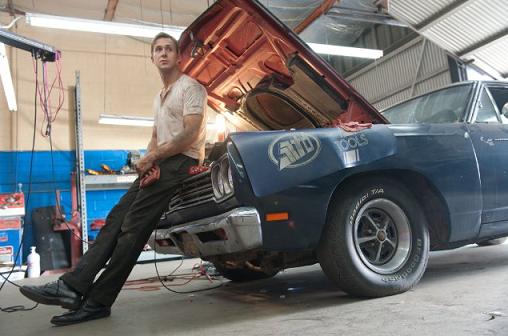
Drive starts promisingly enough, with a simple but intriguing premise. A Hollywood stunt driver billed simply as Driver (Ryan Gosling) earns a little extra cash as a getaway car driver, with help from his boss, custom car builder and small-time hoodlum Shannon (Bryan Cranston). When not engaged in on-camera or off-camera high-speed chases, Driver spends his time in a not quite romantic relationship with his neighbor, Irene (Carey Mulligan), whose husband, Standard (Oscar Isaac), is in prison.
When Standard returns home from the slammer deeply in debt to a brutal gang, Driver offers to help him pay off his debt via a pawn shop robbery. The heist goes horribly wrong, and Driver ends up in caught in a deadly battle between rival organized crime rings.
This tale is told with a curious blend of quiet slow-burn atmospherics, tenuous romance and jarringly grotesque violence. Drive is a film of multiple personalities that aren't fully explored and don't quite complement each other. The tone zings from sultry and sensual to hellishly bloody to almost cartoonishly action-packed, sometimes hitting its visceral mark but often falling emotionally flat. The story may be simple, but it's slightly confusing and packs in half-a-dozen heist film clichés. (Driver finds himself in a moral quandary about what to do with a fortune in ill-gotten loot. Imagine that! And at the end of an impressively choreographed car chase, the bad guys crash. Sorry to spoil it for you.)
Drive also suffers from some embarrassingly obvious technical goofs seen in so many action movies. In one shot, Driver broadsides a mobster's car at high speed, sending it flying over a bluff onto a beach below. In the next shot, the front end of Driver's car appears completely undamaged, with fully functional headlights. Driver and his boss may be exceptionally talented mechanics, but I doubt they could build an undentable car with unbreakable lights.
What bothers me most about Drive is that its impressive cast has little to do. The leading roles seem written for far lesser lights than Gosling and Mulligan, neither of whom are allowed to say much or express much emotion beyond anger and fear. Obviously, Driver is intended to be a reticent, brooding, quietly macho soul, generally gentle but appallingly violent when he feels the need to beat someone to death. Well, fine, but this underdeveloped role -- which also lacks any backstory to explain why the methodical, cautious Driver got involved in crime in the first place -- seems a waste of time for Gosling, arguably one of today's best actors.
Mulligan's talents -- she was radiantly perfect in An Education -- also are wasted in the film's most clichéd role; Irene is merely the helpless love interest seen in so many male-dominated crime stories. Like Driver, she lacks any real back story, and her marriage and loyalty to the charming but criminally inclined Standard are unexplained. Mulligan's performance is fine, but even she can't flesh out a character who serves mostly as an attractive prop.
For all my bashing, I will say Drive has some strong points. The action scenes (especially one memorable car chase) are slick and gripping, and audiences inured to horrific, splattery gore no doubt will enjoy Drive's brand of horrific, splattery gore. The reluctant romance between Driver and Irene is intriguingly underplayed, a subtle, appealing story within a generally unsubtle film. (I also found Driver's paternalistic interplay with Irene's son Benicio (Kaden Leos) to be very natural and believable.) Drive's look and feel also are interesting at times, blending and juxtaposing images in quirky ways; from a visual standpoint, it's definitely superior to most action films.
A charitable critic might argue that Drive is some sort of statement about the thin line between compassion and brutality, its odd mix of understated, soft-focus romance and ultraviolence serving as a metaphor for the rage that boils beneath seemingly benign human activity. But I can't be that charitable. Drive does not explain or justify either element fully enough to reach any level of metaphorical significance, and its uninventive plot and undeveloped characters keep it from being a really good film. It's a slightly unusual but highly predictable crime caper that should have been much more.
This review got it exactly
This review got it exactly right. Pointless and violent. Save your money.