

Review: The Tree of Life
To flesh out a review, a film critic sometimes relies on production notes for a synopsis, short biographies of cast and crew members and production details that readers might find interesting. These notes usually are very concise, running no more than a few pages.
And then there are the production notes for Terrence Malick's sprawling and much anticipated new movie, The Tree of Life. If you're familiar with Malick, it may not surprise you that The Tree of Life's production notes are 45 pages long. With their lengthy expositions about the film's genesis and meaning, even the production notes for this most Malick of Malick films are themselves very, uh, Malick. (Much as I adore Malick's work, I did not read all 45 pages.)
Not that being very Malick is a bad thing, of course, especially if we define "Malick" to mean "laden with sumptuous imagery and thought-provoking ideas." And The Tree of Life certainly is thought provoking; had I not found the production notes' ponderous content to be a perfect metaphor for this exceedingly ponderous and metaphorical film, I might have opened this review with a paragraph containing only one word: "Hmm."
Yes, hmm. A week after watching The Tree of Life, I'm still not sure exactly what to make of it. It's stunningly, powerfully beautiful and deeply spiritual, a captivating meditation on the nature of life and humanity's relationship to the cosmos. But assaying these profound and boundless concepts within the limited boundaries of a feature film can be a recipe for cinematic disaster. Deep as it is, does The Tree of Life work as a coherent, watchable movie? Yes, it does...in some ways, if not in others ... I think.
The Tree of Life is essentially two films with common themes. One is the story of the O'Brien family, set mostly in a small Midwestern town in the 1950s. The story focuses on the relationship between the father, known only as Mr. O'Brien (Brad Pitt), and the eldest son, Jack (played by newcomer Hunter McCracken as a child and Sean Penn as an adult).
In the present day, the adult Jack, a successful archictect, is haunted by conflicting feelings about his childhood and family, especially his father. In gauzy, impressionistic flashbacks that occupy most of The Tree of Life's running time, we see Mr. O'Brien as a man who clearly loves his family and wants the best for his three sons. But his rigidity, anger and desire to instill toughness create more resentment than self confidence; positive parenting this is not. Mr. O'Brien's harshness no doubt stems from fear and self doubt; his feelings of failure are painfully evident as he envies more successful friends and colleagues.
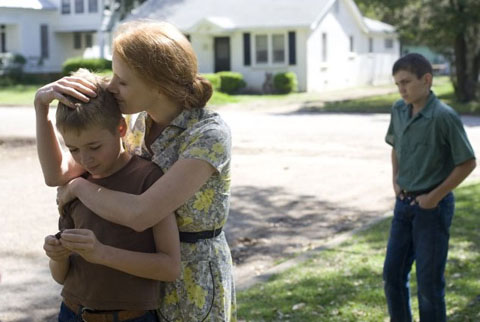
The boys' mother, known only as Mrs. O'Brien (Jessica Chastain), is the antithesis of her husband: a gentle, nurturing, free-spirited woman who allows her sons plenty of freedom while quietly enduring her husband's sometimes brutal outbursts. Her world view and parenting style create plenty of marital tension, as her husband fumes and accuses her of being too soft on the boys. Family strife is the family norm, as Jack and his brothers hear conflicting messages about how to interact with the increasingly complicated world around them.
The Tree of Life's other story is just slightly broader and more ambitious: It's nothing less than the entire history of, well, almost everything, from the formation of the universe to the evolution of life on Earth. In glorious (and perhaps gloriously overblown) imagery, we see nothingness beget the cosmos beget planet Earth beget primitive organisms swimming in the primordial soup, and so on and so forth until the dinosaur age. Then our guided tour skips ahead a bit, taking us billions of years into the future to see the end of the universe. All of this happens in perhaps 20 minutes, which makes for a quick and sometimes baffling ride.
Ostensibly uniting the two stories are various broad themes: the cycle of birth, life, death and rebirth; the parallels between the evolution of one person's life and the evolution of all life; the why-are-we-here mysteries of cosmic and human history; and the we're-all-stardust bond between all living things and the universe we live in.
I say "ostensibly" because while The Tree of Life is beautiful, wondrous and sometimes deeply moving, I'm not sure its two parts work together as well as they should. I always prefer subtlety over blatancy and sing the praises of films that challenge audiences to think about what they're seeing. But the ties that bind The Tree of Life's two parts are sometimes a bit too subtle, and some of its concepts are highly ambiguous, even after much thought. If The Tree of Life is about cosmic connections, it often feels disconnected.
That said, the story of the O'Briens is as fine a cinematic take on family life as I've seen in years, capturing with delicious Malick lyricism the emotions that unite families and yet also drive them apart. One of Malick's many cinematic gifts is his ability to drive a narrative via the characters' emotions, rather than relying on their actions. In this respect, the middle three-quarters of The Tree of Life is perhaps Malick's best work ever. The O'Briens live in a small-town Fifties world that perfectly blends dreamy nostalgia and harsh, jarring heartbreak. We see everything through the wonderfully poetic, impressionistic lens of cinematographer Emmanuel Lubezki, who also shot Malick's The New World. Much of the credit also goes to fine performances by Pitt, Penn, Chastain and McCracken, along with first-time actors Laramie Eppler and Tye Sheridan as Jack's younger brothers, R.L. and Steve.
But while the rest of The Tree of Life is visually breathtaking, it's far less successful. The history-of-everything montage early in the film contains some of the most captivating visuals I've ever seen. (Malick's collaboration with special effects master Douglas Trumbull is obvious; The Tree of Life looks remarkably like another Trumbull triumph, 2001: A Space Odyssey.) But the montage is slightly thematically overcooked and nearly overstays its welcome. Also, some images are hard to identify, making their meaning -- and thus their relationship to the rest of the movie -- unclear. This stretch of The Tree of Life is a feast of sight and sound, but it's often a confounding one. (One other quibble: The digitally animated dinosaurs didn't look real and seemed out of place in an otherwise natural, organic film. Rather than evoking the distant past, they reminded me of Jurassic Park.)
I also didn't buy The Tree of Life's deeply spiritual ending, which I'll just say involves a reunion of sorts. While this sequence is as dreamily beautiful as the anything else in the film, I found it more clichéd than profound and far less inventive than The Tree of Life's other aspects.
Despite these criticisms, I have immense respect for The Tree of Life and its director's ambitions, even if the end result of those ambitions didn't always work for me. The film is a must-see for adventurous audiences and Malick's legions of fans; again, it's arguably the most Malick of Malick's films. If you're less than smitten with the director's meditative style, The Tree of Life still is worth a look; it's a bit faster paced and more thematically intriguing than his other films, although it's more enigmatic.
Love it or not, Malick's latest cinematic poem no doubt will inspire a lot of spirited discussions about whether it really works and exactly what it means. A week after seeing it, I'm still wondering -- which, of course, may be the point of The Tree of Life.
Austin/Texas Connections: Longtime Austinite Malick is a favorite son of the local film community. Parts of The Tree of Life were filmed in Austin and Smithville, with largely local crews. The contemporary city sequences with Penn were shot in Dallas and Houston. McCracken, Eppler and Sheridan are from Texas.
the ending
you called the ending cliche, in that its a spiritual presentation or a somewhat "happy ending", but i think its fitting. the film for me was the portrayal of the multiple parts that make up the lead man, sean penn, as he comes to term with life and death. just like many other parts of this visually poetic film, the ending is merely a part of the character, a possible route of belief and understanding towards the universe, earth and its ideas. but i feel this film will bring about many subjective interpretations amongst the audience, and that's good enough for me.
Since when has Waco, TX, been
Since when has Waco, TX, been considered the Midwest? I read another review that referred to the setting as the Midwest. That's just bizarre. The film is obviously both set and primarily filmed in Texas in and around Austin.
tree of lie
forgive me... I fell asleep in the last minutes of the film.... what was the ending...what was the spiritual awakening/connection I missed?