

DVD Review: The Great Waldo Pepper
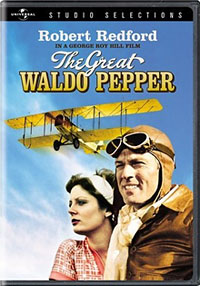

With this week's re-release of The Great Waldo Pepper on DVD
The Great Waldo Pepper opens in 1926 Kansas, where the titular character (played by Redford at the height of his career) earns a meager living as a barnstorming pilot. Waldo spends his days flying from one tiny Kansas town to the next, performing aerobatic stunts and offering rides to anyone brave enough to fly in his rickety surplus WWI biplane. Faced with dwindling crowds (airplanes no longer are novelties by this time), Waldo hopes to stay in business by teaming up with fellow barnstormer and occasional nemesis Axel Olsson (Bo Svenson). Along with Axel's girlfriend, Mary Beth (Susan Sarandon), the two join a flying circus owned by a gruff huckster named Dillhoefer (Philip Bruns).
While testing his own piloting skills in the flying circus, Waldo also seeks to top his barnstorming idol, German WWI ace Ernst Kessler (Bo Brundin), an elusive figure whose wartime exploits and aerobatic feats are the stuff of legend.
Of course, barnstorming is an exceedingly dangerous line of work, and Dillhoefer's pilots routinely cross the line between awe-inspiring bravery and complete foolishness. After two tragic events ground the aerial circus, Waldo and Axel head for Hollywood, hoping to find new careers that will satisfy their thrillseeking addictions and lust for stardom.
After seeing The Great Waldo Pepper again on DVD -- I saw it during its theatrical release and again on VHS years later -- I'm still firmly ambivalent about its artistic merits. On the positive side, it's an entertaining tale that captures the allure and freedom of flying with great visual poetry. It's also a warmly nostalgic look at a small-town America that has long since vanished. Waldo's story is a familiar, somewhat wistful coming-of-age tale: He's torn between his youthful, idealistic dreams of glory and the reality that he -- along with the aviation industry -- is maturing and expected to take on grown-up responsibilities. On a deeper level, his rapidly changing life is a metaphor for the rapidly changing world around him, a world that is increasingly urban, mechanized and complicated.
On the other hand, the film suffers greatly from underwritten, one-dimensional characters. Waldo reveals some of his backstory and worldview, and Redford's golden-boy charisma often carries the film. But the other characters are more plot devices than actual people; we know so little about them that when a few of them meet horrible ends, their fates evoke little emotional reaction. Worst of all, the female characters are merely afterthoughts. Mary Beth is stereotypically ditzy, and Waldo's girlfriend, Maude (Margot Kidder), has a scant few minutes of screen time. Rather than developing into a fully realized love interest who might give Waldo a reason to give up his daredevil ways, she merely begs her man to settle down and get married. With its emphasis on aerial theatrics over human relationships, the film has been criticized as a "guy movie." I totally agree, and in their own way, guy movies are every bit as annoying as chick flicks.
The Great Waldo Pepper also is overly sentimental at times, with pilots mistily reminiscing about their glorious, chivalrous combat experiences. (If war is hell, you wouldn't know it from listening to their stories.) And the ending, although filmed beautifully enough to qualify as artsy, is a bit too ethereal and sepia-toned for my taste.
Anyway, while there is room for debate about The Great Waldo Pepper's scripting, no one would argue that its aerial sequences are boring. The film has long been a favorite of aviation buffs, and for a very good reason. Its sweeping shots of vintage airplanes in flight are breathtaking, as the planes dive, loop, roar overhead at treetop level and engage in thrilling dogfights. The wing-walking scenes are true nail-biters -- and amazingly, they're all completely real. Demanding authenticity, director George Roy Hill filmed all the flying sequences using real planes in the air, rather than in a studio. Famed stunt pilot Frank Tallman supervised all the flight sequences, and his mastery of aerial filming is almost reason enough to see the film. (Tallman worked similar magic in It's a Mad Mad Mad Mad World, Catch-22 and more than a dozen other films of the 1960s and 1970s.)
Unfortunately, even the film's most ardent fans may find the new DVD
Austin Connections: Although set in Kansas and California, The Great Waldo Pepper was filmed mostly in the Central Texas towns of Elgin, Lockhart, Kerrville, Seguin and Floresville. Redford has many ties to Austin; his mother's family lived here, and he spent many childhood summers swimming in Barton Springs. He has been a longtime supporter of the Austin film industry and local environmental initiatives.
Where's Waldo? (that line always kills me!)
I think your appraisal of the film hits pretty close to the mark, although your comments about the pilot's view of war are off a tad. In World War One, pilots really did have respect for their enemies and their skill. Each side knew who the other's best pilots were by name. This was even true to an extent in WW2. It wasn't uncommon for pilots to hope they went up against so-and-so.
Frankly I'm glad the love story was minimal. This film didn't need it. Besides, it already had a love story; Waldo's romantic feelings were for an era he was only peripherally allowed to experience, and he was obsessed by it. Force a love story into a tale like this and you get Pearl Harbor.
Personally, I love the moments when Waldo sees Kessler's plane, and meets his hero. For the first time in Waldo's life, he can be honest.
This film admittedly appeals mostly to we aviation buffs, no question. But for an aviation film I think it had plenty of heart.