

'Temple Grandin' Biopic Screening Brings Autism Advocate to Austin

On Thursday, HBO and Austin Film Festival (AFF) teamed up for a special regional premiere of the locally shot HBO's new docudrama, Temple Grandin, the story of a woman who pioneered changes in cattle management and turned into a powerful advocate for understanding autism.
The reception was held in the same exhibit hall as SXSW at the Austin Convention Center, but used the entire space, with one half a reception area with open bar and several food stations. The stations included some film-specific themed concoctions, including Jello shots (shown above) and sliders. The sliders were tasty, and I hate to admit it, but so was the Jello.
The red carpet was very casual, with Grandin frequently approached by people thanking her for her work, making it less of a spectacle than normal, especially since it was an indoor red carpet. All were grateful for that, as it was a rainy night. Despite the rain, there was a high turnout; the reservation list was closed a week early as the response was so strong. Several groups were invited, not just AFF members and those associated with the production, but a local autism group and cattle association as well.
The film itself began with introductions and gratitude to everyone present involved with the film, directly and indirectly. Director Mick Jackson effusively thanked the city of Austin for its involvement with the production, as well as all the cast and crew. I recognized quite a few faces as extras, particularly in a scene shot in the Austin Convention Center itself. During Jackson's remarks, he mentioned that HBO has its own herd of 30 cattle, purchased to make the film.
Jenni Sherwood, vice president of HBO Films, was also in attendance, and agreed it was not only a "great experience" but that "we will be back" so Austin and central Texas can look forward to more productions from HBO. Austin and Bastrop, and surrounding areas such as Southwestern University, were stand-ins for locations in New Hampshire and Arizona.
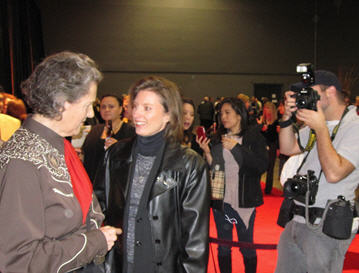 Temple Grandin spoke before the start of the film, but saved most of her remarks for afterwards, when she gave a Q&A after some remarks about autism.
As the film started, it seemed like the sound was exceptionally loud, but in fact, was intentional sound design. The sound design brilliantly if somewhat painfully for this migraineur captures the overwhelming quality of sound for someone who has few filters for external stimuli.
Temple Grandin is not only a biopic, but an experiential piece focusing on what the perceptions of an autistic as well as those around them. The sound design isn't the only perception device used; on several occasions the shot immediately after someone tells Temple something illustrates the way she perceives the words. It helps understand how Temple thinks and perceives by extension, how other autistics do as well.
Clare Danes as Grandin may seem like surprising casting, but it's brilliant. She captures a certain sharply observant gawkiness, and while not always flattering, very, very human. But not to be overlooked is Julia Ormond, as the mother who only wants her child to flourish in the world more than she wants to hold her. As an autistic, human touch like a hug is overwhelming, so it's painfully poignant to see. The rest of the cast is not to be slighted, with David Strathairn as the high school teacher who helps her blossom as a student and future scientist, and Catherine O'Hara as an equally understanding aunt.
Behavior and perception is an important part of the story, but it goes beyond autism. Dr. Grandin revolutionized cattle management by studying behaviors and communication, and developing systems that reduce stress in cattle not only in feed lots, but the slaughterhouse as well, making the process more humane as well as cost-effective.
Being a local production made the audience particularly receptive, but the standing ovation was heartfelt, not just because of the connections to the production, but to the story itself and the masterful way it was put together. Dr. Grandin's remarks after the film included not only her obvious support for the project in general, but that Clare Danes captured her experiences in the roughly 20-year period focused on in the film.
Perhaps the most important scene is the final one, which sums up the perception of autism and the importance of Dr. Grandin's story. Even today, an "autistic" diagnosis immediately restricts a child's potential, yet despite the stigma and a doctor's recommendation of institutionalization, Grandin is a world renowned PhD, making her story an important one. Dr. Grandin defies stereotype, not only being a highly educated woman who revolutionized the cattle industry, but an articulate speaker who seemed at her ease among hundreds of strangers.
 In the post-film remarks, Dr. Grandin, a self-proclaimed geek, talked about few inaccuracies, which, despite dramatic license, helped drive the story. She also talked about the fear component, and used an analogy of being in a roomful of snakes and feeling like you're in one all the time. Dr. Grandin answered several questions on autism, with tips such as "the worst thing you can do is nothing" to how she learned about social graces such as not chewing with your mouth open, and how director Mick Jackson "got into my head and how my mind works... man, the geek side of me was really really turned on."
She also made a point to mention not only that her actual drawings were used in the film, but that the Capitol Land and Livestock company built one of her devices for the film. Someone from the Sam Kane company profusely thanked her during the Q&A for the value her work has brought to his own company.
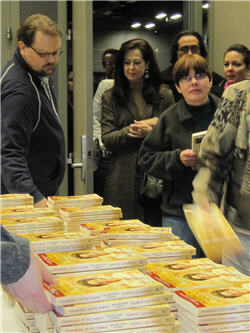
I couldn't help but think of herd patterns as we all filed out of the theater space into the open reception area, to the doors. But even more, thinking about that not only was this a very topical film, but a very good one. Austin Film Festival staff were just outside the exhibit hall doors to hand out films.
Temple Grandin premiered on HBO last Saturday night, and is available through HBO On Demand. Just remember to not adjust the volume when watching it to get the fullest experience out of this powerful film.