

New Technology
Get Ready for the Big Gig: Google Fiber in Austin

So have you heard that Google Fiber is coming to Austin?
Of course you have -- you're a film fan. Whether you create, study or just watch movies, you engage in the one art and entertainment form that chews through network bandwidth and hungers for more.
On Tuesday morning, Google and the City of Austin held a joint event confirming the worst-kept secret in city history: Google will build a gigabit speed, fiber-based Internet access network in Austin. The company will be the fourth entrant in the Austin residential wireline broadband market, joining Time Warner Cable, AT&T and Grande Communications.
Here's what we know so far: The service offerings will be similar to what Google does in Kansas City, their first fiber market. That includes a gigabit broadband service ($70/mo), gigabit broadband with high-def TV channels ($120/mo) and a megabit broadband service (free for 7 years, with $300 install fee). Note: Those are Kansas City prices. Google has stated multiple times the Austin pricing is uncertain -- except for the free service, which they assure us will indeed be free.
SXSWedu 2012: A Filmmaker in Design Land
 Everyone's familiar with the ongoing discussion about how the film and video game industries fit together. In this era of Doom live-action features and Harry Potter videogames, it's inevitable that the two industries would be talked about side by side. But the topic often turns heated, as film and game producers try to protect the integrity of their medium. "Can I make a movie of your game?" "Can I make a game out of your movie?" Stalemate.
From an education perspective, film and games are both great tools for teaching key academic concepts and improving student personal and social development. Both media have slowly crept into schools as a way to engage kids and excite them about learning. As the Austin Film Society's Community Education Manager, this type of programming is part of my world every day. Our Film Club afterschool program works with Austin Independent School District students daily on everything from claymation to documentaries, all with the goal of creating citizens of the 21st century. Being in Austin, with such a robust video game community, means I'm inevitably asked about video game curriculum. "Do you teach that?" "Could you and would you teach games?"
As part of the Austin Film Society's mission to explore game design curriculum, I recently attended the AMD Game On! Workshop, which was offered as an opening component of SXSWedu. The event consisted of three in-depth demonstrations of game technologies being used in K-12 classrooms. It was not only a fascinating workshop, but invigorating! I wanted to run home and write lesson plans. (Read: signs you know you're in education.)
B-Side Festival Genius is Back!
 File this under Couldn't Be Happier Unless I Had Angel Money to Do This Myself... Austin-based B-Side has been acquired by Slated, and the much missed B-Side Festival Genius has been licensed to long time indie nonprofit IFP.
Just announced Thursday night, the film community rejoiced that the best technological tool for film festivals has been revived. People were downright twitterpated, you could say. I'm re-using the same picture Jette used when she had to announce the sad news about B-Side closing its doors, because, well, B-Side founder Chris Hyams looks equally celebratory and defiant, and that attitude seems to have helped B-Side find a new home.
Personally I could not be happier for Chris and the core members of his team (Chris Holland, Jesse Trussell and Mike McCown) who are all back to work a mere six weeks after the unexpected announcement that B-Side was closing its offices. Hyams and McCown go to Slated, Holland and Trussell to IFP. I speak for Slackerwood and perhaps all of Austin’s film geeks in saying congratulations, guys. These last few weeks must’ve been tough, but we’re very glad to see you land on your feet, and even gladder that a great company and a great tool aren’t left languishing.
If you’re not familiar with IFP, they’re the oldest and largest organization of -- and advocate for -- independent filmmakers. Slated is a New York-based entertainment and media company.
Because We Love Cheap Beer and High-Speed Internet: Co-Sponsoring Big Gig Austin Happy Hour
 Slackerwood is happy to be a co-sponsor of the "How Can Google Not Love Us?" happy hour on Tuesday, March 23 from 5:30 to 8:30 pm at The Highball. Check out the Facebook invite for more info on drink specials and whatnot. I suspect I don't need to tell most of you where The Highball is.
In addition, Slackerwood has signed on as a supporter of Big Gig Austin. You may be wondering why a website about movies is interested in an initiative to bring the Google Fiber Network to Austin. It's a no-brainer: Faster network speeds mean we can watch more movies online at a higher picture quality. Film geeks who have found out about this initiative are salivating.
Sure, I can go to Hulu right now and watch Slacker online, and it looks just fine ... unless it's a busy time of day and the network is dragging. But imagine watching Terrence Malick's Days of Heaven with the same exquisite quality on the Criterion Blu-Ray that's releasing this week. (Yes, we'll have a review. I saw it and whatever else I might think of the film, it is visually breathtaking.) Imagine a network that isn't going to drag when everyone in town seems to have a wild hair for watching things online, like the Presidential inauguration.
Videobloggers and Filmmaking at VideoCamp Austin
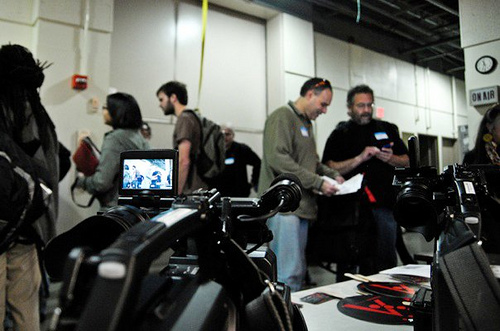
Over 175 people attended the first VideoCamp Austin last Saturday, February 27, and the event was a rousing success. Co-organizers Talmadge Boyd and Weston Norton of Reel Social Media and Lights. Camera. Help. co-founder David Neff coordinated the event, which took place at The University of Texas at Austin's Jesse H. Jones Communication Center. Local aspiring filmmakers and videobloggers learned techniques and tricks of the trade from fellow attendees with years of experience.
VideoCamp Austin followed the barcamp model of the "unconference," in which a large piece of paper was taped to the wall with a handwritten schedule on it. Sessions were written on stickies and then placed in open time slots. Folks who showed up early to sign up had an idea of what they wanted to talk about, such as Arts from the Streets filmmaker Layton Blaylock's presentation on making a documentary. However, spontaneity was the main focus, as Rachel Farris of PetRelocation.com learned. She didn't have a presentation prepped, but used PetRelocation's Pup in the Air videos to demonstrative the effectiveness of "Using Online Video in Your Business." Air Sex World Championship host Chris Trew of The New Movement taught an "Improv Comedy in a Video and Filmmaking" session where a few of the attendees were pulled into the demonstration.
Registration Open for VideoCamp Austin
 Next month's VideoCamp Austin event is a free one-day ad-hoc gathering of video, public
relations, new media and marketing professionals born from the desire
for people to learn about best practices in online video production and
distribution in an open environment. David Neff of Lights. Camera. Help. and the American Cancer Society, Talmadge Boyd and Weston Norton are coordinating this collaborative event that includes discussions, demos and interaction from participants who are the main
actors of the event. Not surprising, as I'd first met Dave at BarCamp Austin 3 in 2008. Although he shared information about his project SharingHope.tv, the real take-home message I got that day was that non-profit organizations should use online video and documentary filmmaking as a way to convey their messages. With VideoCamp Austin, Dave is taking this mission even further.
Next month's VideoCamp Austin event is a free one-day ad-hoc gathering of video, public
relations, new media and marketing professionals born from the desire
for people to learn about best practices in online video production and
distribution in an open environment. David Neff of Lights. Camera. Help. and the American Cancer Society, Talmadge Boyd and Weston Norton are coordinating this collaborative event that includes discussions, demos and interaction from participants who are the main
actors of the event. Not surprising, as I'd first met Dave at BarCamp Austin 3 in 2008. Although he shared information about his project SharingHope.tv, the real take-home message I got that day was that non-profit organizations should use online video and documentary filmmaking as a way to convey their messages. With VideoCamp Austin, Dave is taking this mission even further.
VideoCamp Austin will be held on February 27 from 10 am to 4 pm on the University of Texas campus at CMB Building UT Campus, Studio 4B. The event is being organized in a "barcamp" style, that is, it is an ad-hoc rather than pre-determined schedule. Barcamps are an international network of user generated conferences -- open, participatory workshop-events, with content is provided by participants. The first Barcamps focused on early-stage web applications and related open-source technologies, but the format is now widely applied to a variety of other topics, including social media tools and now video and filmmaking.
2009 in Review: Biggest Geek Uprising
Don't piss off the geeks. They've got their Twitters and they know how to use them.
We found that out back in April, when Time Warner Cable (TWC) announced that Austin would be one of four cities in the nation to get "consumption-based billing." The proposal was to cap the standard broadband Internet plan and then charge extra for usage over the cap.
The proposal was portrayed as an issue of fairness -- a way to manage excessive or abusive users. In reality, it was a shot directly at emerging online video usage.
Standard definition video requires about 1GB/hour bandwidth. That means there will be about 1 gigabyte of data transferred for every hour you watch video. So a 20GB cap means you have sufficient bandwidth to watch about 20 hours of video.
If you reach your usage cap and try to stream a movie across your Internet connection, TWC is going to assess a surcharge. You’d pay about $2 for a typical movie. [...] High-definition video is worse. It uses about 2GB-4GB/hour, so that surcharge could jump as high as $8 for a single high-def movie.
The geeks were irate. The issue became the talk of the town, and was covered nationally. By the end of April, TWC announced that the plan would be suspended while they conduct a "customer education process." (shudder)
Consumption-based billing has not returned -- yet. Online video remains a serious threat to cable video, so none of us believe that we've heard the last on this issue.
The D-Box Experience During 'Terminator Salvation'

Editor's Note: The following report is from Aaron Zern and James Curry, who went to one of the first screenings of Terminator Salvation in Austin and sat in the new D-Box seats, the ones that Chris Holland tried out. I was interested to hear how the seats felt during a whole feature film, and thought I'd share their discoveries. (Thanks, guys!)
D-Box seats are billed as "The next Dimension of your cinematic experience. Taking you literally inside the movie" and the promotional material explains that "Using advanced proprietary robotics and commercial-grade motion technology, D-BOX Motion Code immerses theatregoers into the heart of the action. The experience is nothing short of stunning." Rhetoric so dramatic that it would lead you to opine that D-Box represents an advance akin to that between going to see a moving picture, and going to see one of those fabulous new talking pictures with sound. Common sense, on the other hand, would lend itself to suggesting that a gyrating seat in a darkened theater is more likely a leap between going to see a moving picture and going to see a moving picture while being made to feel slightly queasy.
At Galaxy Highland, we were ushered into the theater a little ahead of those with regular tickets and invited to take our seats in the D-Box section, 22 seats spanning two rows about halfway up from the screen.
Austin's Digital Television Divide
 When it comes to things digital, we like to think of Austin as a national leader. And we mean "leader" in the good way. That's why it's so surprising that according to a report by Nielsen published last week, Austin is the fourth least prepared city in the nation for the upcoming digital television transition.
On Friday, June 12, 2009 – less than two weeks from now! – all full-power television stations will cease "analog" transmissions and will broadcast only a "digital" television signal. This affects all households that receive over-the-air television via rabbit ears or rooftop antenna. Preparing for DTV is usually pretty easy. Older televisions can receive digital signals with the addition of a low-cost digital converter box.
As it currently stands, 30,000 central Texas households could lose their television reception when the transition occurs. The City of Austin regards this as a serious public safety concern. Rondella Hawkins, Manager of the City's Office of Telecommunications and Regulatory Affairs noted, "Television is a primary source for news, weather and public safety information for many Austinites."
To help remaining residents across the digital television divide, the city has scheduled a Walk-In DTV Help Clinic that will be open June 3-12.
Time is running short, but it's not too late. For more information about the DTV transition, visit http://www.ci.austin.tx.us/telecom/dtv.htm or http://www.dtv.gov/.
Photo credit: "Digital TV Coupons" by Gary Hunt. Found on Flickr and used under Creative Commons license.
D-Box Motion Code Seats at Galaxy Highland - Bring the Dramamine
Created with Admarket's flickrSLiDR.
This past Wednesday I attended a reception held by D-Box Motion Code and the Galaxy Highland 20 Theaters in Austin celebrating the installation of twenty D-Box motion seats in one of the theater's auditoriums. The seats use three motors and "intelligent vibrations" to bring a new element to movie watching: coordinated motion and vibrations timed to the picture's soundtrack. The result is something like those flight simulator rides at amusement parks (MGM's Star Tours comes to mind), which use the power of visual suggestion combined with motion to convey a moderately intense physical experience.
The reception included both a standalone demo unit (the two seats pictured together) and a full-immersion experience using about fifteen minutes of the new film Terminator: Salvation. While the seats deliver the expected bumps and rolls during explosions and car chases, there are a few more subtle touches that I actually found quite clever. When one character starts a car, the seat vibrates slightly to the purr of the engine while the characters hold a conversation.
