

AFF09: Debbie's Conference Wrap-up
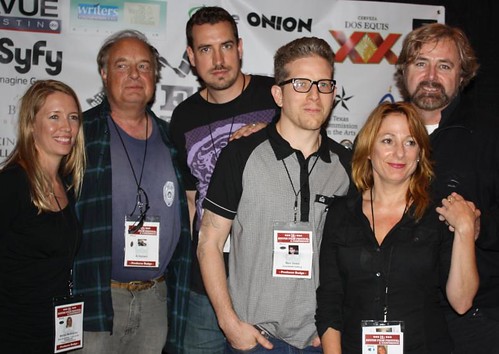
This is the first year that I've attended panels during the conference portion of Austin Film Festival (AFF). Overall I'd say that I was not disappointed, other than the disadvantage of having to miss some screenings I'd really wanted to see such as the screening of Texas Weather at the Texas Spirit Theater.
I thoroughly enjoyed the honest and informative "Texas Film Incentives" panel with Paul Alvarado-Dykstra, Central Texas Representative of the Texas Motion Picture Alliance (TXMPA), along with filmmakers James Crowley (The Rookie, Hidalgo) and Dominic Cancilla (Hope Floats, A Scanner Darkly).
James talked about the high quality of production crews in Texas, with Dominic pointing out that Dicky Deats is the only key grip ever to win an Academy Award, for Hope Floats. During the discussion it was also confirmed that Whip It, which shot primarily in Michigan, is still waiting for incentives because funds are depleted in some other states' incentive programs.
Paul spoke about the details of the Texas Production Incentives Program. The new program allows eligible qualifying projects to receive an incentive payment of up to 15 percent of eligible Texas spending. Program qualifications include:
- Minimum Texas spending of $250,000 (for episodic television series, $250,000 per season).
- At least 60 percent of shooting days must be completed in Texas.
- At least 70 percent of the total number of paid crew must be Texas residents.
- At least 70 percent of the total number of paid cast, including extras, must be Texas residents.
The state of Texas is also not required to make payments to projects that include inappropriate content or content that portrays Texas or Texans in a negative fashion.
Film projects may choose to receive an incentive payment based on either total Texas spending (including wages) or wages paid directly to Texas residents. Panelists recommended Option B because although it may maximizes incentive payments, Option B requires less documentation resulting in quicker payments. Projects that complete at least 25% percent of their total shooting days in an underutilized or economically distressed area of Texas are eligible to have an additional amount added to their incentive payment percentage, varying between Option A and B.
As informative as the incentives panel was, my favorite panel at AFF this year was "Documentaries from the Ground Up." Moderated by Fred Strype, panelists included Ben Velez and Shan Nicholson (Downtown Calling), Al Reinert (For All Mankind), Melina McKinnon (Torey's Distraction and Bob Schneider Live at the Paramount) and Nicole Torre (Houston We Have a Problem).
The contrast between Reinert's eight years to raise funds for his documentary and Velez/Nicholson's self-described "guerilla filmmaking" created a dynamic discussion between all the panelists about financing and distribution. Music licensing appeared to be a stumbling block for several of the filmmakers, from the cost involved to the time and resources involved in securing music.
Melina McKinnon spoke briefly about the filmanthropy model, which is the focus of the M3 Films division "Making Movies with a Message." I was intrigued by her statement that "the difference between me and an independent filmmaker is ... I'm not going to tell you that you are getting your money back." Their model is based on the premise that investors invest "because it is good for the soul," and many of their projects are meant to live on as educational tools.
The final take-home message from all the panelists: Help people get their visions to the screen, and have confidence to really go for it. Individuals with no particular education end up changing the world.
[Photo credit: After the Panel Session with (L-R) Melina McKinnon, Al Reinert, Shan Nicholson, Ben Velez, Nicole Torre and Fred Strype, by Debbie Cerda on Flickr]