

Review: Anna Karenina
My high-school class once spent an afternoon watching the 1956 movie War and Peace, and we susceptible sophomores fell hard for the Hollywood-ized love story with Audrey Hepburn, swoony Mel Ferrer and Henry Fonda (despite that flat drawl of "Nataaaahsha," all I can remember about the film now). I decided it would be fun to read Leo Tolstoy's novel (I was also show-offy, but never mind). I found out quickly that the story we adored in the movie was only a small, stripped-down part of a far more complicated novel, which included more of the war and much less of the romance. Plus, everyone had 10 names. The epilogues in particular were quite disappointing. At age 15, I preferred Hollywood over epic Russian literature.
The latest lavish adaptation of Anna Karenina, like that version of War and Peace, focuses is on love and romance and passion, although at least this time the accents are harmonious and the tragic ending remains. The tagline is "You can't ask why about love" and some press materials I received call it "A bold new vision of Tolstoy's epic of love." I'm not sure how Tolstoy would feel about the implication that Love Is All, but if he were going to turn over in his grave he would have done so decades ago. Besides, how many people watching this movie have actually read the novel? (I haven't.) I'd believe that filmmaker Joe Wright would focus on the romantic aspects, judging by his 2005 Pride and Prejudice adaptation, but the script is written by Tom Stoppard, who I hoped would be more subtle.
Anna Karenina is about a woman who falls prey to True Love and decides to follow it no matter what happens to her or anyone else, and then realizes that the price she is paying is pretty damn harsh. Kiera Knightley plays the title character, who not only cheats on her dull, older husband (Jude Law) with the dashing and passionate Count Vronsky (Aaron Taylor-Johnson) but violates social mores by being public about it. If they'd only just hidden their affair, things might have been fine, but their love is just too passionate and amazing and strong to be kept hidden, especially by Anna.
Various subplots also tend to focus on Love. Anna's brother Oblonsky (Matthew Macfayden) is trying to repair his marriage after his wife Dolly catches him in an affair with the governess, but has no intention of stopping his philandering, and Dolly knows it. His friend Levin (Domhnall Gleeson) is deeply in love with Kitty (Alicia Vikander), who spurned him for Vronsky. Levin consoles himself by working on his family's farm, refusing to succumb to the depraved pleasures encouraged by Oblonsky. And then there is Anna's deep maternal love for her young son.
Wright and Stoppard have set Anna Karenina in the context of a staged performance. The first 20 minutes in particular are a whirl of scenes on a stage to set up the background and plot. Unfortunately, that whirl is more confusing than enlightening, and I felt extremely frustrated -- I couldn't figure out who was married to whom and what in the world was going on. It takes nearly a half-hour for the movie to settle into its style, and to understand that the level of staginess in a given scene reflects the reality of the characters and their emotions at the time. The farm scenes are all outdoors and on location, perhaps to show the novel's reflections on agrarian versus city living. But I found the device more distracting than revealing.
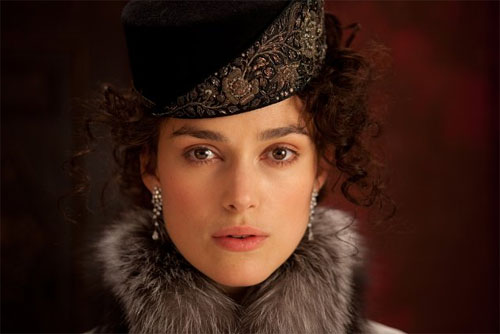
Even if you haven't read the novel, a sense of doom prevails. The movie is more than two hours long and once Anna makes her big choice in favor of Love, you know it's not going to end well. Various moments of foreshadowing that are sledgehammer-subtle. One difficulty is that the lead performances are not especially complex nor sympathetic. As portrayed by Knightley and Johnson (yes, the Kick-Ass guy), the two leads are defined primarily by passion and love, which frankly gets a little dull to watch after awhile. (Anna has some marvelous hats, though.) The gem of a performance in this movie is Jude Law, looking far more unattractive than Law should, as Anna's husband Karenin. In the opening scenes, I didn't expect much of him, but he shows more depth than most of the other characters put together. Kelly Macdonald, as poor patient Dolly, also stands out.
The score, from Dario Marianelli, is perfect and not too obtrusive, and Seamus McGarvey's cinematography makes use of light and shadow contrasts in beautiful ways. I loved some of the individual scenes: Levin and Kitty's reunion scene in a drawing room; Oblonsky arriving and leaving his office; Anna at the races; Dolly admitting her admiration for Anna; Karenin receiving Anna's note. But overall, the movie held too few charms for me. Perhaps I'm too old to be swayed by An Epic of Love, or at least one as unsurprising and routine as this Anna Karenina adaptation. If we could send it back in time, my 15-year-old self might have cried her eyes out and longed for Vronsky; these days, I'd rather watch The Red Shoes, which combines many of the same elements in a more intricate, vibrant and compelling way.