

Review: A Late Quartet
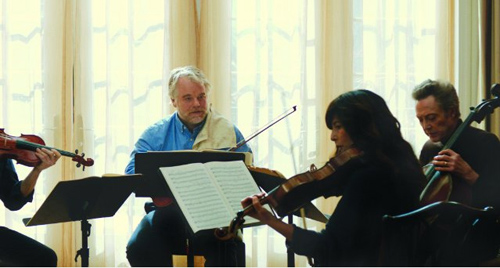
The chamber music-themed drama A Late Quartet is the kind of movie that film critics and our culturally elitist friends so want to like. We would love to discuss the film's mastery of metaphor over a few pints of craft-brewed beer, or turn down the volume on All Things Considered while en route to Whole Foods in our Prii (yes, the plural of Prius is Prii) and ask our passengers, "Wasn't Philip Seymour Hoffman's performance astonishing?"
Alas, there can be no such discussions. While the erudite and painfully highbrow A Late Quartet is straight out of Stuff White People Like, it's also mostly a bore.
Which is a pity, because the film has many essential ingredients of an entertaining meditation on music as a reflection of human nature, the sort of high-culture anti-Twilight that excites those of us with discerning (and slightly snobby) taste in film. Aside from Hoffman, the cast includes Catherine Keener! And Christopher Walken playing against type! And Wallace Shawn! And lots of Manhattan locales! And lots of Beethoven! And to keep things from becoming too stuffy, a gratuitous sex scene with gratuitous nudity!
A Late Quartet also has a promising storyline with plenty of avenues for dramatic tension. The film follows the members of a world-renowned string quartet as they prepare for their 25th anniversary concert, which will feature Beethoven's Opus 131 String Quartet in C-sharp minor. (Yeah, you know it, right?) The four musicians have had their share of minor differences over the years, but they've always managed to overcome their problems and focus on creating great music.
As the concert date approaches, cellist Peter (Walken) learns he has a devastating disease that will end his career and eventually his life. The diagnosis further strains the quartet's already complicated relationships: Second violinist Robert (Hoffman) and violist Juliette (Keener) endure a rocky marriage, and first violinist Daniel (Mark Ivanir) can barely resist the flirtations of Robert and Juliette's daughter Alexandra (Imogen Poots), who's half Mark's age. When Peter's disease forces everyone to make difficult choices, the simmering tensions and passions boil to the surface, threatening the quartet's future.
Obviously, the quartet's dramatic musical performances mirror the drama in their personal lives; this is the point of A Late Quartet, which is cleverly structured around the varying moods of Opus 131's seven movements. Like many of the film's elements, this device should make for an interesting study of the relationship between music and life. The music captures the pathos of Peter's grim future and the tension of second-fiddle Robert's burning jealousy of Daniel, along with the sensuousness of Daniel's reluctant lust for Alexandra and everyone's triumphant joy over playing a passage just right after hours of practice.
But while all this artsy sophistication and indie star power should make A Late Quartet a hit among the NPR set, it probably won't be. It's just too dull; even the film's solid performances, occasional humor and confrontational sparks can't overcome the mostly lifeless script and sometimes plodding direction. A Late Quartet is emotionally flat and lacks any real dramatic punch. And while I appreciate a good slow-paced gabfest, the ceaseless gab in A Late Quartet isn't original or clever enough to make us care much about the characters or story.
When the characters seldom say or do much of interest, it's a challenge even for A-list actors to deliver memorable performances. But the A-listers in A Late Quartet do the best they can with mediocre parts; their work no doubt elevates the film beyond what it would have been without such megawatt talent. Walken is the best of the lot with his understated take on Peter, a believable portrait of a man coming to grips with the end of his musical career. Best known for playing quirky, creepy, quietly menacing types, Walken is equally comfortable in the skin of a sensitive musician stoically confronting a cruel fate.
Despite A Late Quartet's fundamental flaws, all is not lost. The classical score is expectedly lush. The camerawork is equally so; New York in winter looks welcoming and even cozy. And the film is a rare window into the world of classical music, a surprisingly ego-driven world -- at least according to A Late Quartet -- where musicians have great respect for the music while also seeing it as a tool to further their careers.
A Late Quartet is an entirely noble effort to pay homage to classical music, and I wish it had lived up to its potential. With a more captivating story, it would be a fine tribute to the best our culture has to offer.
[Editor's Note: Mr. Clinchy is a card-carrying NPR listener who drives a Prius and has been spotted in public consuming craft beer.]