

Doc Night Provides a Look Inside the Life of an Artist
 By Olivia Calderon-Stucky
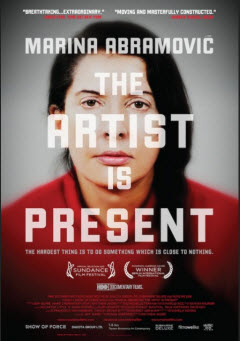
Recently at the Alamo Drafthouse on South Lamar, Austin had its first-ever viewing of Marina Abramovic: The Artist Is Present as part of the Austin Film Society's monthly Doc Nights. The film's Austin premiere featured director Matthew Akers in attendance. He was in Austin to serve on this year's Texas Filmmakers' Production Fund jury.
Beginning with her retrospective show at the MoMA in 2010, Marina Abramovic: The Artist Is Present intimately captures Abramovic's world from the hectic months leading up to the show to its final bittersweet night. Along the way, audiences glimpse pieces of the artist: from her manifesto delivered to an Italian audience to her past life with fellow artist and collaborator Uwe Laysiepen, who also appeared in the documentary for a sort of engineered once-lovers' reunion. The movie is as fearless and provocative as the artist herself and I left the theatre feeling the full weight of the emotionally charged experience.
"Marina seduces everyone she meets," explains the curator of her MoMA show, and I agreed with the thought. I felt wholly taken with her as a person and as the artist with her aura. For her opus of a show, Abramovic became the exhibit, sitting for more than seven hours every day for three months in the museum. The space looked like a film set and viewers would sit in front of Abramovic, as she held them in her unwavering gaze. Through this process the public became unquestionably, inescapably part of the piece.
Abramovic exhibited her enviable drive and stamina. In Marina Abramovic: The Artist Is Present, she says an artist "must be a warrior and must conquer new territory ... himself ... his weaknesses ... This is my cross to bear." Certainly she is an iconoclastic figure of late 20th century art. Her performance pieces caused many to question her sanity, as the works often involved graphic and violent bodily threatening acts. Now in her 60s, Abramovic explains that she is tired of being "alternative" and wants respect. As she was trying to make herself and her work accessible to everyone, what better way than Akers' filming to add an extra layer to this endeavor.
During the post-film Q&A session, Akers was quick to admit his initial skepticism with the project. He had little knowledge of performance art, but after meeting Abramovic, who regaled him with a key to her apartment within a week of starting the project, he said it was a refreshing experience. "She is just a fun person to be around," Akers said. "It was nice to be filming someone who wanted me there." Akers shot hours and hours of footage, some of which will be available on the film's DVD.
What didn't make it in the documentary? Akers lamented that he had gotten clearance to shoot the museum security guard meetings, but at the last minute the museum backed out. Someone asked exactly what I was wondering during the film, which is what Abramovic thought of the film. Akers amusingly stated that after showing her a rough cut, she was decidedly shocked and gave him 16 pages of notes. He took none of them. This film is shot verité but it is very much subjective. Akers is laudable in his capturing of a world unknown to many outside of the art world and was able to create a work that very much stands on its own.
Marina Abramovic: The Artist Is Present paints its title subject as complex and intriguing, and also challenges audiences to consider performance art and its relation to greater human experience, all the while captivating us with a multifaceted and arresting woman. I recommend the film for art connoisseurs and novices alike as well as anyone who enjoys a genuinely engaging movie.
Olivia Calderon-Stucky is an intern at the Austin Film Society.