

Review: Ruby Sparks
I'm all for romance and comedy, but I've never been a fan of romantic comedies. My problem with them lies less in the concept than the execution; most rom-coms are clichéd, formulaic, dumbed-down and totally unrealistic exercises in bad filmmaking. They tell script-by-committee stories wholly detached from the mundane and sometimes harsh realities of real-life dating, with pretty-faced actors portraying characters unlike anyone I know.
So, given that I'm less than smitten with the genre, you may be shocked -- shocked -- to learn that I like Ruby Sparks.
Not totally, mind you, and perhaps somewhat grudgingly. But Ruby Sparks is sufficiently charming, funny, observant and clever that I'll forgive its occasional forays into predictability. It's also about far more than relationships, a rare quality in movies of the romantic persuasion.
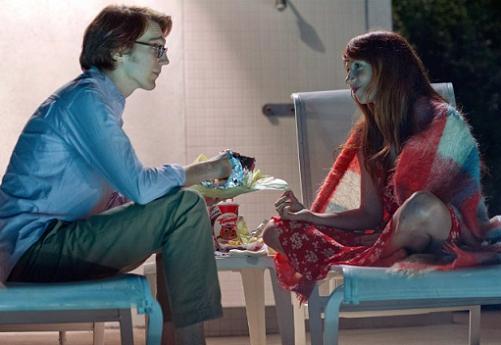
Ruby Sparks's story isn't new, but it feels unexpectedly fresh. Successful but lonely novelist Calvin Weir-Fields (Paul Dano) creates a female character, the titular Ruby (Zoe Kazan, also the film's screenwriter), who miraculously springs to life. She suddenly appears in his house as an incarnation of the ideal girlfriend of his literary fantasies -- among other things, she's painfully cute and a gourmet cook. While the long-single Calvin knows her only from the pages of a manuscript, she acts as if they've been dating for some time.
At first, a somewhat frightened Calvin assumes Ruby is little more than a very realistic hallucination who will disappear as suddenly as she appeared. But she proves to be real, at least real enough to interact with other people including Calvin's brother, Harry (Chris Messina), who is understandably skeptical when Calvin tries to explain Ruby's origins. (In a very funny scene, Calvin convinces Harry -- and also himself -- that he created Ruby by conducting a simple test: He writes a few changes to her character to see if she behaves differently. For example, when he writes that she speaks only French, she indeed starts speaking only French.)
Calvin knows a good thing when he sees it, so he accepts Ruby as his girlfriend and keeps her origins a secret from everyone but Harry; even Ruby is unaware of how she came to be. Admirably, Calvin also locks away the manuscript from whence she came, promising himself he won't rewrite or tweak her to make her a better girlfriend.
In many ways, the story continues in the usual romantic comedy vein; there are slightly cutesy scenes of slightly cutesy dates and a very funny sequence in which Calvin introduces Ruby to his hippy-dippy, über-granola mother and her equally hippy-dippy second husband (hilariously played by Annette Bening and Antonio Banderas). As we also would expect, the relationship gets complicated. Calvin wrote Ruby as an independent woman, and soon enough she wants her space.
It is this desire for independence that makes Ruby Sparks more interesting than the typical rom-com, for Calvin discovers that just as people are complicated, so is writing about them (or in this case, writing them). While he wants his relationship with Ruby to be ideal, he doesn't want to solve their problems the easy way, simply by writing changes to Ruby's behavior.
Ruby Sparks is every bit a romantic comedy, but what intrigues me about the film is that in a larger sense, Calvin's rocky relationship with Ruby is a metaphor for the creative process. When Ruby distances herself from Calvin, her desire for independence is totally believable, but it doesn't fit within Calvin's idealistic vision of the perfect relationship. In this way, Ruby is an incarnation of every novelist's struggle to develop believable characters who behave in believable ways, rather than ways that seem manipulated to fit within the writer's artistic vision of the perfect story.
These parallels to the creative process, along with some deliciously cynical shots at the publishing business, give Ruby Sparks enough depth and substance to elevate it a couple of notches above most films of its kind. It's a thinking person's romantic comedy, a perceptive and often hilarious film with plenty to say about life and literature.
The acting also is terrific, with Dano pulling off his unlikely turn as a romantic lead and Kazan portraying the perfect embodiment of everyone's dream girl, by turns sophisticated and sexy. Again, Bening and Banderas are a hoot as the freer-than-free-spirited Gertrude and Mort, whose casual ways grate on the controlling, uptight Calvin. Steve Googan also is uproariously smarmy as Calvin's lecherous and ever-tippling fellow novelist Langdon Tharp.
My only major criticism of Ruby Sparks is that I didn't like the ending; I can't say why without spoiling it. Also, the story adheres to a few predictable rom-com conventions and is slightly cloying at times, but thankfully it usually favors barbed humor over sentimentality.
In a world of cookie-cutter romantic comedies, Ruby Sparks is an unexpected pleasure. It's the rare blend of romance and insight that will satisfy even rom-com bashers like me who generally avoid the genre.