

Chatting with the Founder/Co-Chairs of Austin Jewish Film Festival
 By Jeremy Simon
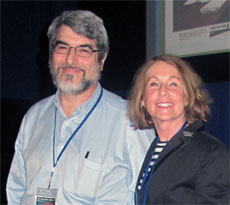
With its most recent festival, which ran from March 24 to 30 this year, the Austin Jewish Film Festival celebrated its 10th anniversary. Now that its one-decade milestone has been reached, AJFF founder David Goldblatt and his co-chair Cindy Pinto took a look back to refresh their memories and ours about just how far the festival has come.
Slackerwood: Describe the origins of the AJFF. When was the festival initially created and why?
David Goldblatt: Since I came to Austin in 1988, I had many discussions with people in the Jewish community about how we needed to have a Jewish film festival here. But it never happened. I got involved with the arts committee of my Synagogue, Agudas Achim, and [they] encouraged me to go to Jackson, Mississippi, to find out about starting a film festival.
In 2002, I went to Jackson to the Jewish Cinema South program of the Goldring Woldenberg Institute of Southern Jewish Life to learn how to do a Jewish Film Festival. When I got back, our committee -- Susan Broockman, Sandy Sack, and Elizabeth Fleschler -- got together to plan our first festival. It took place at the original Alamo Drafthouse on Colorado. We showed five films on four weeknights. We had to turn folks away on the opening night when we showed Shalom Y'all, a really fun history of the Jewish South along with contemporary stories. Brian Bain, the director, came and did our first Q&A. We had people sitting on the railing and in the aisles. It was an auspicious beginning. The following year Cindy Pinto came on as my co-chair.
How has the festival changed over the years?
Cindy Pinto: Our audience has grown enormously. We have four venues (University of Texas, Arbor Cinema, Georgetown and UT Hillel), not one. We have 25 films instead of five. We have more speakers, panels, Q&As and filmmakers. We show more films during the year.
David Goldblatt: We try to bring as many filmmakers and others involved in the making of the films as we are able. We try to make as many connections in the Jewish and larger Austin community and look for films which may draw as many people as we can into the discussion. The quality of the films has improved as we get a little better at picking films and as the quality and diversity of films we [screen] improves. We have witnessed a tremendous improvement in the quality of Israeli film in the past ten years.
When we began it was day to day. We had no idea if we would be able to do it again. It has been an amazing ride. We have met so many interesting folks. We work with the Jewish Community Association closely. Jay Rubin has been a great supporter and a friend. Their support staff in marketing -- led by Emily Cohen -- has been indispensable. Wendy Corn has been a great liaison between us and the JCAA. We work with Bob Abzug, the director of the Schusterman Center for Jewish Studies at UT. He has been a great friend.
One of our most stalwart supporters has been Chale Nafus, the programming director of the Austin Film Society. He has helped us in so many ways. He has introduced us to so many people and great films. Recently he introduced us to Mary Gawron and Johanna Gut-Lehr from the Austin Polish Film Festival. This year we showed three Polish films, two of which we saw first at their festival.
How do you feel about AJFF making it to its 10th anniversary?
Cindy Pinto: The festival has surpassed our wildest dreams. We are very pleased.
What's next for the AJFF?
David Goldblatt: I have no idea what is next, but my most outrageous wish is for some wonderful donor to support the building of a theater on the Dell Campus so that we could have a real home. That would make our festival so much more convenient and efficient. We would be able to do so much more than we are able to do now. Barring that we will press on and get back to screening films and start to plan next year.