

TAMI Flashback: The Legends of Austin
This article is the twelfth in a Slackerwood series about the Texas Archive of the Moving Image (TAMI) video library.
I'm wrapping up a year of the nostalgic TAMI Flashback series by featuring a doubly nostalgic video. The Legends of Austin -- itself nearly a half-century old -- examines more than 70 years of Austin history that came before it.
Produced in 1962 as part of Austin National Bank's Progress Report Austin series, The Legends of Austin is a sequel to a similar program that aired a year earlier. (Sadly, the original video is not in the TAMI library.) This fascinating program presents an eclectic montage of the city's history, with plenty of old photos and stories about Austin's famous citizens.
Much of the film's content is familiar; we've all seen photos of an unpaved (and hopelessly muddy) Congress Avenue, an equally muddy Sixth Street and various long-gone courthouses, hotels and other buildings. But other images are less common, such as a shiny new Braniff airliner at Robert Mueller Municipal Airport in 1935 and a slightly erroneous sign at 11th Street and Congress Avenue marking the Chisholm Trail. (Austin was on the trail, but no one drove cattle up Congress; the herds crossed the Colorado River near the Montopolis Bridge and below Mt. Bonnell.)
The Legends of Austin is full of largely forgotten local history. For example, did you know that Texas A&M University has its roots in Austin? (No kidding. You can pick up your jaw off the floor now.) The famous "castle" house west of Lamar Boulevard housed the Texas Military Institute from 1870 to 1879, when the institute closed and its president and faculty moved to College Station to become the first Texas A&M employees. That's right: Austinites helped found Texas A&M. (Want to annoy your Aggie friends? Tell them this bit of trivia.)
The film's perspective on early to mid-twentieth century history is particularly interesting, because what has now receded into the distant past was still very fresh in the minds of Austinites in 1962. The narrator frequently asks the audience to identify old buildings and locations. As we see a photo of a rural unpaved road, the narrator says, "And now for a younger generation, we'll give you who lived here in 1941 a moment or two to figure out just where you are." The road is Lamar Boulevard "just 21 years ago," we're told. The pastoral images are astounding 70 years later, but I wonder how "historical" these photos seemed to the film's original 1962 audience. Would photos from 1990 seem historical today?
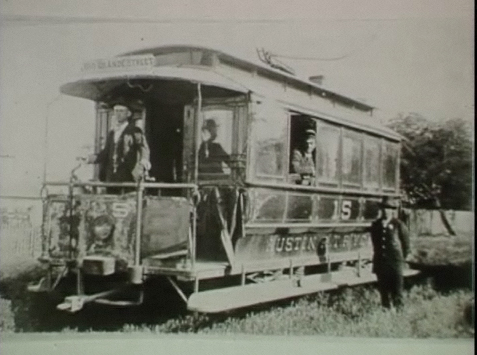
Like many examinations of history, The Legends of Austin also reminds us that everything old is new again. Austin's current commuter rail system has been controversial -- but really now, what's all the fuss about? As we see in the film, Austin had a thriving trolley system from the 1880s until it was dismantled in 1940 in favor of a more "modern" bus system. (Next time you're stuck in Austin traffic behind a bus and see a MetroRail train speed by, ask yourself which mode of transportation is more modern.)
While The Legends of Austin seems to present an accurate historical picture of Austin, it isn't quite as accurate in predicting the future -- and this is a good thing, for it foresees the end of Austin's famous moonlight towers. "The romance of these moonlight towers will disappear in a few years," the narrator laments. "Modern times and new improvements in lighting have made these inefficient for providing light to our city at night. And it's a shame, for anyone who has walked under their glow on a fall evening, watching the shadows around him, knows the beauty they have provided." Fortunately, this prediction did not come to pass; 17 towers remain to this day.
The Legends of Austin also features the requisite midcentury plug for the local chamber of commerce (Austin National Bank sponsored the series, after all). Thus, we see photos of every building that housed the chamber since its inception (in 1869, according to the film; the chamber's website says 1877). The sequence ends with footage of the chamber's then-current location, a sleek midcentury modern building next to Palmer Auditorium. As we hear a grandiose musical score, the camera quickly sweeps around the building. In contrast to the ancient images we've seen, this segment feels thoroughly modern, as if to say the future has arrived in Austin.
The future did arrive, and still it does. But thankfully, we have The Legends of Austin and thousands of other TAMI videos to take us back to the past. Speaking of which, the program ends on an achingly nostalgic note: To the sound of "White Christmas," we see store window displays and holiday lights on Congress Avenue. How could anyone watch this scene without getting misty eyed? I did, and as with so many other TAMI videos, fell in love with Austin all over again.