

Review: Melancholia
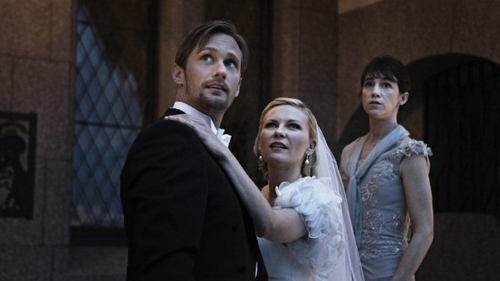
The most aptly titled film I've seen this year is undoubtedly Melancholia.
Lars von Trier's latest movie is dark, dreary and relentlessly dour, as we would expect from a story about family discord and the end of the world. There is, however, a striking beauty to Melancholia, a film full of memorably surreal imagery.
Melancholia follows the strained relationship of two sisters, newlywed Justine (Kirsten Dunst) and scandalously wealthy Claire (Charlotte Gainsbourg), who has the unenviable task of coordinating a highly overproduced wedding reception for Justine and her husband, Michael (Alexander Skarsgård). The film's first half focuses on what is mostly a party from hell: As if the fancy festivities aren't enough of a logistical challenge, Justine is your basic depression-addled bridezilla, wandering in and out of the party as she wanders in and out of various moods. (At one point, she disappears on a golf cart to commune with nature; at another, she locks herself in a bathroom for a prolonged soak in the tub.)
The sources of Justine's stress are many. The party is running far behind schedule, and Claire is understandably fed up with Justine's antics. The sisters' mother, Gaby (Charlotte Rampling), seems to carry a grudge against everyone in the family. Justine's ad agency boss, Jack (Stellan Skarsgård), apparently thinks a wedding is no excuse for Justine to take a break from work. Even Justine and Claire's amiable prankster father, Dexter (John Hurt), can't lighten the mood.
Everyone somehow survives the wedding. But the second half of Melancholia prompts us to wonder why they bothered with any of it, for there is a distinct possibility that the titular planet Melancholia will crash into the Earth in a few days.
If the preceding paragraph reads like an absurd joke, it isn't. Thanks to Claire's astronomy buff husband, John (Kiefer Sutherland), we learn that the Earth-dwarfing Melancholia will put on a spectacular show, passing close enough to Earth to fill the sky with its astounding visage. But beyond causing a few unsettling atmospheric disturbances and other inconveniences (among them, thin air and power outages), it poses no danger.
Or does it? Claire, John, their precocious young son, Leo (Cameron Spurr) and Justine spend the film's second half tracking the ever-closer, increasingly menacing planet and considering their fates. Against a horrifying backdrop of possible annihilation, Melancholia builds Justine and Claire's back stories and probes their relationship, which hardly improves despite their attempts at reconciliation.
Again, Melancholia is an entirely glum movie, albeit one with an intriguing premise, some interesting interplay between the characters, and plenty of magnificent visuals. But the images are no less depressing than the story. The planet Melancholia casts a misty, mottled light on the Earth as it approaches; aside from a few contrasting sunlit scenes, most of the action happens either in darkness or an oppressive twilight. The slow-paced Melancholia is every bit a von Trier film; the director is famous for methodically exploring the worst aspects of human nature, and his latest work only compounds his usual cynicism with an added dose of apocalyptic hopelessness.
On the bright side (or maybe only slightly less dark side), Melancholia's superb cast delivers some interesting performances. Justine may be Dunst's most complex character to date, a deeply introspective woman suffering from episodes of debilitating depression. (Her nude scenes seem a bit gratuitous, but they are among the movie's more memorable moments, lushly and tastefully shot.) Gainsbourg is excellent as the frustrated but sympathetic Claire, a weary soul who has done all she can for her ailing sister, but it's never enough.
Veteran actors Rampling and Hurt are also impressive as the sisters' completely mismatched (and, unsurprisingly, divorced) parents: Rampling all shrewish and selfish as Gaby, and Hurt entirely calm, likeable and benevolent as Dexter. I do wish they were given more to do in the film, instead of disappearing after the first half.
I'll give Melancholia an iffy recommendation for von Trier fans and audiences in the mood for some thought-provoking but discouraging cinema. I suppose the film could be a statement about the insignificance of human problems in light of what could go wrong -- after all, when we consider that the Earth could be blown to smithereens, our family quarrels seem rather petty. But any message Melancholia might deliver is all but lost in the film's endlessly bleak outlook and tone.