

Review: The Ides of March
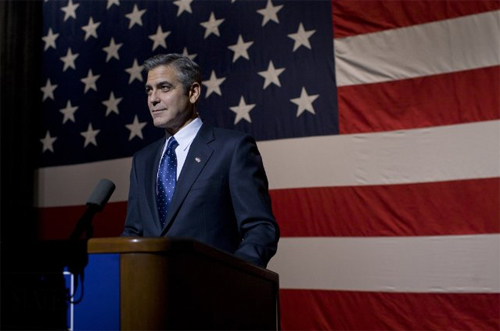
Looking for a feel-good film that will restore your faith in American politics? By all means, skip The Ides of March.
George Clooney's latest directorial effort is cynical to the core, a powerfully bitter statement about the sorry state of our political system. Based on the play Farragut North by Beau Willimon (which, in turn, is loosely based on Howard Dean's 2004 Democratic primary campaign), the movie The Ides of March is less the story of one campaign than an indictment of campaigns in general.
Set during the final days of a hotly contested Ohio Democratic presidential primary, The Ides of March centers on Stephen Myers (the currently ubiquitous Ryan Gosling), a young and idealistic press secretary for Democratic presidential candidate Gov. Mike Morris (Clooney). The race is far closer than it should be, and Morris's victory hinges on an endorsement from Ohio Sen. Thompson (Jeffrey Wright), who, of course, would like something in return. It's up to Morris, Myers and campaign manager Paul Zara (Philip Seymour Hoffman) to secure the endorsement without making a deal they find too unpalatable.
The loyal and hardworking Myers's idealism is short-lived, however, when he becomes involved in a political scandal that threatens to sink Morris's campaign. As much as I'd like to describe the lurid and smartly written nature of the scandal -- as well as other intriguing subplots at the heart of The Ides of March -- I can't say another word without revealing several major spoilers. I'll just say there are multiple machinations at work, and because they come into play early on, it's best not to give more plot details.
The Ides of March is as whip-smart and sharply barbed as any film I've seen this year, with a gripping storyline, crackling dialogue and stellar performances from its A-list cast. Political thrillers usually are relevant to our times, but The Ides of March is especially so as the 2012 U.S. Presidential race takes shape. (I imagine that in the coming months, a campaign or two will quietly deal with scandals not unlike those in The Ides of March, and the public may never be the wiser.) The film has a lot to say about how America conducts the often sordid business of democracy (or perhaps the sarcastically quoted "democracy"), and delivers its dour message with great intelligence and finesse.
As The Ides of March's producer, director, co-writer (with Willimon and Grant Heslov) and co-star, Clooney is due a lot of credit for turning what could have been a vanity project into a laudable piece of filmmaking. His direction is flawlessly paced. His performance as the solidly progressive but not-quite-upstanding Morris is as solid as ever, but his screen time is minimal. He wisely lets Gosling steal the show as the rapidly hardening Myers, whom we suspect may not have been terribly idealistic to begin with. Gosling's Myers is his best role in years, a frustrated, high-minded liberal with a pronounced Machiavellian streak who isn't above exploiting a horrible situation to further his career. (In other words, he'll go far in politics.)
Every performance in The Ides of March is superb; of course, we would expect no less from the likes of Clooney, Gosling, Wright and Hoffman. As if their incandescent presences weren't enough, there is also Paul Giamatti as Tom Duffy, the slithering manager of a rival campaign. Evan Rachel Wood is unabashedly sexy and yet painfully sympathetic as intern Molly Stearns, part femme fatale but mostly a pathetic mess. No less impressive is Marisa Tomei as New York Times reporter Ida Horowicz, who may be the film's only honest (or mostly honest) character.
A taut thriller with implications far beyond its storyline, The Ides of March is an ugly study of an ugly business. But any honest film about politics can be no other way. It's required viewing not only for fans of its stellar cast, but also for anyone interested in the forces -- namely, the eternal lust for money and power -- that shape the political landscape.