

Review: Moneyball
Sports movies ought not to be talky. We could argue that Moneyball isn't really a sports movie -- it happens to take place in the world of sports, but its true focus is the growing battle between science and tradition. Even so, a movie with so much baseball in it ought to have a little more zip.
Fortunately, the talkiness is often snappy dialogue, well-written by Aaron Sorkin and Steve Zaillian. The movie's dialogue seems to be written for a lighter-toned movie than the occasionally sluggish Moneyball, based on real-life people and events.
Billy Beane (Brad Pitt) is the general manager of the Oakland A's, a major-league baseball team trying to compete successfully with teams that have far larger budgets. It's impossible for Beane to attract top-drawer players with third-tier salaries. He needs to find another way to improve his team, and believes he has the answer after meeting Peter Brand (Jonah Hill). Brand, a disciple of Bill James, believes that he can use a certain set of statistics to find the players who will bring them the most runs ... and many of those players are bargains because they look funny when they pitch, or get most of their runs on walks.
The coach of the A's, Art Howe (Philip Seymour Hoffman), is unconvinced, as are the veteran scouts for the team. So the underlying theme of the movie is Science Versus Folklore, which I found amusing because it's the same theme addressed by a very different movie also opening locally this weekend: the first-rate documentary Incendiary: The Willingham Case.
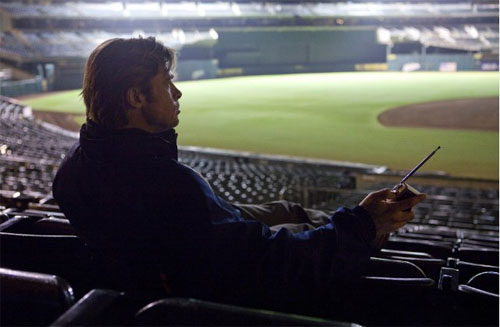
Moneyball has a flavor of 1970s movies about it -- a grown-up edition of The Bad News Bears, perhaps. And our first look at Brad Pitt's character is angled and lit in such a way that he bears a striking resemblance to Robert Redford, recalling The Natural. And yet, what Moneyball lacks is the light touch that made such movies a success. I expected a little more Slap Shot and a little less All The President's Men.
The problem is in the direction from Bennett Miller (Capote), who seems to add unnecessary gravity to the film, as though the potential changes in baseball are as ponderous and weighty as international diplomacy. Moneyball felt flabby -- it needed to be just a little tighter and faster and lighter.
Pitt could not be better as the team manager relentlessly determined to succeed, and as hard on his own past as he is on his team's present. Jonah Hill is fine as the nerdy assistant, except that we've seen him play this exact same role before (Get Him to the Greek leaps to mind) so it feels a little tired. Phillip Seymour Hoffman makes the most of a small role in which he has minimal dialogue, which was disappointing to someone who still fondly cherishes that scene of his in another Sorkin-scripted film, Charlie Wilson's War. (The scene with the window. I'd really like to take a break right now and just watch the Hoffman scenes from that movie, please.)
Moneyball isn't a bad movie -- it's a perfectly fine way to spend an evening out at the movies -- but it's not terribly engaging, and many of the characters and relationships feel just a little too stock. Still, it's definitely a beacon of solid entertainment during a time of year when many new releases are scraping the bottom of the barrel.