

Review: 50/50
The title of 50/50 refers to the survival odds of the film's protagonist, who is fighting a rare form of cancer. But 50/50 also could refer to the odds that with a great cast and some genuinely poignant and funny moments, the movie can survive its entirely formulaic storyline.
Sadly, it doesn't. Despite the best efforts of Joseph Gordon-Levitt, Seth Rogen, Anna Kendrick and Anjelica Huston to rise above the predictable material, 50/50 amounts to little more than a mildly funny and entertaining but unoriginal take on a life-or-death struggle with disease.
50/50 is the story of 27-year-old Adam (Gordon-Levitt), a public radio producer whose chronic back pain leads to a diagnosis of a rare spinal tumor. Facing months of chemotherapy followed by a risky operation, Adam relies on his struggling artist girlfriend Rachael (Bryce Dallas Howard) and oversexed friend Kyle (Rogen) for everything from emotional support to transportation. When she learns of the diagnosis, Adam's mother, Diane (Huston), shifts into full maternal mode immediately, not trusting Rachael to tend to Adam's needs.
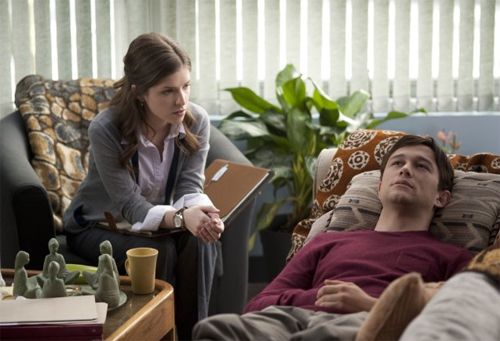
Complicating matters is Adam's young and inexperienced therapist, Katie (Kendrick), who obviously wants to turn their doctor-patient relationship into something much more. The therapy sessions careen between Katie's sincere efforts to help Adam and her none too subtle attempts to drop hints. The increasingly sickly and perplexed Adam responds with a mixture of anger at her unprofessionalism and intrigue at the thought of dating her.
Meanwhile, the relentlessly randy Kyle pals around with Adam not only to lift his spirits, but also because he sees Adam's illness as a golden opportunity to strike up conversations with attractive, sympathetic women. (Kyle is not the most likable character in recent film history.)
If you've seen most any Hollywood romantic comedy or medical drama, you already know what happens in the film's second act, so I'll spare you the neatly resolved, melodramatic, script-by-committee details. I'll just say there are no arthouse ambiguities or overly unpleasant events that might inspire viewers to tell their friends not to see 50/50 because, you know, the ending is such a bummer. 50/50 dares not inject the horrid realities of cancer into its nonthreatening, focus-group-friendly worldview.
This is not to say that 50/50 is without redeeming qualities. For one thing, the movie is entirely likable. (Which, on the other hand, may be its major problem. Cancer is not likeable.) Its strongest suit is the sparkling chemistry between Adam and Katie, whose awkward dance around the edges of mutual attraction is fodder for many of 50/50's best moments. Philip Baker Hall and Matt Frewer are great comic relief as Adam's perpetually stoned fellow chemo patients. And if you like Rogen (I don't, or at least not the characters he usually plays), you'll enjoy him as the typically rowdy, raunchy, shameless Kyle.
50/50 also benefits from the ever-reliable Gordon-Levitt, who does his best with the unevenly written Adam. Except for some forced histrionics at the film's climax, his mostly low-key performance is dignified and believable. As you would expect, Huston also is perfect as the highly demanding and slightly insecure Diane.
But again, these attributes can't save 50/50 from its shallow underpinnings. The movie hints at some powerful themes, such as the hardships of young adult cancer patients who must maintain their jobs, households and relationships while poisoning themselves with chemotherapy and radiation. It also touches on the emotional toll of dating a seriously ill cancer patient. But it never explores these themes in any real depth, goes to the dark places it should go, surprises us, or develops its characters fully enough to make us really feel their pain. Without this emotional resonance, the odds are that most viewers will find 50/50 entirely forgettable.