

Review: Skateland
I came of age in the early 1980s, but feel no nostalgia for the era. From its anti-government politics to its greed-fueled economic ethos to its mostly insipid popular culture, the decade of Ronald Reagan, Madonna and Dallas wasn't exactly America's finest hour. Thirty years later, sentiments like "government is the problem" and soulless techno-pop like "Rock the Casbah" are hardly the stuff of fond memories. (That is, at least for those of us who so wish we'd come of age during America's coolest decade, the 1960s.)
That said, I do enjoy some modern cinematic takes on the Eighties; it's interesting to see the era filtered through various filmmakers' visions, even if their sentiments are more nostalgic than mine. I particularly enjoy films that regard Eighties culture with a mixture of warm fuzziness and well deserved mockery.
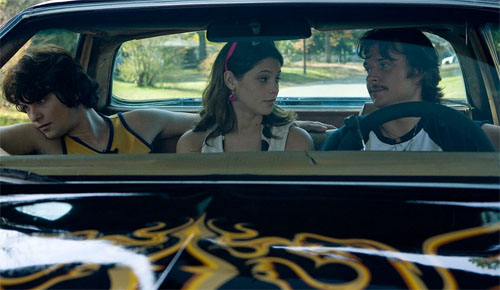
A case in point is Skateland, a pleasantly entertaining story about coming of age in a small Texas town in 1983. The film sets an oft-told tale of dawning adulthood and family turmoil against an authentic backdrop of, well, 1983. (Think Camaros, skin-tight jeans and music stores -- remember those? -- in shopping malls. 'Nuff said.)
Skateland's protagonist is 19-year-old Ritchie Wheeler (Shiloh Fernandez), manager of his town's once-popular but now fading roller rink. Although he toys with a writing career (the awards on his bedroom wall attest to his talent), Ritchie is mostly content to work at his dead-end job, party with his friends and maintain a halfhearted relationship with his friend Michelle (Ashley Greene).
Far more of a long-term thinker than Ritchie, Ashley prods him to pursue a writing career or at least find a direction in life. Her motorcycle-racing brother Brent (Heath Freeman, also the film's co-writer and producer) is another central figure in Ritchie's life, a slightly older mentor of sorts. Like Ritchie, Brent clings to his fading youth, living in limbo between the relatively carefree world of high school and the looming responsibilities of adulthood. Ritchie's other best friend, unreconstructed womanizer Kenny (Taylor Handley), is no less complacent about his less-than-ambitious existence.
Much of Ritchie's ambivalence about the future is understandable; he still lives with his parents and younger sister, Mary (Haley Ramm), who bombard him with mixed messages about grown-up responsibility. In their best moments, his parents regard each other with tense civility; in their worst moments, they fight loudly about the pressures of career and parenthood. Ritchie's very traditional, very East Texas father David (Brett Cullen) is immersed in his lucrative but exhausting oil-field job. He bristles when his wife Debbie (Melinda McGraw) dares to pursue her own interests rather than cooking dinner for the family every night. If this is what career and marriage are all about, why would Ritchie want any part of either one?
Like many movies in its genre, Skateland is more about slice-of-life observation than plot. Not much happens through much of the film, as Ritchie, Brent and their cohorts amble through their somewhat claustrophobic lives, reflecting on their world rather than participating in it. However, Skateland isn't completely plotless; there are some surprisingly dramatic turns of events, with healthy doses of tragedy and, in turn, hopefulness. And unlike many other coming-of-age films, despite some very funny moments, Skateland is too dark at times to be a true teen comedy. There are a few clichéd teen comedy hijinks, but the characters more often deal with heartbreakingly real problems.
Skateland is highly effective in many ways. It flawlessly captures both the dawning of 1980s pop culture and a small East Texas town's resistance to it. The film establishes its party-hearty-in-the-Bible-Belt (or maybe against the Bible Belt) milieu with great finesse and attention to detail. Visually, the clothes, cars and music are spot-on; the movie looks and feels very much like it was made in 1983. More importantly, the underlying theme of resistance to change is spot-on. The stories of Ritchie and his friends are perfect metaphors for what is happening in their larger world. As they face change with reluctance and uncertainty, so does their deeply traditional small-town culture as it deals with the outside influences of MTV and rampant consumerism.
Despite these strengths, Skateland is a bit uneven and doesn't quite pack the emotional punch necessary to be a truly great film. What it does so well for its milieu, it doesn't quite do for its characters. They're entirely believable, but mostly underdeveloped; to pronounce Skateland truly memorable, I needed to know and care more about them. Also, the tone is a bit flat at times, the ending is a bit too neat, and Skateland doesn't reach the comic or dramatic heights of the iconic films that obviously influenced it. It's competently made and very watchable, but lacks the poignancy of American Graffiti, the unforgettable characters of John Hughes's best efforts, or the timelessly stoned groove of Dazed and Confused.
On the other hand, Skateland benefits from strong direction and fine acting. First-time director Anthony Burns (who co-wrote the script with brothers Heath and Brandon Freeman) moves things along briskly enough that the dialogue-centric film is never dull. The standout among the performances -- all very strong -- is Heath Freeman's Brent. He's by far the film's funniest and most complex character, a likable rogue with an underlying pathos. Cullen and McGraw also are terrific as the stressed-out, ever-bickering couple we all know, devoted to their kids but feeling trapped in their own lives.
An imperfect but astute take on coming of age in a small town, Skateland is a strong first film that should have broad appeal. Teens -- especially recent high school graduates -- will appreciate its immediacy to their lives. And older viewers will appreciate its universal story and realistic glimpses of life in the Eighties, whether or not we really want to remember the decade.
Austin/Texas Connections: Skateland was filmed in Shreveport, Louisiana and Marshall, Texas and has many local connections. The movie is a production of Austin-based Freeman Film, founded by Brandon Freeman, who earned a BA from The University of Texas at Austin and a J.D. from Southern Methodist University School of Law. Heath Freeman studied in the BFA acting program at the University of Texas. Haley Ramm is from Collin, Texas, and Brett Cullen is from Houston. Cinematographer Peter Simonite is from Austin and has worked on many Texas films, and several cast and crew members also have Austin and Texas film and television credits. Skateland screened at both SXSW and the Dallas International Film Festival in 2010.
You can also read Debbie's review from SXSW 2010.