

Review: The Concert
As much as I enjoy The Birdcage, the Americanized version couldn't hold a candle to the original classic French farce La Cage Aux Folles, in which the setting of the gay club in St. Tropez lends so well to the atmosphere and mood. I was reminded of this while watching The Concert (Le concert), a dramedy set in Russia and Paris. Writer/director Radu Milhaileanu and his collaborator Alain-Michel Blanc originally envisioned creating The Concert in English with American actors to appeal to a mainstream audience. However, the filmmakers decided that English would render the movie more artificial, and decided to shoot in the original languages of Russian and French -- a choice I wholeheartedly support, especially after watching The Concert.
The Concert focuses on Andreï Filipov (Aleksey Guskov), the janitor at the Bolshoi. He enjoys listening to the famed Bolshoi Orchestra, but not because he's a low-class worker aspiring to greatness that he can never hope to achieve -- in fact, 30 years ago he was the celebrated conductor of the Bolshoi. At the height of his fame he was fired for refusing to expel Jewish musicians in his orchestra as directed by Brezhnev, and several of his friends were sent to and later died in Gulag labor camps. Filipov retreats into his despair and alcoholism, with the painful memories of a concert that was never finished.
After the Director of the Bolshoi publicly humiliates Filipov in front of the orchestra, Filipov steals a fax with an invitation to play at the Theatre Du Chatelet in Paris in less than two weeks. With the help of his best friend Sacha Grossman (Dmitri Nazarov), Filipov reunites his former orchestra, most of whom now barely make a living in Moscow as cabdrivers, flea market vendors and even porn film sound effects crew. Filipov even reaches out to old enemy Ivan Gavrilov (Valeriy Barinov) for support in achieving the dream.
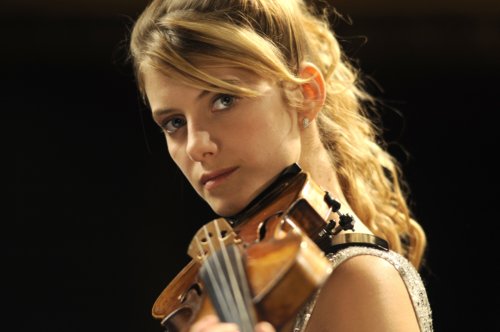
Proving more difficult is securing the famous violinist Anne-Marie Jacquet (Melanie Laurent), who is fiercely protected by her manager Guylène de La Rivière, superbly played by Miou-Miou. Filipov's selection for the concert? Tchaikovsky’s "Concerto for Violin and Orchestra," the last composition he'd ever directed until interrupted midway through the concert by Gavrilov, a staunch member of the Communist Party.
The Concert is well-cast with both familiar and obscure actors who all contribute to the harmony of the film, no matter how small their role. Laurent is best known to American audiences for her role in Inglourious Basterds and is well-suited to the role of a young woman orphaned as a baby who wants to know the truth about her heritage. François Berléand (The Chorus, The Transporter trilogy) as the Director of the Chatelet is even more entertaining than in his English-speaking roles, and Guskov is endearing as the friend who has and will go to any length to protect and support his friends. Despite cultural boundaries, the portrayal of the Russians speaking their version of French is humorous enough to cross the language barriers for American audiences to enjoy.
The locations and cinematography of The Concert lend an authenticity despite being filmed in overused historic locations such as Red Square, the Theatre Du Chatelet and The French Communist Party Headquarters. Several of the scenes in Russia were shot with handheld camera and deliberately off-set, contrasted with scenes in Paris with well-calculated fixed camera shots. The contrast between the Russian and French sets comes across magnificently, with Paris as more luminous and modern, and Russia chaotic and imperfect. The costume design also demonstrates the contrast between the motley bunch of musicians and the lovely and elegant Anne-Marie, dressed in simple modern clothing.
The musical score of The Concert is a combination of Russian folk songs in addition to Tchaikovsky’s "Concerto for Violin and Orchestra," adapted by composer Armand Amar for the film from 22 to 12 minutes. When we do finally witness the concerto, the music plus the layering of voice-overs and flashbacks/forwards significantly conveys the ultimate harmony that Filipov has been wishing to achieve. The climax was so elegantly and successfully executed that I was amazed to realize that I'd listened to 12 full minutes of classical music in a film, which can often be overwhelming for some viewers.
The Concert demonstrates that despite difficulties and tragedies, humor and the fulfillment of dreams can shine through. Despite an abundance of cliches including old Communists, uptight French music critics and Gypsies who can make you a passport in minutes, The Concert is an endearing movie that I look forward to watching again.