

SXSW Review: Fly Away
The challenges of autism have inspired many great films, from the often-quoted classic Rain Man to the Austin-made Temple Grandin. This isn't surprising, because while autism can be devastating, the successes of autistic people can be very inspirational. Their stories are tailor-made for powerfully dramatic movies.
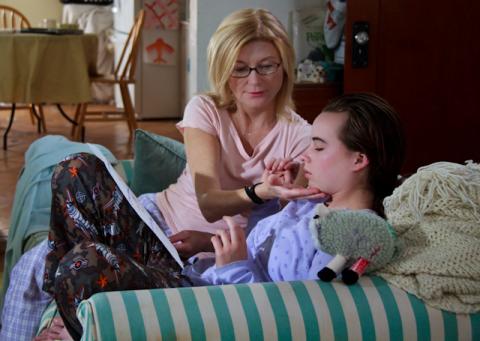
Fly Away is an example of how autism's challenges can translate into interesting cinema. The low-budget indie, which played SXSW this year, is the story of single mother Jeanne (Beth Broderick) and her teen daughter Mandy (Ashley Rickards), whose severe autism impacts their lives in both expected and unexpected ways. While Fly Away is uneven, it's a mildly entertaining and poignant depiction of living with autism.
Mandy has reached a point in her life where Jeanne must make some difficult decisions about the girl's future. Now an adolescent, Mandy still behaves like a young child at times, throwing tantrums and demanding her way. But she's also becoming a woman who's curious about dating and marriage. She exhibits common autistic behaviors such as fixating on objects, constantly repeating words and phrases, and not listening to others, as if she's in her own world. Jeanne can manage these behaviors, but is less able to handle Mandy's violent outbursts, which get her suspended from her special education program.
As demanding as Mandy is, her mother has her own set of problems to deal with. Her relationship with her ex-husband, Pete (JR Bourne), is grudgingly civil at best, and her financial consulting business is faltering in the midst of the Great Recession. When Mandy is suspended from school, Jeanne loses the precious few daily hours when she's alone and can focus on her work. Things fall apart quickly; the fact that Pete isn't much help with Mandy only makes matters worse.
Enter Tom (Greg Germann), a friendly new neighbor who takes an interest in Jeanne and Mandy. A nice guy who's eternally patient with Mandy's often difficult behavior, Tom obviously hopes to date Jeanne. But she's so focused on Mandy that she's not sure she can make any romantic relationship work. When Mandy's increasingly violent outbursts prevent her from returning to school, Jeanne realizes she can't care for Mandy at home, either, and must think about the unthinkable: moving Mandy into an institution.
Fly Away is likeable enough, and based on my admittedly limited knowledge of autism, it appears to be a very accurate take on how the condition affects families. However, it often plays like a tepid, soft-focus Lifetime network drama and lacks the polish to be a truly great movie. The timing is off in some scenes, and things drag a bit at times.
The film's 80-minute running time demands economical story development, fast pacing and tight editing. But Fly Away spends too much time establishing Mandy's personality and her relationship with Jeanne, which leaves other aspects of the story (such as Jeanne's possibly interesting relationship with Tom) feeling rushed and underdeveloped. Also, some of the dialogue is clunky; some conversations don't sound natural, which contributes to the film's occasionally awkward timing. Also, Fly Away's overall tone is too reserved; it could use far more grit and raw emotion.
On the positive side, the film's gentle, low-key humor often is quite funny. Although there are a few descents into melodrama, Fly Away is gratifyingly free of the clichéd romantic subplots, preachy speeches and conveniently tied up loose ends that plague so many other family dramas. I won't divulge the ending, but I will compliment it for its mildly indie sensibility and thank writer and director Janet Grillo (whose autistic son inspired the film) for not insulting my intelligence with happily-ever-after sentiment.
The Fly Away cast's performances are reliable, if understated. Veteran actor Broderick does a believably tired, slow burn as the stressed-out Jeanne, and fellow veteran Bourne is suitably not-quite-nice as the not-quite-reliable Pete. Germann also puts his decades of experience to good use as Tom, the film's funniest character. I'm less fond of relative newcomer Rickards's relentlessly strident take on Mandy. Portraying an autistic person obviously is very difficult, and something about Rickards's performance didn't quite ring true; her perpetually amped performance lacks nuance, and she seemed uncomfortable with the role in some scenes. Then again, someone more familiar with autism might find her performance more authentic than I did.
Despite my criticisms, I do credit Fly Away for making some important points about autism (and, by extension, any mental condition). The film reminds us that helping autistic people and their families begins with understanding what autism is and how difficult it can be to live with the condition. In a larger sense, Fly Away also reminds us that in any family, it's always hard to know when to let go of our loved ones.