

Review: Barney's Version
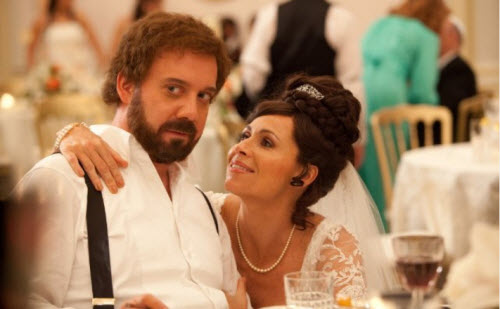
Although no one would argue that Barney Panofsky is a good role model, he's undeniably entertaining.
Hard drinking, completely self absorbed and proudly politically incorrect, Barney (Paul Giamatti) is the protagonist of Barney's Version, a dark, wry and witty study of a life lived fully, if not quite ethically. If creativity and pithy sarcasm are Barney's strong suits, honesty and empathy for others are not; nor are fidelity, sobriety or high idealism. Frankly, he's just short of being a complete SOB.
Why, then, do we find ourselves almost rooting for him now and then? Because thanks to a great script and the even greater Giamatti, Barney transforms SOBism into a high art.
Based on the acclaimed Mordecai Richler novel of the same title, Barney's Version opens as 65-year-old television producer Barney reflects on his colorful and often sordid life. The story is told largely in flashbacks spanning four decades, chronicling Barney's young adulthood in Rome and Montreal in the 1970s, his slightly shady financial schemes, three marriages, and later life of parenthood and career doldrums.
As the title implies, the story is told entirely from Barney's point of view. Its telling is prompted when a longtime nemesis publishes a tell-all book about Barney's life, centering on a decades-old unsolved mystery involving the disappearance and possible murder of Barney's best friend, Boogie (Scott Speedman). Because the story hinges on many unexpected events, it's difficult to say much more without revealing spoilers. I'll say only that a pivotal moment happens at Barney's second wedding, when he meets his future third wife, Miriam (Rosamund Pike). Yes, Barney is precisely the sort of self-centered bastard who would flirt with another woman at his own wedding.
Barney's Version is a quintessential tragicomedy, both bitter and bitterly funny. The tragic elements are many, and every one delivers an emotional knockout. Suffering -- some of it deserved -- is a constant theme in the film, and it leaves no character unscathed, as if everyone in the story is somehow cursed for being part of Barney's life. There are many combative and devastating scenes in Barney's Version, but quiet and contemplative moments often follow them, as if the film encourages us during these moments to think about the nature of suffering.
All this would make for a dreary time at the movies if there weren't plenty of humor to balance all the glumness. Most of the jokes are of the biting, insulting variety we would expect from Barney, his family and his friends, many of whom are no more likable than he is. (Barney slings a typical line during a heated argument with Boogie: "To let you finish that thought would be an insult to stupidity.") The film also mines Barney's Jewish background for much of the comedy; while all the jokes are quite funny, some of them do border on being ethnic and religious stereotyping, rather than commentary on this stereotyping.
Although Barney's Version is as smart a film as any I've seen lately, I do have one beef with the story: I didn't quite buy the film's central romance between Barney and Miriam. My question is this: Why would a smart, successful, confident and emotionally secure woman like Miriam bother with an incorrigibly selfish and obviously untrustworthy guy like Barney? Really, now: This is a man who hits on Miriam at his own wedding, even offering to run away with her and leave behind his new bride (known only as "Second Mrs. P" and deliciously played by Minnie Driver). He then sends her flowers regularly throughout his marriage, as if his current matrimonial commitment matters not one whit. Wouldn't this sort of blatant disregard for the so-called sanctity of marriage -- not to mention his wife's feelings -- be a glaring red flag for any woman, especially one like Miriam? But for reasons that aren't adequately explained, she readily takes up with Barney when the ink on his divorce papers is barely dry, even after he makes a complete drunken fool of himself on their first date.
Barney's Version is otherwise so strong that I will grudgingly suspend disbelief about this glaringly ridiculous relationship. (After all, I've known of many real-life relationships that make even less sense.) There are a host of memorable characters, all well developed and played in stellar fashion. Giamatti is in his usual award-worthy form, nailing every aspect of Barney's personality and making us empathize with him even when he really doesn't deserve it. We empathize because in the ever-likeable Giamatti's hands, Barney comes across mostly as a victim of his own glaring faults, inflicting as much misery on himself as he does on others.
The actresses playing Barney's trio of wives all nail their characters also. Rachelle Lefevre is convincingly loopy as Barney's artsy and outwardly carefree but painfully troubled first wife, Clara. Driver is hilariously bitchy and superficial as Second Mrs. P, although some may find her stereotypically loud and whiny Jewish American Princesshood slightly offensive. Like Barney, Driver's character is moderately sympathetic, at least until she gives Barney a very good reason to divorce her. In a way, Pike's Miriam may be the most difficult of the three to portray believably. Far more subdued than the hippie-chick Clara and the shrill Second Mrs. P, Miriam is an ambitious, focused, quietly strong woman who must convey her frustration with Barney without her predecessors' histrionics.
I also must give a nod to Dustin Hoffman as Barney's father, Izzy, who apparently taught Barney everything he knows about boozing and relationships. Fifty years into his career, Hoffman has suffered no noticeable loss of charisma, and his take on the unabashedly sexist and hilariously blunt Izzy is his most memorable performance in years.
I could recommend Barney's Version for Giamatti's performance alone, but the film works in most every other way also. One of the past year's most moving films, it's a thoughtful and very human portrait of an often thoughtless but very human character.