

Review: The King's Speech
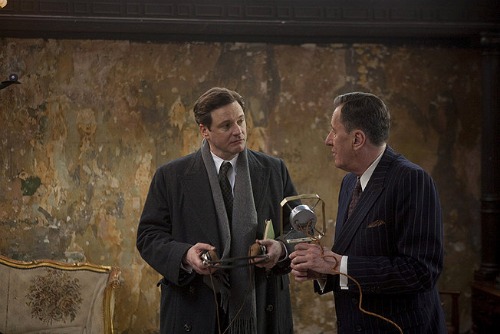
Buzz about The King's Speech has been circulating for months, before the MPAA fracas even took place. There have been mutterings for a while that Colin Firth is sure to win an Oscar for the lead role (and as the awards tend to favor biographical depictions, this speculation is likely not too far off). So I watched the movie bearing all this in mind, and all in all I was quite pleased with the British import. The movie opens on Saturday in Austin theaters.
The film opens in pre-World War II Britain with King George V (Michael Gambon) still reigning, but worried about his succession. Second son Bertie (Firth), the Duke of York, feels humiliated as he verbally stumbles through a speech at the 1925 British Empire Exhibition. His wife Elizabeth (Helena Bonham-Carter) engages a speech therapist for her husband. Australian Lionel Logue (Geoffrey Rush) works with the soon-to-be king using some non-traditional techniques. He also insists that their lessons occur on equal footing. As the lessons continue, a relationship grows between Bertie and Logue.
The King's Speech also depicts what happens behind the scenes of the British monarchy as the king grows ill and dies, leaving Bertie's older brother David (an almost unrecognizable Guy Pearce) to become King Edward VIII. "You needn't be governed by fear," Logue counsels Bertie during the short reign of his older brother, as rumors abound about the king's relationship with American divorcee Wallis Simpson (Eve Best, Nurse Jackie).
This statement could be the motto of the film. Colin Firth plays Bertie as sure of his social standing, but uncertain of himself and his capability. Through the years that the film encompasses, we see that as the Duke eventually becomes King George VI, he becomes more assured and resigned to his new status. Firth's performance and dedication to his role are stand-out, but Geoffrey Rush's Logue steals the show. As the main "commoner" in the film, his is the most relatable viewpoint. Rush's Logue is serious about his work, but also provides much of the film's humor.
The supporting cast is formidable: Derek Jacobi plays a commanding Archbishop of Canterbury and Timothy Spall a very convincing Churchill. Jennifer Ehle -- who once starred as Elizabeth to Firth's Darcy in the much-beloved Pride and Prejudice miniseries -- plays a supportive Mrs. Logue. As war creeps ever closer, the fear on the faces of Logues is visible (they have a recruitment-age son).
It's obvious that much thought went into the cinematography and art direction in The King's Speech; some of the scenes in Logue's office seem particularly painstakingly shot for just the right angle. Music also plays an important role. Alexandre Desplat's soundtrack doesn't detract from the action on screen. However, some of my favorite pieces by Beethoven (the second movements of his Symphony VII and Emperor piano concerto) are used near the end of the film, and I admit I didn't pay as much attention as I should have to the language being spoken. Still, that's hardly a point against this excellent movie.