

TAMI Flashback: 'To Market, To Market' and 'Summer Fun'
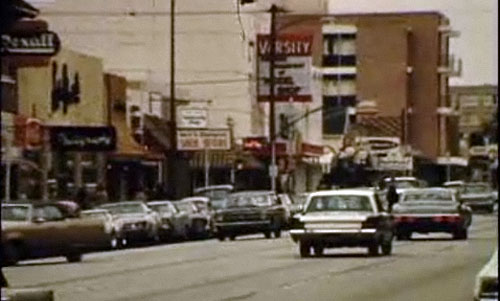
This article is the second in a Slackerwood series about the Texas Archive of the Moving Image (TAMI) video library.
In the late 1960s, Austin was rapidly outgrowing its sleepy small-city persona. Although the population was one-third its current size (there were 251,000 residents in 1970), Austin saw some fundamental changes that shaped the city we know today, including the birth of the high-tech industry.
As the population grew, Austin's surprisingly small media market became ever larger and more competitive. Today's Austinites may find it hard to believe that until 1965, Austin had only one commercial TV station, KTBC-TV (owned by Lyndon and Lady Bird Johnson), which carried programming from CBS, ABC and NBC (and the largely forgotten DuMont network until its demise in 1956). KHFI-TV (now KXAN-TV) signed on in 1965 and carried NBC programming starting in 1966, and KVUE-TV signed on in 1971, carrying ABC programming.
All of which brings us to the first Texas Archive of the Moving Image (TAMI) video I'm highlighting in this article, To Market, To Market, in Austin, Texas. Produced circa 1969, this short promotional film is an overview of programming on the KTBC network's TV and radio stations. The film was intended to sell advertising time; I'm not sure how effective it was in wooing advertisers in its day, but today it's yet another intriguing peek at life in mid-century Austin.
To Market, To Market's descriptions of 1970-ish Austin are amusingly out of sync with the image most of us have of the city during this era. For example, the narrator tells us that "the city is the hub of a booming Central Texas agricultural community that depends on Austin as a source of materials and supplies ranging from dry goods to heavy equipment." Although I've come across no mention of this anywhere else, I suppose it was true; maybe the idea of Austin as a major supplier of tractors and cattle feed is just too unhip to bear mentioning when describing the city's halcyon hippie days.
To Market, To Market obviously was targeted at a very middle-aged audience, namely the Chamber of Commerce types who bought advertising time for their department stores and car dealerships. The soundtrack is a blend of mid-century progress-on-the-march music and toe-tapping sort-of-jazz (we'll have none of that awful modern rock-n-roll, now). There are repeated references to the "housewife" audience, "contemporary music," the "now listener" and "the good music sound of today" (that would be easy listening, folks). These references -- combined with images of clean-cut, Brylcreemed employees in business attire -- give the entire KTBC enterprise a hopelessly square image, the sort of conservative media outlet that any purveyor of dry goods or heavy equipment could trust. A bastion of Austin weirdness KTBC was not.
The film also reminds us how drastically television has changed in four decades. There are scenes from The Uncle Jay Show, a fondly remembered Austin children's program, and Women's World with Carolyn Jackson, a locally produced afternoon show obviously aimed at the housewife audience. (Let us give thanks that the term "housewife" has been mostly retired from use.) Sadly, this kind of homegrown daytime programming has all but disappeared in favor of syndicated shows. Another sign of change is that the local newscast -- with nary a digital device in sight --– looks entirely primitive compared to today's graphics-laden broadcasts.
Like many TAMI videos, To Market, To Market is laden with images of vintage Austin. For a seven-minute film there are landmarks aplenty, including the almost nonexistent Austin skyline, I-35, Congress Avenue, The Drag, Bergstrom Air Force Base and the Sears store at Hancock Center.
A very different take on Austin is Progress Report Austin 7 – Summer Fun, one of a 1962 series of programs about Austin life. Sponsored by the Austin National Bank, Summer Fun is essentially a tour of the city's recreational venues and activities, captured in gloriously grainy black-and-white images.
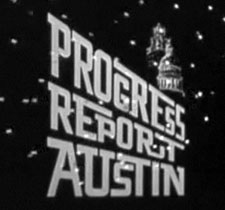 What this film lacks in production quality, it more than makes up for in sheer warm fuzziness. The soundtrack is lush and stately, but it's also loud, repetitive and often intrusive; in a way, it fits perfectly with the crude camerawork and choppy editing. But the nostalgic content is priceless, including many lazy-day, Austin-y shots of people at play at Barton Springs, Zilker Park, City Park and Lake Travis. There is even footage of a Zilker Hillside Theater play and an Austin Senators baseball game.
Longtime Austin residents will appreciate the interview with Parks and Recreation Director Beverly Sheffield, a cherished Austin citizen, denizen of Barton Springs and lifelong champion of Austin's green spaces. Austin American-Statesman managing editor Dick Brown also chimes in about how recreation is important to economic development. (Economic boosterism is a common theme in old Austin-related videos, reflecting a widespread belief that the city couldn't grow fast enough.) There is also an interview with Joe K. Wells, Vice-Commodore of the Aqua Festival Navy, who discusses plans for the upcoming first Aqua Festival. The festival promised to be an elaborate affair, featuring everything from a water parade to a religious service to baseball games.
Summer Fun has so many images of Austin landmarks that I won't list them all here. Surprisingly, many of the recreational sites are remarkably unchanged after nearly 50 years, especially Zilker Park.
For all its crudeness, Summer Fun is highly poetic and surprisingly moving at times. One scene is enough to leave a viewer misty eyed; the dreamy soundtrack swells as we see striking visuals of a sunset on Town Lake. It reminded me of how fortunate we are that decades later, we still can enjoy Austin's natural beauty as the sun slips behind the hills.