

DVD Review: The Thin Red Line
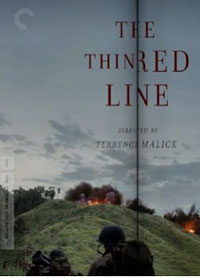

The elegant new Criterion release of The Thin Red Line, available today on DVD
Based on James Jones's 1962 novel, The Thin Red Line tells the story of C-for Charlie Company, a group of young soldiers sent to Guadalcanal to battle the Japanese for control of the island. Victory on Guadalcanal is crucial to an Allied victory in the Pacific, because the island's airfield will serve as a base for the Allies' Pacific campaign. C-for-Charlie's mission is to break the final Japanese resistance, and the film follows the men through a costly, hellish, protracted battle to take control of the few remaining Japanese strongholds.
The action is seen from the perspectives of many soldiers in the company, among them Lt. Col Tall (Nick Nolte), Capt. Staros (Elias Koteas), 1st Sgt. Welsh (Sean Penn), Sgt. Keck (Woody Harrelson), Cpl. Fife (Adrien Brody), Pfc. Doll (Dash Mihok), and Pvt. Witt (Jim Caviezel). As the soldiers slog their way through Guadalcanal's dense jungles and steep hills and finally earn some long-overdue R&R, they share their thoughts through dialogue and numerous voiceovers (and, for Witt, gauzy flashbacks to his childhood and newlywed days). These thoughts are about far more than the battle at hand, however; they're poetic and deeply philosophical musings about everything from the meaning of death to humanity's relationship with nature.
And of course, herein lies the heart of the debate about The Thin Red Line: Is the battle of Guadalcanal its subject, or merely its setting? I'm firmly in the latter camp, mostly because The Thin Red Line is, after all, a Malick film. For all its bloody and relentlessly violent action, the film's overall point is more poetic than brutal. The battle scenes are nothing we haven't seen in every other honest war film; while they're horrifically realistic, they're not why The Thin Red Line is memorable. Instead, the film is a masterpiece -- that is, a masterpiece of poetry, rather than merely a war-is-hell lament -- because these scenes are woven into a far deeper milieu, a milieu created in the finest Malick fashion. The philosophical musings are set against stunning, dreamy, lyrical visuals, and the film's pacing is what I call contemplative. (Some critics just call it slow, but I beg to differ. As I said in my review of the Criterion release of Days of Heaven, the less-than-prolific Malick -- and the action in his films -- are not to be rushed.)
I've always considered The Thin Red Line to be one of those rare films that really can do no wrong, with acting as memorable as the scripting, directing and cinematography. The enormous cast (I lost count, but there are supposedly more than 100 speaking roles) is universally spot-on, inhabiting the roles and looking every bit the dirty, grizzled grunts we've seen in photos from the war. Penn and Nolte are perfectly harried as Welsh and Tall, barking orders amid the mayhem and revealing their true humanity in quieter moments. As Witt, the intense, thoughtful Caviezel relies on philosophical detachment for survival. Koteas' sensitive Staros is a fine foil for Tall, and Mihok -- as Doll, one of the company's requisite baby-faced privates -- takes what could have been a clichéd character to unexpected places. There are far too many great performances (including now-familiar faces such as John C. Reilly in minor roles) to discuss here, so I'll just sum up the cast as uniformly superb.
I enjoyed watching the Criterion release of The Thin Red Line every bit as much as I enjoyed the film's theatrical release. To fully appreciate the film's visual power, I recommend watching it on the largest TV you can find. The two-disc set is of the usual Criterion quality, with a perfect digital transfer, more than two hours of extras and a 36-page booklet with lengthy essays by Jones and critic David Sterritt. (Curiously, while most of the extras mention Malick repeatedly and reverently, he appears in none of them. Then again, Malick is notoriously reclusive, so perhaps this isn't surprising.)
Extras: The commentary track with producer Grant Hill, cinematographer John Toll and production designer Jack Fisk is the standard mix of production details and insights. The track also displays subtitles, which are very helpful for following the dialog while listening to the commentary.
The film trailer accurately reflects the story and the film's look and feel. On the other hand, the trailer implies that George Clooney has a major role, when in fact he has less than a minute of screen time. (I attribute this distortion to the evils of marketing.)
Most of the other extras feature interviews with the cast and crew. In The Actor's Perspective, a half dozen cast members reflect on their filmmaking experiences, including attending a harshly realistic "boot camp," working with Malick, etc. In The Editing of The Thin Red Line: Shaping a Terrance Malick Film, the film editors discuss the monumental task of turning more than 1 million feet of footage into a coherent film. Casting director Dianne Crittenden also discusses the casting process, including her extensive research on the battle of Guadalcanal. Her interview also features surprising audition photos and footage. (With all due respect to Neil Patrick Harris, not casting him was probably a wise choice.) Other interviewees include score composer Hans Zimmer and James Jones' daughter, Kaylie Jones.
The outtakes include eight scenes cut from the film. (Alas, there are no bloopers.)
Guadalcanal in Newsreels is interesting in two ways. First, this collection of vintage newsreels reminds us how inaccurately the war was presented to the home front: There are plenty of patriotic accounts of success, but nary a mention of the horrors of war. Also, the newsreels testify to The Thin Red Line's authenticity, as scenes of soldiers storming ashore at Guadalcanal look astoundingly similar in the newsreels and the film.
Melanesian Chants is a collection of chants recorded on Guadalcanal and illustrated with striking black-and-white production stills from the film.
Austin Connections: Malick has lived in Austin for many years, has a long association with the Austin film industry, and was inducted into the Texas Film Hall of Fame in 2002.